Table of Contents >> Show >> Hide
- Why Statue Removals Became a National Reckoning
- The 29 Statues and Monuments People Removed
- Robert E. Lee (Richmond, Virginia)
- Stonewall Jackson (Richmond, Virginia)
- J.E.B. Stuart (Richmond, Virginia)
- Jefferson Davis (Richmond, Virginia)
- Matthew Fontaine Maury (Richmond, Virginia)
- Battle of Liberty Place Monument (New Orleans, Louisiana)
- Jefferson Davis (New Orleans, Louisiana)
- Robert E. Lee (New Orleans, Louisiana)
- P.G.T. Beauregard (New Orleans, Louisiana)
- Jefferson Davis (Memphis, Tennessee)
- Nathan Bedford Forrest (Memphis, Tennessee)
- The Durham Confederate Monument (Durham, North Carolina)
- “Silent Sam” (UNC Chapel Hill, North Carolina)
- Confederate Soldiers and Sailors Monument (Birmingham, Alabama)
- John B. Castleman Statue (Louisville, Kentucky)
- Albert Pike (Washington, D.C.)
- Robert E. Lee (Charlottesville, Virginia)
- Stonewall Jackson (Charlottesville, Virginia)
- Theodore Roosevelt Equestrian Statue (New York City)
- Thomas Jefferson Statue (New York City Council Chamber)
- Christopher Columbus (Grant Park, Chicago)
- Christopher Columbus (Minnesota State Capitol, St. Paul)
- Christopher Columbus (Tower Grove Park, St. Louis)
- Christopher Columbus (Inner Harbor, Baltimore)
- Christopher Columbus (Wooster Square, New Haven)
- Christopher Columbus (Byrd Park, Richmond)
- Junípero Serra (Golden Gate Park, San Francisco)
- Francis Scott Key (Golden Gate Park, San Francisco)
- Ulysses S. Grant (Golden Gate Park, San Francisco)
- What These Removals Actually Say About Humans
- Experiences From the Front Lines of Statue Debates (Extended Section)
- Conclusion
Bronze lasts a long time. Memory doesn’t. That’s part of the problem.
Across the United States, communities have spent the last decade asking a hard question: Who do we honor in public, and why? In many cities, the answer led to cranes, court fights, protests, museum transfers, and some very uncomfortable history lessons. These weren’t just debates about stone and metal. They were debates about slavery, white supremacy, colonial violence, racial hierarchy, and the habit humans have of calling cruelty “heritage” when enough time passes.
This article looks at 29 statues that were removed, toppled, relocated, or taken out of public places because people saw them as symbols of systems that harmed real human beings. Some removals were official. Some were spontaneous. Some ended in museums. Some ended in storage. But all of them forced a public conversation many cities had postponed for generations.
Why Statue Removals Became a National Reckoning
Monument fights are never just about history. They are about power. Most controversial statues weren’t built immediately after the events they depict; many were installed later, during periods when political leaders wanted to shape public memory in a way that reinforced racial or social hierarchy. In plain English: a lot of these monuments were less about “remembering” and more about “sending a message.”
That message often looked like this: some people matter more than others. That slavery should be softened into nostalgia. That colonization can be repackaged as “discovery.” That public space belongs to the winners, even when the winners were brutal. Once communities started revisiting those messages, statue removals spread quicklyespecially after the 2020 protests that pushed local governments, museums, and residents to confront what had been normalized for far too long.
The 29 Statues and Monuments People Removed
-
Robert E. Lee (Richmond, Virginia)
The giant Lee monument on Richmond’s Monument Avenue became one of the most visible symbols of the Confederacy in America. Its removal marked a major turning point in a former Confederate capital, especially because it had long towered over a city still dealing with racial inequality.
-
Stonewall Jackson (Richmond, Virginia)
Richmond also removed the Stonewall Jackson statue as part of a broader push to clear city-owned Confederate monuments. For many residents, it represented a shift from glorifying Confederate military leaders to acknowledging the harm tied to that legacy.
-
J.E.B. Stuart (Richmond, Virginia)
The J.E.B. Stuart statue came down after the mayor ordered the removal of all city-owned Confederate statues. The city’s move showed that this wasn’t about one monumentit was about rethinking an entire public landscape built around Confederate hero worship.
-
Jefferson Davis (Richmond, Virginia)
Protesters tore down the Jefferson Davis statue on Monument Avenue, targeting the former president of the Confederate States. The action reflected anger at monuments that honored leaders who defended slavery as a political system.
-
Matthew Fontaine Maury (Richmond, Virginia)
Maury was known for scientific work, but his statue stood in Richmond’s Confederate monument corridor and was part of the same commemorative project. When it was removed, it highlighted how monuments can carry political meaning beyond a person’s résumé.
-
Battle of Liberty Place Monument (New Orleans, Louisiana)
This monument honored a white supremacist uprising against an integrated local government. If that sounds bad, it’s because it was. New Orleans removed it first among four controversial Confederate-era monuments, and for many people it was the clearest example of a monument openly celebrating racist violence.
-
Jefferson Davis (New Orleans, Louisiana)
New Orleans removed its Jefferson Davis statue as part of a city-led effort to take down monuments deemed racially offensive. The move signaled that public honor for Confederate political leadership no longer matched the city’s values.
-
Robert E. Lee (New Orleans, Louisiana)
The Lee statue in New Orleans was another major removal in the city’s 2017 process. Officials argued these monuments had become civic endorsements of a racist past rather than neutral historical markers.
-
P.G.T. Beauregard (New Orleans, Louisiana)
The Beauregard statue was also slated for removal in the same New Orleans campaign. Taken together, the city’s decisions challenged the old idea that “tradition” automatically deserves a pedestal.
-
Jefferson Davis (Memphis, Tennessee)
Memphis removed a Jefferson Davis statue after the city transferred park ownership to a private nonprofit, a workaround that let officials move monuments that had become flashpoints. The decision reflected Memphis’s civil rights history and the city’s unwillingness to keep honoring Confederate leaders downtown.
-
Nathan Bedford Forrest (Memphis, Tennessee)
The Forrest statue was especially controversial because Forrest was not only a Confederate general but also associated with the Ku Klux Klan. Keeping that statue in public space had become indefensible for many residents.
-
The Durham Confederate Monument (Durham, North Carolina)
Demonstrators in Durham toppled a Confederate statue from its pedestal in 2017. The event became an early signal that public patience with Confederate monuments was wearing thin long before 2020 made the issue national.
-
“Silent Sam” (UNC Chapel Hill, North Carolina)
“Silent Sam” stood on the UNC campus as a Confederate memorial tied to the Jim Crow era. Critics pointed to its racist dedication history and argued it served less as education and more as intimidation in a public university setting.
-
Confederate Soldiers and Sailors Monument (Birmingham, Alabama)
Birmingham workers removed the top of a Confederate obelisk in Linn Park after protests intensified. The move reflected how quickly public officials began acting once they recognized these monuments were driving conflict, not civic unity.
-
John B. Castleman Statue (Louisville, Kentucky)
Louisville removed the Castleman statue after years of protests and renewed demonstrations in 2020. The controversy showed how statues linked to contested racial history can become symbols of exclusion even when supporters frame them as “local heritage.”
-
Albert Pike (Washington, D.C.)
Protesters toppled and burned the Albert Pike statue on Juneteenth in 2020. It had long drawn criticism because Pike was tied to the Confederacy, and many people saw its presence in the nation’s capital as a glaring contradiction.
-
Robert E. Lee (Charlottesville, Virginia)
The Charlottesville Lee statue became nationally known after the 2017 “Unite the Right” rally and deadly violence. When the city finally removed it, the act was about more than one monumentit was a response to years of trauma and public division.
-
Stonewall Jackson (Charlottesville, Virginia)
Charlottesville also removed its Stonewall Jackson statue. The city treated both removals as part of the same historical reckoning, acknowledging that Confederate monuments had become rallying points for extremist politics.
-
Theodore Roosevelt Equestrian Statue (New York City)
The Roosevelt statue outside the American Museum of Natural History was moved after criticism of its composition, which placed Roosevelt on horseback with Indigenous and African figures walking beside him. The debate focused less on Roosevelt alone and more on the racial hierarchy depicted in the design.
-
Thomas Jefferson Statue (New York City Council Chamber)
New York City removed the Jefferson statue from the Council chamber after a public reassessment of honoring a founding figure who was also a slaveholder. It was a classic American contradiction, cast in bronze and placed in plain view.
-
Christopher Columbus (Grant Park, Chicago)
Chicago removed a Columbus statue in Grant Park after clashes and safety concerns around protests. The monument had become a symbol of two competing memories: Italian American pride for some, and colonial violence for many Indigenous activists and allies.
-
Christopher Columbus (Minnesota State Capitol, St. Paul)
Protesters pulled down the Columbus statue outside the State Capitol in St. Paul, saying they viewed Columbus as a symbol of genocide against Native people. The removal reflected frustration with years of failed attempts to change it through official channels.
-
Christopher Columbus (Tower Grove Park, St. Louis)
A Columbus statue that stood for 134 years in a St. Louis park was removed amid national protests. The length of time it had stood only made the debate more revealing: a monument can be old and still be wrong.
-
Christopher Columbus (Inner Harbor, Baltimore)
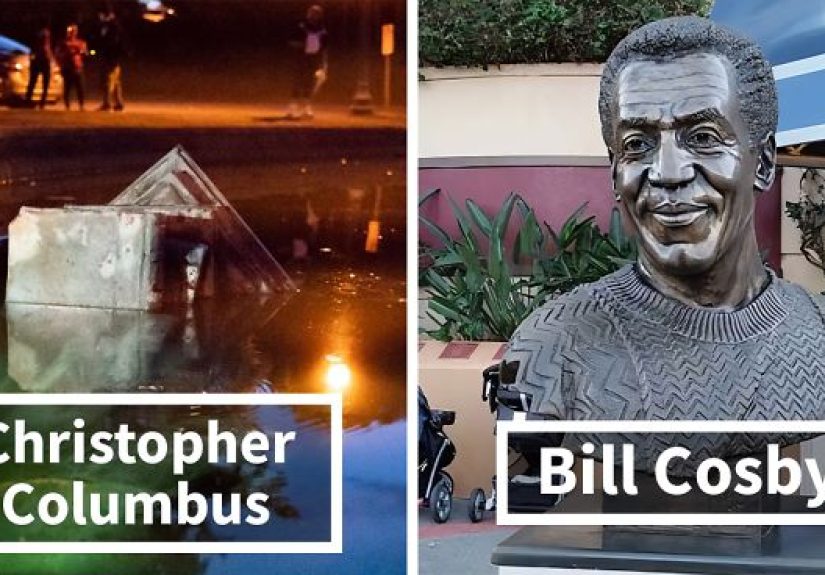
In Baltimore, protesters pulled down a Columbus statue and threw it into the Inner Harbor. It was one of the most dramatic removals and underscored how Columbus statues had become shorthand for unresolved colonial history.
-
Christopher Columbus (Wooster Square, New Haven)
New Haven removed its Columbus statue in 2020 during the racial reckoning that followed George Floyd’s killing. Later, the statue was moved toward a museum setting, which many cities have used as a compromise between erasing and contextualizing.
-
Christopher Columbus (Byrd Park, Richmond)
Richmond protesters tore down a Columbus statue, set it on fire, and dumped it into a lake. The action connected colonial-era violence to modern protest movements and widened the conversation beyond Confederate symbols alone.
-
Junípero Serra (Golden Gate Park, San Francisco)
Protesters in San Francisco toppled a statue of Serra during a night of monument removals. For critics, Serra represented the violence and coercion tied to the California mission system and the treatment of Indigenous communities.
-
Francis Scott Key (Golden Gate Park, San Francisco)
Key is best known for writing “The Star-Spangled Banner,” but activists pointed to his history as a slaveholder. His statue’s removal reflected a broader argument: national symbols don’t get a free pass from moral scrutiny.
-
Ulysses S. Grant (Golden Gate Park, San Francisco)
Grant’s case was more complicated. He led the Union Army and fought the Confederacy, but he also had a history as a slave owner earlier in life. His toppling showed how protest moments can pull in figures with mixed legaciesand why public history debates are rarely simple.
What These Removals Actually Say About Humans
If you zoom out, these 29 removals expose a pattern that is bigger than any one city. Humans are really good at building stories that protect power. We rename oppression as honor. We carve injustice into stone. We place it in parks, in front of museums, on university campuses, and then act surprised when people say, “Hey, this feels hostile.”
But these removals also reveal something better: people can change public memory. Communities can decide that being “historic” is not the same as being worthy of celebration. They can move objects to museums, add context, or choose new monuments that tell a fuller story. In other words, a pedestal is not a lifetime appointment.
The hardest part is not removing a statue. The hardest part is what comes next: fixing the systems those statues once normalized. Housing inequality. School segregation. Policing disparities. Political exclusion. If a city removes a monument but keeps the injustice, the bronze may be gone, but the message stays.
Experiences From the Front Lines of Statue Debates (Extended Section)
One of the most important things people learned during these statue removals is that communities do not experience monuments the same way. A statue that looks like “history” to one group can feel like a warning sign to another. That gap in experience is exactly why so many debates became emotional so quickly. For years, many Black residents, Indigenous residents, students, and local activists said these statues were not neutral. They were daily reminders of who had power, who was excluded, and whose pain had been politely edited out of the official story.
In places like Richmond and Charlottesville, the experience was especially intense because Confederate statues were tied to more than memorythey were tied to identity, politics, and public space. Residents watched monuments become protest sites, memorial sites, art sites, and legal battlegrounds all at once. After removals, many people described a sense of relief, but also a sense of unfinished business. The feeling was basically: “Yes, that needed to happen… and no, that doesn’t solve everything.” That response matters because it shows how symbolic change can be meaningful without pretending it is enough.
On campuses, the experience often felt different. Students pushing to remove monuments like Silent Sam described these statues as part of the climate of the school, not just landscaping. When a university says it values inclusion while a Confederate monument dominates a central walkway, students notice the contradiction. The debate becomes personal: not “What does this statue mean in a textbook?” but “What does this statue say about who belongs here?”
Museum-related removals, like the Theodore Roosevelt equestrian statue in New York, created another kind of public experience: the shift from celebration to interpretation. Museums and cities started treating some monuments as artifacts that require context, not endorsements that deserve grand entrances. That distinction is huge. It gives communities a way to preserve historical objects while changing the message they send in public.
The Columbus statue debates showed perhaps the most visible clash of lived experiences. For many Italian American families, these monuments had long been tied to a story of immigrant pride and belonging. For Indigenous communities and others, Columbus symbolized dispossession, violence, and the beginning of a long colonial legacy. Both groups were often speaking from real historical painjust different histories. The most thoughtful cities recognized this and looked for ways to honor immigrant contributions without keeping a colonizer on a pedestal.
In the end, the shared experience across these removals was not “cancel culture,” despite what the loudest headlines suggested. It was civic argument. Messy, emotional, imperfect civic argument. People protested. City councils voted. Courts got involved. Museums negotiated. Communities fought over memory in public, which is exactly where democracy is supposed to happen. The statues came down, but the deeper lesson stayed: public honor is a choice, and every generation has the rightand responsibilityto choose again.
Conclusion
These 29 removals were not random acts of outrage. They were a public audit of values. Communities looked at what their statues honored and decided that many of them honored domination, racism, or selective memory more than truth. Some removals were careful and procedural. Some were chaotic. But together, they forced a national conversation about what belongs in public space.
The real question now is bigger than statues: what new stories should replace them? If the next generation is going to inherit our parks, plazas, campuses, and capitols, we should probably give them something better than monuments to cruelty with a polished plaque.