Table of Contents >> Show >> Hide
- First, How Doctors “Map” Left vs. Right
- Outside Landmarks on the Left Side (The “Map Pins”)
- Head and Neck: What’s Actually “Left” Up Top?
- Chest: The Classic “Left Side” Zone
- Upper Abdomen (Left Upper Quadrant): The “Spleen & Snacks” District
- Middle and Lower Abdomen (Left Side): The “Pipeline” Section
- Pelvis: Left-Sided Organs and Structures
- Left Side “From the Outside” Below the Pelvis: Legs and Feet
- Normal Variations: When the Map Isn’t Standard
- Common “Left Side” Sensations People Notice (Without Panic-Googling)
- Real-Life Experiences: of “Yep, I’ve Felt That” Moments
- Conclusion: Know What’s Left, What’s Paired, and When to Pay Attention
Quick reality check: your body looks pretty symmetrical in the mirror, but the stuff running the “behind-the-scenes show” absolutely is not. Some organs are paired (like lungs and kidneys), some sit right in the middle (hello, bladder), and a few are classic left-side residents (the spleen is basically the neighbor who never comes out because it lives under the rib cage).
This guide walks from head to toe and points out what’s truly on the left, what’s “mostly centered but leaning left,” and what’s paired but still matters when you feel something on your left side. It’s educationalnot a diagnosisand it’s written for real humans, not mannequins with perfect anatomy.
First, How Doctors “Map” Left vs. Right
When people say “left side organs,” they usually mean one of these:
- Left side of the chest (heart area, left lung, ribs, muscles, nerves).
- Left side of the abdomen (stomach, spleen, pancreas tail, left kidney, parts of the colon).
- Left pelvis (parts of the reproductive system and lower urinary tract structures).
Clinicians often divide the belly into quadrants (left upper quadrant, left lower quadrant, etc.) or regions to narrow down what might be involved. That’s useful because your “left side” covers multiple neighborhoods, not one single street.
Outside Landmarks on the Left Side (The “Map Pins”)
Before we go internal, here are a few external landmarks people use to describe locations:
- Left rib cage (protects the heart and left lung; also covers the spleen area below).
- Left upper abdomen (just under the ribs): often where the stomach and spleen “live.”
- Left flank (your left side/back, below the ribs): often where the left kidney sits deeper inside.
- Left lower abdomen (closer to the hip): often where parts of the colon and pelvic organs may be felt.
Important: “Where you feel it” doesn’t always equal “where it is.” Some pain can be referred (felt in a nearby or even far location). Your body is helpful, but it’s not always precisekind of like autocorrect.
Head and Neck: What’s Actually “Left” Up Top?
Left Side of the Brain (Mostly a Functional Left, Not a “Single Left Organ”)
Your brain has two hemispheres. Anatomically, they’re both thereso it’s not like you have a “left brain” sitting alone on the left shelf. But functionally, many people have language processing that’s more left-hemisphere dominant. That’s why clinicians pay attention to left-sided brain injury when someone suddenly struggles with speaking or understanding language.
Left Eye, Left Ear, Left Sinuses (Paired, but Left Still Matters)
These are paired structures, but left-sided issues can still be very real: a left ear infection feels like a left ear infection, not a philosophical debate about symmetry.
Chest: The Classic “Left Side” Zone
Heart (Centered-ish, With a Left Lean)
Your heart sits in the mediastinum (the central space between the lungs) but it’s often described as being behind and slightly to the left of the breastbone. That’s why many people associate the left chest with “heart area.”
And yes, you can sometimes feel your heartbeat more on the leftespecially after exercise, stress, caffeine, or any moment you remember that deadlines exist.
Left Lung (Two Lobes and a “Heart-Shaped Accommodation”)
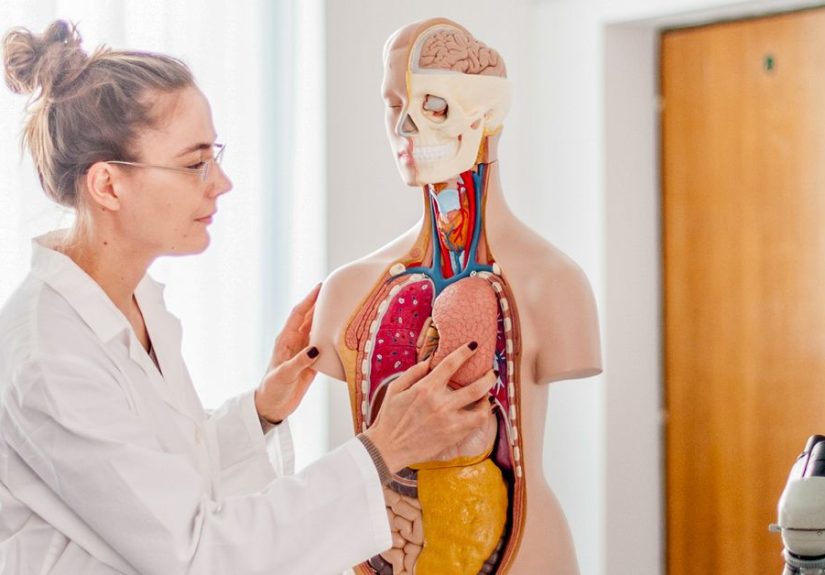
Your lungs are paired, but they’re not twins. The left lung is smaller and has two lobes (instead of three on the right) to make room for the heart. It also has features like the cardiac notch, basically an anatomical “excuse me, heart coming through.”
Other Left-Side Chest Structures
- Pleura (the lining around the lung) on the left side
- Left ribs, cartilage, muscles, and nerves (frequent sources of sharp, movement-related pain)
- Left major blood vessels and lymph nodes (structures travel through the chest on both sides, but symptoms can localize)
Upper Abdomen (Left Upper Quadrant): The “Spleen & Snacks” District
If you point under your left ribs, you’re near the left upper quadrant (LUQ). This area commonly includes:
Stomach
Your stomach is a muscular organ in the upper abdomen and is commonly described as sitting toward the left side. It mixes food, produces acid and enzymes, and occasionally makes noises that sound like a whale learning beatboxing.
Spleen (The Shy Organ Under the Left Ribs)
The spleen sits under the left rib cage, generally above the stomach area. It’s part of the lymphatic/immune system. It helps filter blood and supports immune function. Many people don’t think about their spleen until someone says, “Your spleen might be enlarged,” which is a sentence nobody wants as a surprise.
Pancreas (Especially the Body and Tail)
The pancreas sits behind the stomach and stretches across the upper abdomen. While it’s not exclusively “left,” the tail end extends toward the left side near the spleen. It plays a double role: digestive enzymes (digestive system) and hormones like insulin (endocrine system). Yes, it’s an overachiever.
Left Kidney and Left Adrenal Gland (Deeper, Toward the Back)
Your kidneys are paired and sit toward the back, just below the rib cage on either side of the spine. The left kidney is your left-side filtration powerhouse, and the left adrenal gland sits like a little hat on top, involved in hormones like cortisol and adrenaline.
Colon (Splenic Flexure, Transverse/Descending Transition)
Your large intestine frames the abdomen. On the upper left, the colon makes a turn called the splenic flexure before heading down the left side as the descending colon.
Middle and Lower Abdomen (Left Side): The “Pipeline” Section
Descending Colon
The descending colon runs down the left side of the abdomen. Its job is to keep absorbing water and move waste along. It’s not glamorous, but it’s loyal.
Sigmoid Colon (Left Lower Quadrant VIP)
The sigmoid colon is the S-shaped portion that connects the descending colon to the rectum. It typically lives in the left lower quadrant (LLQ) and is a common area where people feel cramping from gas, constipation, or other GI issues.
Small Intestine (Not “Left Only,” But Often in the Mix)
The small intestine coils throughout the abdomen, so left-sided discomfort can still involve small bowel loops. Translation: the small intestine is the ultimate “I could be anywhere” roommate.
Pelvis: Left-Sided Organs and Structures
The pelvis is a shared spaceurinary, digestive, and reproductive structures all meet here.
Urinary Structures (Centered, But Symptoms Can Be Left)
- Bladder is midline, but pain can feel left or right depending on irritation and surrounding muscles.
- Left ureter (tube from kidney to bladder) can cause left-sided flank-to-groin pain when irritated (like with a stone).
Female Reproductive Organs (If Applicable)
- Left ovary (paired gland on the left side of the uterus)
- Left fallopian tube (paired tube connecting ovary to uterus)
- Uterus is generally centered, but sensations can be one-sided depending on cycles, cysts, and normal variation.
Male Reproductive Organs (If Applicable)
Structures are paired or midline, but symptoms can be one-sided. For example, discomfort can localize to the left testicle or left groin due to muscles, nerves, veins, or referred pain.
Left Side “From the Outside” Below the Pelvis: Legs and Feet
Most of what’s left vs. right in the legs is paired anatomy: bones, muscles, arteries, veins, nerves, and lymph nodes. The “organs” here are mostly structures rather than distinct organs, but they still matter. Left calf pain is still left calf paineven if your tibia is very politely symmetrical.
Normal Variations: When the Map Isn’t Standard
Situs Inversus and Dextrocardia (Rare Layout Changes)
In rare congenital conditions, organs may be reversed or the heart may sit on the right side (dextrocardia). This can change what “left side” means for that person. That’s one reason clinicians combine symptoms with exams and imaging rather than relying on location alone.
Accessory Spleens and “Wandering” Organs
Some people have small accessory spleens, and some organs can be slightly higher/lower than average depending on body shape, age, pregnancy, or prior surgery. Anatomy is consistentbut it’s not photocopied.
Common “Left Side” Sensations People Notice (Without Panic-Googling)
- Left chest flutter after running: often awareness of heartbeat, sometimes muscle or anxiety-related, but persistent chest pain should be evaluated.
- “Stitch” under left ribs: can happen with exercise and breathing mechanics; usually temporary.
- Upper-left belly pressure after a big meal: the stomach is doing its job; gas can also collect near the splenic flexure.
- Left flank ache after not drinking enough water: muscles are common culprits, but kidneys/urinary causes are possible.
- Lower-left cramping: often bowel-related (gas/constipation), but pelvic causes can also be involved.
Get urgent medical help if symptoms are severe, sudden, or come with warning signs like trouble breathing, fainting, vomiting blood, black stools, severe chest pressure, or symptoms after a major injury.
Real-Life Experiences: of “Yep, I’ve Felt That” Moments
Let’s talk about the everyday experiences that make people suddenly aware they have organs on the left sidebecause most of the time, your internal organs are quiet coworkers. Then one day they send a calendar invite labeled “URGENT” and you’re like, “Excuse me, spleen, we do not have that kind of relationship.”
The post-run heartbeat check. A super common moment: you finish sprinting for the bus (or, let’s be honest, jogging for 18 seconds), and you can feel thumping in your left chest. Most of the time, you’re just noticing the heart doing normal heart thingspumping faster because your body demanded more oxygen. People often describe it as “it feels like it’s on the left,” which makes sense because the heart sits slightly left and the left lung shapes around it.
The “why is my stomach talking?” phenomenon. Another classic left-side experience is hearing or feeling a gurgle in the upper-left abdomenespecially when you’re hungry, stressed, or you ate too fast. That’s your stomach mixing food and moving liquids and gas around. It’s not always dramatic; it’s just the digestive system doing choreography. Unfortunately, it likes to perform its solos during quiet momentstests, meetings, elevators, first dates.
The under-left-rib “stitch.” Many people have felt a sharp, temporary pain under the ribs during exercise. It can show up on either side, but when it’s left-sided, it often makes people think “spleen!” In reality, that area includes the diaphragm, abdominal muscles, and the outer edges of the stomach/colon region. A stitch usually fades with rest, slower breathing, or adjusting pace, which is your body’s way of saying, “We are not a sports car; we are a reliable sedan.”
The gas-that-picked-a-specific-address. Gas and constipation can cause cramping that parks itself in the lower-left abdomen, where the descending and sigmoid colon often hang out. People describe it as pressure, cramps, or a “tight spot.” It can feel oddly localized, like your intestines selected one exact square inch to complain about. Often it improves after a bowel movement, hydration, or gentle movementthough if pain is severe, persistent, or paired with fever or blood in stool, that’s a “get checked” situation.
The left flank ache scare. A dull ache in the left flank (side/back, below the ribs) can come from musclesespecially if you lifted something heavy or slept in a position that turned you into a pretzel. But because the left kidney sits deeper in that area, people naturally worry. The “experience” here is usually uncertainty: the discomfort feels real, but the source isn’t obvious. That’s why clinicians look at patternspain with urination, fever, sudden severe waves, nausearather than location alone.
The cycle-related one-sided pelvic twinge. For people with ovaries, mild one-sided pelvic twinges can happen around ovulation or with benign cysts. It can be left or right and often comes and goes. The lived experience is noticing that the pelvis isn’t always “centered” in how it communicatessometimes it sends side-specific updates.
Bottom line: left-side sensations are extremely common and often harmless, but your body deserves attention when something feels wrong, intense, sudden, or persistent. Awareness is useful; panic is optional.
Conclusion: Know What’s Left, What’s Paired, and When to Pay Attention
The left side of your body includes some headline organs (like the stomach and spleen), paired structures that are still meaningful on the left (left lung, left kidney), and “mostly centered but left-leaning” anatomy (the heart). Using quadrants and landmarks helps you describe what you’re feeling, but it can’t replace a proper medical evaluation when symptoms are serious or persistent.
If nothing else, you can now confidently say: “Yes, I do know what lives under my left ribsand it’s not just my love of snacks.”