Table of Contents >> Show >> Hide
- What makes New Hampshire’s smart bridge “smart”?
- The real-world model: Memorial Bridge and the Living Bridge project
- Why the tidal generator is the project’s most intriguing twist
- What the smart bridge can teach engineers
- What researchers are learning about environmental impacts
- Why this matters for New Hampshire’s economy and identity
- The extended human experience: what it feels like when infrastructure gets smarter
- Conclusion
Some bridges just sit there looking sturdy and minding their own business. This one, by contrast, seems to have read a little too much science fiction and decided that being a regular bridge was beneath it. New Hampshire’s high-profile “smart bridge” concept, centered on Portsmouth’s Memorial Bridge and the University of New Hampshire’s Living Bridge project, blends old-school steel-and-concrete practicality with something much more ambitious: real-time sensors, environmental monitoring, and a tidal energy system that turns moving water into useful power.
That combination matters because bridges are no longer expected to simply hold up traffic and wave politely at passing boats. Modern infrastructure is being asked to do more. It has to last longer, report problems sooner, support safer operations, adapt to climate pressures, and, ideally, avoid becoming a very expensive surprise. In New Hampshire, researchers and transportation officials have used the rebuilt Memorial Bridge as a working example of what that future might look like. The result is a project that feels part bridge, part laboratory, part power experiment, and part public science exhibit. Honestly, if bridges could brag, this one would have plenty to work with.
What makes New Hampshire’s smart bridge “smart”?
The short answer is data. The longer answer is better data, collected in more places, more often, and for more purposes than a traditional bridge would ever bother with. Instead of relying only on periodic inspections and human observation, the smart bridge model uses a network of sensors to monitor the bridge itself, the traffic it carries, and the river environment around it. That means the structure can do something most infrastructure has historically been terrible at: explain what it is experiencing before something goes wrong.
The bridge watches its own structural health
Structural health monitoring is the star of the show. Sensors can track how the bridge responds to weight, vibration, movement, and stress. For engineers and transportation agencies, that is a big deal. A conventional inspection might tell you how the bridge looked on a certain day. A smart bridge can show how it behaves across seasons, traffic loads, lift operations, temperature swings, and day-to-day wear. That difference is like comparing a yearly school photo to a livestream.
For Memorial Bridge, that means researchers can study the span’s stress patterns, how smoothly it moves, and how specific elements perform over time. In practical terms, this can help inspectors target attention where it is actually needed instead of treating every square foot of steel like an equal suspect. Maintenance becomes more strategic, and the odds of catching trouble early improve.
The sensors do not stop at the steel
This is not just a bridge-health story. The Living Bridge concept also includes environmental sensors in and around the Piscataqua River. That opens the door to tracking current, turbidity, conductivity, salinity, temperature, tides, weather, and other estuarine indicators. Researchers have also described monitoring related water-quality measures such as chlorophyll and dissolved oxygen from the platform beneath the bridge.
That matters because the bridge does not exist in a vacuum. It lives in a tidal estuary with heavy marine traffic, strong currents, changing weather, and ecological stakes. A bridge that can report on both structure and surroundings becomes more useful to engineers, marine energy researchers, environmental scientists, educators, and public agencies at the same time. It is a rare case where one piece of infrastructure is good at multitasking without turning into a bureaucratic nightmare.
The real-world model: Memorial Bridge and the Living Bridge project
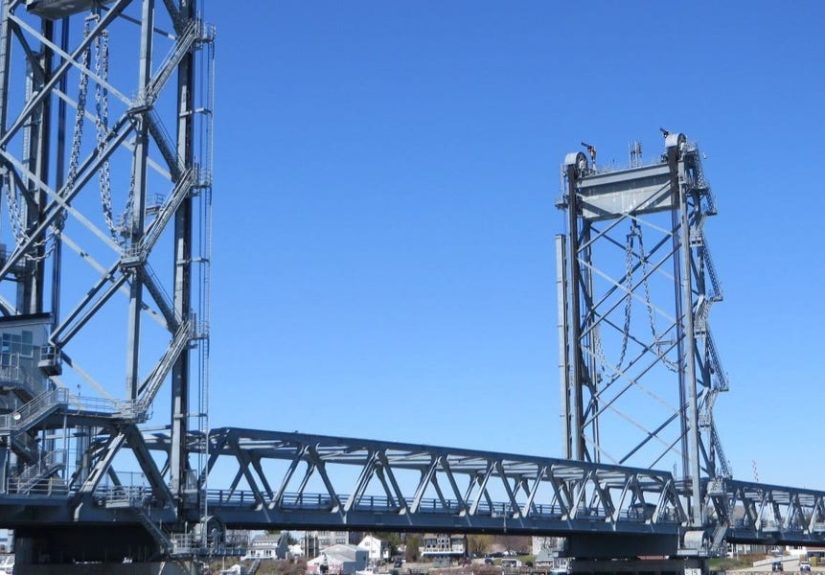
The story behind this headline leads straight to Memorial Bridge, the vertical-lift span connecting Portsmouth, New Hampshire, and Kittery, Maine. The older bridge was closed in 2011 for safety reasons, and the replacement opened in 2013, restoring a direct route for drivers, cyclists, and pedestrians. Federal officials highlighted how important that crossing is to daily mobility and local business activity, because it reconnects two downtown areas with a bridge that had carried significant traffic before the closure.
But the rebuilt bridge was not just a replacement. It also became the platform for something more experimental. University of New Hampshire researchers, working with transportation partners, began treating the structure as a living laboratory. Over time, the bridge was outfitted with data systems and sensors that transformed it from a handsome piece of coastal infrastructure into what UNH describes as a self-diagnosing, self-reporting smart bridge.
There is also a design angle worth noting. Memorial Bridge drew attention as a modern truss bridge built without traditional gusset plates, using a spliced approach that fit the members together differently while preserving the familiar visual character of the old crossing. So even before the sensors entered the picture, the bridge already had a reputation for not doing things the boring way.
Why the tidal generator is the project’s most intriguing twist
Smart sensors are useful. Smart sensors powered, at least in part, by the water moving under the bridge? That is where the project goes from impressive to “wait, you can do that?”
The Living Bridge effort includes a tidal turbine installed beneath the bridge on a deployment platform in the river. The purpose is twofold. First, it demonstrates marine energy technology in a real operating environment rather than in a lab or a glossy slide deck. Second, it helps power the bridge’s sensor network and offset energy use while feeding performance data back to researchers.
This is clever for a very New England reason: the location makes sense. The Piscataqua River and the broader Great Bay estuary system are known for strong, fast-changing tidal currents. NOAA has described Portsmouth Harbor and the Piscataqua as an area with swift, difficult currents, while UNH’s upstream tidal test work has documented energetic flows and short slack-water periods. In plain English, the water there moves with purpose. If you want to test tidal technology, lazy water is not your friend.
Why a bridge site is practical for tidal power research
Marine energy often struggles with a familiar problem: getting equipment into the water, keeping it there safely, collecting usable data, and doing all that without spending a small moon mission’s worth of money. A bridge changes that equation. It provides existing access, a fixed structure, known geometry, and a convenient place to mount equipment, gather data, and connect power systems.
Researchers working on the New Hampshire site have emphasized exactly those benefits. A bridge-supported tidal platform can reduce deployment headaches, make instrumentation easier, and create a more visible, public-facing test bed. That visibility is important. Marine energy can feel distant and abstract. Put a turbine under an iconic downtown bridge, and suddenly the public can see that clean energy is not just happening “somewhere out there.” It is happening under the route to coffee.
What the smart bridge can teach engineers
The biggest infrastructure benefit is not that the bridge has gadgets. It is that the data can improve decisions. Transportation agencies have long depended on inspections, engineering judgment, and maintenance schedules that are necessarily limited by time and resources. Sensor-rich infrastructure makes those decisions sharper.
Better maintenance, fewer nasty surprises
When a bridge can report how it performs under actual traffic and environmental conditions, agencies can build better models of fatigue, stress, and long-term wear. UNH researchers have described using the bridge’s sensor data to run large numbers of trials and refine their understanding of which sections deserve closer attention. That is the kind of knowledge that can stretch maintenance dollars further and reduce the chance of finding serious problems the hard way.
There is also a user-experience benefit hidden in all that engineering. Fewer surprise closures. Better-timed repairs. Smarter inspections. A smoother lift-bridge operation. Most drivers do not wake up excited about structural health monitoring, but they do care when a critical crossing is suddenly unavailable on a Tuesday afternoon. Smart infrastructure helps the public even when the public never thinks about it.
A bridge that informs future bridge design
Memorial Bridge is valuable not only because it can be monitored, but because it can help designers understand what should be built next. Data on stress, movement, traffic patterns, weather exposure, and environmental conditions can inform future bridges in New Hampshire and beyond. That is especially relevant as states face aging infrastructure, tighter budgets, and increasing climate-related stressors such as sea-level rise, storm intensity, corrosion, and temperature swings.
In that sense, this smart bridge is a research platform as much as a transportation asset. It is helping answer a national question: what should infrastructure look like when we stop pretending that “inspect it every so often and hope for the best” is a cutting-edge strategy?
What researchers are learning about environmental impacts
Whenever a turbine goes into moving water, one question arrives almost immediately: what does it do to the surrounding environment? That concern is fair, especially in a busy estuarine setting where fish, marine mammals, and commercial activity all matter.
So far, one of the more encouraging findings from work associated with the Memorial Bridge site is that underwater-noise studies did not observe substantial acoustic emissions from the operating turbine above the already high ambient sound conditions of the busy port environment during measured test conditions. That does not mean every question is permanently settled, but it does suggest the project is contributing exactly the kind of real-world environmental data regulators and developers need.
The project has also evolved to include improved data acquisition and expanded monitoring tools. More recent Department of Energy documentation describes instrumentation upgrades and the addition of imaging sonar to strengthen marine wildlife monitoring capabilities at the site. That is an important signal. The project is not merely trying to prove that tidal energy works. It is also trying to prove that it can be studied responsibly.
Why this matters for New Hampshire’s economy and identity
For New Hampshire, the appeal of a smart bridge with a tidal generator goes beyond engineering bragging rights. It touches transportation reliability, clean-energy innovation, coastal research, and public education all at once.
First, it strengthens the case that infrastructure spending can produce more than replacement value. Instead of building a bridge that simply restores a crossing, the Living Bridge model shows how a new span can also generate research, workforce development, public engagement, and technology testing. That is a better return on concrete, steel, and public patience.
Second, it reinforces New Hampshire’s role in marine energy research. UNH’s work, including the Atlantic Marine Energy Center effort, positions the Memorial Bridge site as part of a broader push to make the region a credible place for tidal-energy testing and scaled demonstrations. That matters in a clean-energy market where progress depends on real sites, real data, and real-world operating experience.
Third, it gives the public a visible example of what “smart infrastructure” actually means. Too often that phrase gets tossed around until it sounds like something dreamed up by a consultant with too many slide transitions. Here, it is tangible. Sensors tell engineers how the bridge is behaving. River instruments track the estuary. A tidal turbine turns local currents into electricity and research data. School groups can learn from it. Agencies can manage from it. That is not buzzword soup. That is a working system.
The extended human experience: what it feels like when infrastructure gets smarter
Now for the part that often gets skipped in technical coverage: what does a project like this actually feel like to the people around it?
For a commuter, the experience starts quietly. You drive across Memorial Bridge because it is the direct way between Portsmouth and Kittery. You are probably thinking about lunch, not load paths. The steel rises around you, the water flashes below, and if the bridge lift is not interrupting your schedule, you may never realize that the structure is collecting information while you roll across it. That is part of the magic. The smartest infrastructure often feels ordinary to the people using it. It does not ask for applause. It just works harder behind the scenes.
For a cyclist or pedestrian, the bridge offers a different kind of relationship. This is not a faceless highway viaduct. It is a visible, local landmark with sidewalks, views, and a strong sense of place. On a windy afternoon, you can look down at the Piscataqua and understand, in a very physical way, why engineers got interested in tidal energy there. The water does not stroll. It hustles. It turns, surges, and throws around enough attitude to make the idea of harvesting its motion seem less like fantasy and more like common sense.
For students, the bridge becomes a gateway drug to engineering. That is probably the nicest thing anyone can say about a piece of infrastructure. UNH has described ways the project can connect with classrooms and public outreach, including live data and on-site learning. A middle-school student who might never care about a textbook chapter on buoyancy or environmental monitoring could care a great deal when the lesson involves a real bridge, a real turbine, and a real river in their region. Suddenly science is not trapped in a worksheet. It is hanging over the water downtown.
For researchers, the experience is less poetic and more salty. There are boats, cables, sensors, platforms, weather windows, software, mechanical headaches, and the kind of fieldwork that makes laptops feel hilariously fragile. But that is exactly why the site matters. It forces ideas to deal with the real world. Salt water is an unforgiving reviewer. Tidal turbulence is not interested in your elegant theory. A smart bridge in a busy estuary lets engineers test whether systems can survive reality instead of just impressing each other in a conference room.
For local residents, there is also a civic pride factor. The bridge is not only a crossing. It is a symbol of connection between communities and, increasingly, a symbol of what practical innovation can look like in northern New England. It says a place does not need to be huge to do meaningful infrastructure research. A regional city can host national-level ideas. A local bridge can contribute to cleaner energy, smarter transportation management, and better public understanding of how all those systems overlap.
And for the rest of us, the project offers a useful reminder: infrastructure is not supposed to be invisible until it breaks. The best version of infrastructure is alive to its environment, responsive to stress, and generous with information. That does not make it glamorous. It makes it trustworthy. In an era when public systems are being asked to do more with less, a bridge that can monitor itself, support research, and experiment with renewable power is not a gimmick. It is a preview.
Conclusion
New Hampshire’s smart bridge story is compelling because it combines three things that rarely share the spotlight gracefully: transportation infrastructure, clean energy, and public-facing science. Memorial Bridge and the Living Bridge project show how a rebuilt bridge can become more than a route from Point A to Point B. With structural sensors, environmental monitoring, and a tidal generator beneath the span, the bridge becomes a piece of infrastructure that informs, adapts, teaches, and experiments all at once.
That is the larger lesson. The future of bridges is not just stronger steel or better paint, though those are nice too. It is intelligence. It is continuous monitoring. It is renewable power integrated into everyday systems. It is using the places we already depend on to produce better information and smarter public decisions. In New Hampshire, that future is not hypothetical. It is already standing over the Piscataqua, collecting data and refusing to be boring.