Table of Contents >> Show >> Hide
- Why “New Comet 2019” Became a Big Deal
- The Headliner: 2I/Borisov, an Interstellar Comet Discovered in 2019
- The Comet That Almost Stole the Show: C/2019 Y4 (ATLAS)
- More 2019 Newcomers Worth Knowing
- How “New” Comets Get Found in the First Place
- How to Observe a New Comet Like It’s 2019 All Over Again
- Why 2019’s New Comets Still Matter Today
- Experiences: What It Feels Like to Chase a “New Comet 2019”
- Conclusion
If you typed “New Comet 2019” into a search bar back then, you weren’t alone. 2019 delivered a rare mix of
comet drama: a confirmed visitor from another star system, multiple “freshly discovered” comets with
survey-telescope names that sound like sci-fi passwords, and at least one celestial overachiever that
showed up looking like a modest fuzzy dot… then turned into a full-blown headline.
This guide breaks down what “New Comet 2019” usually means (spoiler: it’s not always “a comet you can see
naked-eye tonight”), highlights the biggest 2019 discoveriesespecially 2I/Borisovand
shows how to follow the next “new comet” without falling for hype, doomscrolling orbital charts, or
buying a telescope you’ll use exactly twice.
Why “New Comet 2019” Became a Big Deal
“New comet” can mean two different things:
-
Newly discovered: astronomers (or skilled amateurs) spot a comet that wasn’t previously known.
Its official name typically includes the year of discoverylike C/2019 Q4 or C/2019 Y4. -
Newly visible: a comet that was already known becomes bright enough to observe easily, often
because it’s nearing the Sun and getting more active.
2019 mattered because it gave us a true “newly discovered” comet story with blockbuster credentials:
2I/Borisov, the first clearly comet-like interstellar object ever observed. Think of it as a
postcard from another solar systemdelivered by cosmic mail carrier, no return address.
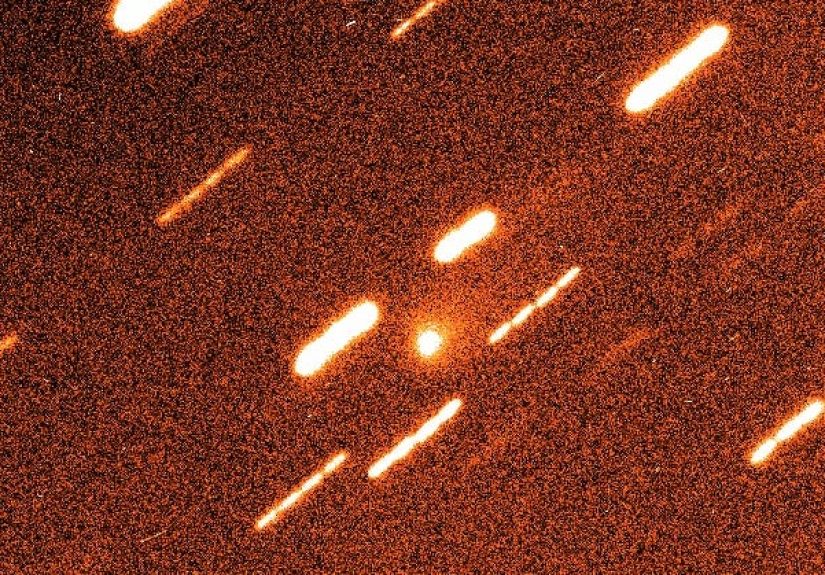
The Headliner: 2I/Borisov, an Interstellar Comet Discovered in 2019
Discovery: one observer, one fuzzy speck, and a lot of excited astronomers
The object first surfaced as C/2019 Q4 (Borisov), discovered on August 30, 2019
by Gennady Borisov at the MARGO observatory in Nauchnij, Crimea. What made professionals
sit up straight wasn’t just “hey, new comet,” but the early orbit calculations: it was moving too fast
and on a path that looked “not from around here.”
NASA’s automated and human-led tracking pipeline kicked in quickly. The object was flagged as a potential
interstellar visitor, and orbital work used additional observations coordinated through major centers
that specialize in near-Earth objects and small bodies. In other words: the comet got a background check.
What made it interstellar (without turning this into a math class)
A comet from our own solar system typically travels on an orbit bound to the Sunlike an elastic band.
An interstellar comet travels on a hyperbolic pathmore like a rock skipping across a pond:
it comes in, slings past, and keeps going.
For C/2019 Q4, the numbers were eyebrow-raising. Reports noted a speed around 93,000 mph (150,000 kph)
while still far from the Sunfaster than typical solar-system objects at that distance. The comet reached
perihelion on December 8, 2019 at roughly the distance of Mars’ orbit (about 190 million miles / 300 million km)
from the Sun. Translation: it was a drive-by visitor, not a new neighborhood resident.
Why Borisov was scientifically delicious (and not just because it had “alien water”)
Unlike 2017’s ‘Oumuamuawhich was asteroid-like and weirdly tricky to interpretBorisov looked and behaved
like a classic comet: an icy nucleus warming up, releasing gas and dust, forming a glowing coma and tail.
That’s a gift to scientists because comet activity is full of chemical clues.
Researchers reported detections of water and other volatiles, and multiple studies focused on what Borisov’s
composition might reveal about planet formation around other stars. Even better (from an observing standpoint),
Borisov was discovered on the way in, which allowed months of planned observations rather than a frantic,
“Waitwhere did it go?” situation.
So… could you actually see it?
Interstellar doesn’t automatically mean “bright.” Borisov wasn’t a naked-eye spectacle for most people.
But it was observable with telescopes for an extended periodpeaking around mid-December 2019 and remaining
reachable for moderate telescopes for months afterward. For many amateurs, this wasn’t about a stunning
sky showit was about spotting a historic object and saying, “Yep. I saw the one that came from another star.”
The Comet That Almost Stole the Show: C/2019 Y4 (ATLAS)
Discovered at the end of 2019, hyped in early 2020
If Borisov was the “prestige documentary,” C/2019 Y4 (ATLAS) was the trailer that promised
a summer blockbuster. It was discovered on December 29, 2019 by the ATLAS
survey system in Hawaiʻi, and it brightened quickly enough that some observers hoped it might become
a naked-eye comet in 2020.
Brightening… then breaking: a comet’s dramatic exit
Then ATLAS did what comets sometimes do: it refused to follow the script. Instead of continuing to brighten,
it began dimming abruptly. Observers suspected fragmentationand space-based observations later confirmed a
breakup into many pieces. Hubble images in April 2020 revealed dozens of fragments, like a cosmic piñata
that nobody intended to hit.
The ATLAS saga became a perfect lesson in comet reality: brightness forecasts are educated guesses,
not contracts. A comet is basically a dirty snowball held together by enthusiasm and low gravity.
When it warms up, it can put on a showor fall apart like a cookie dunked for too long.
Takeaway: comets are nature’s improvisers
ATLAS wasn’t “a failure.” It was data. Fragmentation events help scientists understand how comet nuclei
evolve and die, how common breakups may be, and why predicting comet brightness is notoriously hard.
It also reminded observers to keep joy in the chase, not just in the outcome.
More 2019 Newcomers Worth Knowing
C/2019 Y1 (ATLAS): the “other ATLAS comet” that kept showing up
Not all ATLAS comets are drama queens. C/2019 Y1 (ATLAS) was discovered on December 16, 2019
and showed steadier progress for observers tracking it into 2020. It became a useful “practice comet” for amateurs:
not too famous to be crowded, not too faint to be pointless, and not too unpredictable to be discouraging.
P/2019 LD2 (ATLAS): the comet that looked like an asteroid at first
Here’s where 2019 gets extra fun: P/2019 LD2 was discovered in June 2019 by ATLAS and
became a “what exactly are you?” object for a while. It was initially discussed as asteroid-like in behavior and
location, then later recategorized when its orbit and activity suggested it fit better as a Jupiter-family comet
(and more broadly, a transitional object influenced by Jupiter).
Why should anyone outside a planetary science department care? Because objects like this blur the neat lines between
“asteroid” and “comet” and help explain how small bodies migrate through the solar system. Also: it’s a reminder that
discovery is not a single momentit’s a process of learning what something truly is.
How “New” Comets Get Found in the First Place
Survey telescopes: the sky’s full-time lifeguards
Modern comet discovery is powered by wide-field surveys that scan huge portions of the sky repeatedly, looking for
anything that moves. Systems like ATLAS and Pan-STARRS were built for finding near-Earth
hazards, but they also catch cometsbecause comets don’t wear name tags.
The workflow usually looks like this:
- Detection: a moving, fuzzy point shows up in repeated images.
- Confirmation: other telescopes re-observe it to confirm it’s real and moving consistently.
- Orbit calculation: astronomers estimate its trajectory (and whether it’s bound to the Sun).
- Designation: the object gets an official provisional name reflecting discovery date and type.
From fuzzy dot to official comet: the “paperwork” that makes it real
Once a candidate is found, organizations that coordinate small-body data help gather measurements, refine orbits,
and publish updates so observers worldwide can track it. That’s especially important for something fast-moving or
unusuallike an interstellar visitorwhere early measurements can shift predictions quickly.
Quick guide to comet names (so you don’t feel like you’re decoding a Wi-Fi password)
Comet names often have two layers:
-
Type prefix: C/ generally indicates a long-period or non-periodic comet (not known to return soon),
while P/ indicates a periodic comet with a shorter, repeatable orbit. -
Discovery code: the year plus a letter/number code reflects when it was discovered and the order of discovery
in that time window. So C/2019 Q4 means “a comet discovered in 2019,” with “Q4” encoding a specific discovery period and sequence. -
Special cases: 2I/ is an interstellar designation (“I” for interstellar). So 2I/Borisov
literally means “the second interstellar object confirmed,” named for its discoverer.
How to Observe a New Comet Like It’s 2019 All Over Again
Step 1: set expectations you’ll actually enjoy
Most comets will not look like a Hollywood poster. Through binoculars or a small telescope, a comet often appears as
a soft, round glowsometimes with a short tail, sometimes not. The goal is usually the experience:
finding it, tracking it night to night, and watching changes as it approaches or leaves the Sun.
Step 2: use reliable tracking tools (and don’t trust random screenshots)
Comets move. Sometimes quickly. Use established ephemeris sources and planetarium tools that update positions as new
observations refine the orbit. If you’re using a sky app, make sure it’s pulling current comet data rather than showing
a cached position from last week (comets love being “last week”).
Step 3: pick the right gear for the job
- Binoculars (7×50 or 10×50): great for brighter comets and wide-field sweeping.
- Small telescope (3–6 inches): helpful for fainter comets, structure in the coma, and tail hints.
- Tripod + phone camera: surprisingly useful for wide-field shots of brighter comets.
Step 4: observe like a detective, not a tourist
A good comet session isn’t just “I saw it.” Try logging:
- date/time and sky conditions
- estimated brightness (even a rough comparison to nearby stars helps)
- whether the coma looks concentrated or diffuse
- any tail direction or length you can detect
Over multiple nights, small differences add up. That’s where comet chasing becomes addictivein a wholesome way,
like birdwatching, but with more dew on your shoes.
Why 2019’s New Comets Still Matter Today
Interstellar visitors are chemistry time capsules
2I/Borisov gave scientists the rare chance to compare material formed around another star with our own solar system’s
comets. Findings about water and other volatiles help refine models of how planetary systems build icy bodiesand how
common “familiar” chemistry might be elsewhere.
Breakups teach us how comets end
C/2019 Y4 (ATLAS) highlighted how fragile comet nuclei can be. Breakups are not just fireworks; they’re a clue to
internal structure, spinning behavior, jet activity, and stress from heating. They also explain why comet forecasts can
be both reasonable and wrong in the same week.
Amateurs are still part of the story
The Borisov discovery itself is a reminder that skilled amateurs can still find major objects. And when a comet fragments
or outbursts, amateur imaging often provides early confirmation and detailed timelines that professionals may not capture
continuously. The universe is big; teamwork helps.
Experiences: What It Feels Like to Chase a “New Comet 2019”
Chasing a new comet is equal parts science, patience, and a tiny bit of comedybecause the sky does not care that you
finally cleared your schedule. The experience usually starts with a notification or a late-night rabbit hole: a fresh
designation, a projected brightness curve, a star chart with a squiggly path that looks like it was drawn by a caffeinated
ant. You tell yourself, “I’ll just take a quick look.” Two hours later you’re checking cloud forecasts like they owe you money.
The first attempt is often humbling. You set up in the dark, you wait for your eyes to adjust, and you realize that the
“easy” object is sitting near a messy star fieldor low in the murk where city glow and humidity team up like villains.
You learn fast that comet hunting is less “point-and-wow” and more “slowly sweep, confirm, and re-check.” When you finally
spot the comet, it might look like a faint smudge, almost anticlimactic… until the meaning catches up. That smudge is
sunlight reflecting off dust that was frozen for billions of years. It’s a time capsule with terrible PR.
If you chased 2I/Borisov back in 2019, the thrill had an extra layer: you weren’t just seeing a cometyou were seeing a
visitor from another star system. Even if it wasn’t bright, it felt historic. The satisfaction came from the process:
finding the correct star pattern, confirming the position, and knowing that professionals and amateurs worldwide were
essentially sharing the same treasure map.
Then there’s the “comet mood swing” lesson, courtesy of objects like C/2019 Y4 (ATLAS). You may have watched it brighten,
read predictions about naked-eye visibility, and started imagining a cinematic tail over your backyard. And thenplot twist
it dims. It fragments. Your big comet night becomes a lesson in astrophysical fragility. Oddly, that disappointment often
deepens the fascination. You realize comets aren’t performances staged for humans; they’re natural objects responding to
heat, rotation, and stress in real time. You didn’t miss the show. The breakup was the show.
Over time, comet chasing trains your instincts. You start choosing observation sites with a clear horizon, checking moon
phase before you get excited, and packing warm layers even when the afternoon felt mild. You learn that the best “comet
souvenir” isn’t always a perfect photoit’s the memory of the search: the quiet, the starry context, and the moment you
realize you’re looking at something that won’t ever pass this way again.
Conclusion
“New Comet 2019” isn’t just one objectit’s a snapshot of how comet discovery and observing works in the modern era.
2019 gave us 2I/Borisov, a confirmed interstellar comet that turned an ordinary discovery into a once-in-a-generation
science opportunity. It also gave us the rollercoaster of C/2019 Y4 (ATLAS), a reminder that comets are unpredictable
by natureand that’s exactly why they’re worth following.
The next time a “new comet” hits the headlines, you’ll know how to decode its name, set realistic expectations, track it
with reliable tools, and enjoy the chasewhether it becomes a bright spectacle or just a faint, historic smudge that you
earned by looking up.