Table of Contents >> Show >> Hide
- Who Was George Nakashima?
- What Is a Nakashima Straight-Backed Chair?
- A Brief History of the Straight-Backed Chair
- How Much Do Nakashima Straight-Backed Chairs Cost?
- How to Style Nakashima Straight-Backed Chairs at Home
- Caring for Nakashima Straight-Backed Chairs
- Are Nakashima Straight-Backed Chairs Worth It?
- Experiences and Stories: Living with Nakashima Straight-Backed Chairs
- Conclusion
Some chairs are just places to park yourself while you scroll on your phone.
And then there are chairs that feel like they should come with a museum label,
a family story, and possibly a velvet rope. The Nakashima Straight-Backed Chair
definitely falls into the second category.
Designed by master woodworker George Nakashima in the mid-20th century, this
straight-backed, spindle-legged beauty is a modern interpretation of the classic
Windsor chair. It’s simple, honest, and surprisingly comfortable – the design
equivalent of someone who wears a plain white T-shirt and still looks like they
just stepped out of an architecture magazine.
In this guide, we’ll walk through what makes Nakashima Straight-Backed Chairs
special, how they’re built, what they’re worth, how to style them at home,
and why collectors (and design nerds) are still obsessed with them decades
after they first appeared.
Who Was George Nakashima?
Before we talk chairs, we need to talk about the man behind them. George
Nakashima (1905–1990) was one of the leading figures of the American
studio furniture movement. Trained as an architect, he brought a
philosophical, almost spiritual approach to woodworking. He believed each
piece of wood had a “voice” and that the craftsman’s job was to help it speak
– not cover it up with heavy stains or unnecessary decoration.
Nakashima’s work is known for:
- Solid wood construction: often American black walnut, cherry, and other hardwoods.
- Visible grain and natural edges: instead of hiding the wood, he highlighted it.
- Simple, honest joinery: structural elements are part of the visual beauty.
- Handcrafted details: no two pieces are exactly alike.
The Straight-Backed Chair (often called the Straight Chair or N19 in Knoll’s
line) is one of his best-known seating designs and a perfect entry point into
Nakashima’s world.
What Is a Nakashima Straight-Backed Chair?
At first glance, a Nakashima Straight-Backed Chair might look like a very
refined Windsor chair. That’s intentional. Nakashima reinterpreted traditional
Windsor forms through a modernist lens, stripping away excess and letting
proportion and material do the talking.
Key Design Features
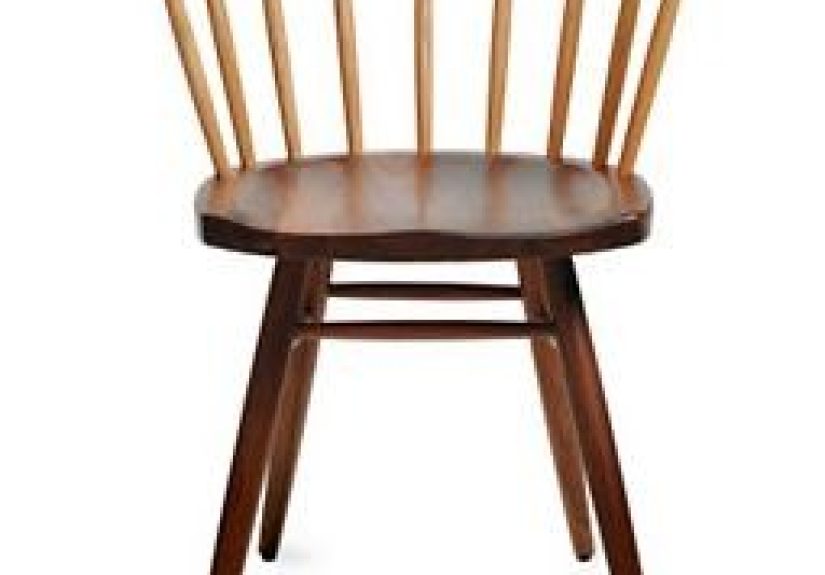
- Modern Windsor silhouette: a straight, slightly angled back with a row of turned spindles.
- Solid wood frame: typically American walnut for the frame and legs.
- Contrasting spindles: often hickory, which creates a subtle two-tone effect.
- Low-sheen finish: to highlight grain patterns rather than create a plastic shine.
- Signature underside: Knoll and Nakashima Studio pieces often carry his signature or a mark under the seat.
The overall effect is clean and architectural but still warm. The chair feels
grounded and solid without being visually heavy. It’s the kind of piece that
plays nicely with both midcentury modern and contemporary interiors – and
even traditional dining rooms if you like a little tension in your décor.
Dimensions and Proportions
Exact measurements vary slightly between studio-built, Knoll, and later
editions, but many Straight-Backed Chairs fall in roughly this range:
- Height: about 29–31 inches (around 74–78 cm)
- Width: around 20–24 inches (about 51–61 cm)
- Depth: roughly 18–21 inches (about 46–53 cm)
- Seat height: generally around standard dining height (16–18 inches)
These fairly compact proportions make the chair an excellent choice for
dining rooms, breakfast nooks, and small apartments. It doesn’t crowd a space,
but it also doesn’t disappear visually. It’s like the quiet friend in the
group who doesn’t talk much, but when they do, everyone listens.
Materials and Craftsmanship
One of the reasons people fall in love with Nakashima furniture is the
material quality. The Straight-Backed Chair typically features:
- American black walnut frame: valued for its rich color and expressive grain.
- Hickory spindles: lighter, strong, and visually contrasting with the darker frame.
- Turned legs and stretchers: simple, functional, and beautifully proportioned.
- Clear, low-sheen finish: protects the wood while keeping it close to its natural appearance.
On original studio pieces, the joinery and finishing were painstakingly
done by hand. Even licensed Knoll versions adhered to high standards of
craftsmanship, which is why so many vintage examples are still in good
condition today.
Comfort: More Than Just a Pretty Back
You might assume a straight-backed, wooden chair is a fast track to
regretting your dinner party. Surprisingly, the Nakashima Straight-Backed
Chair is quite comfortable for a solid wood seat:
- The gentle angle of the back encourages good posture without feeling rigid.
- The spindles provide support while allowing airflow (no sweaty backs during long meals).
- The sculpted or subtly contoured seat on some examples distributes weight more comfortably than a flat board.
Is it a lounge chair? No. Is it a “let’s talk for two hours over wine and
cheese” dining chair? Absolutely.
A Brief History of the Straight-Backed Chair
The Straight-Backed Chair emerged in the 1940s as Nakashima was developing
his language of simple, functional forms rooted in American and Japanese
traditions. One of the most important chapters in this chair’s history is
its collaboration with Knoll.
The Knoll N19 Straight Chair
In the late 1940s, Nakashima partnered with Knoll to create a version of
the Straight Chair that could be produced on a larger scale. The resulting
model, often referred to as the N19, was manufactured by Knoll from the
mid-1940s into the 1950s.
This was unusual for Nakashima, who typically favored one-of-a-kind studio
furniture. But the Straight Chair translated well into a more standardized
design: you still got the solid wood construction, the Windsor-inspired
spindles, and the un-fussy, modern proportions.
Today, both Nakashima Studio originals and vintage Knoll examples show up
at auctions and on design marketplaces. Early Knoll pieces can command
strong prices, especially if they are in good condition and have clear
provenance.
Studio vs. Licensed vs. Contemporary
When people talk about Nakashima Straight-Backed Chairs, they may mean:
-
Studio originals: chairs made in Nakashima’s own workshop
in New Hope, Pennsylvania. These often have slight variations and are
highly valued by collectors. -
Knoll production: midcentury N19 Straight Chairs produced
under license. These are more standardized but still high quality. -
Later or inspired versions: chairs built later at the
Nakashima Studio under Mira Nakashima’s direction, and various inspired
designs on the market (some clearly labeled, some more “in the style of”).
For serious collectors, authenticity matters: signatures, labels, invoices,
and even original client names inscribed under the seat can all help
document a piece.
How Much Do Nakashima Straight-Backed Chairs Cost?
This is where things get interesting. Unlike mass-market chairs, you’re
not just paying for a seat – you’re paying for design history.
New or Licensed Reissues
Licensed contemporary versions offered through design retailers or
high-end modern furniture shops can still cost around the low-to-mid
four figures per chair, depending on the retailer and finish. It’s a
serious investment compared to generic dining chairs, but relatively
modest compared to rare vintage studio furniture.
Vintage and Auction Market
Auction results and resale sites show:
- Single Straight-Backed Chairs selling in the low thousands of dollars.
- Sets of four, six, or eight chairs reaching significantly higher totals.
- Studio-made, early, or particularly well-documented pieces bringing a premium.
Condition, provenance, and whether the piece can be authenticated (for example,
with documentation from Nakashima Studio or Mira Nakashima) all affect value.
As with most design icons, prices have generally trended upward over time.
How to Style Nakashima Straight-Backed Chairs at Home
The good news: Straight-Backed Chairs are surprisingly versatile. They’re not
fussy, not overly “look at me,” and yet they have a strong point of view.
1. Around a Dining Table
The most obvious and classic use is as dining chairs. Some pairing ideas:
-
With a solid wood table: a walnut table highlights the grain
and makes the whole setup feel cohesive and calm. -
With a live-edge or slab table: leaning into the Nakashima
aesthetic of honoring the natural form of the wood. -
Mixed with other chairs: use Straight-Backed Chairs on the
long sides and different end chairs (like armchairs or upholstered host chairs)
for a relaxed collected look.
2. As a Desk or Work Chair
If you have a simple writing desk or a home office with a minimalist vibe,
a single Straight-Backed Chair can be a perfect companion. It keeps your
posture fairly upright (good for focused work), and the open spindle back
keeps the room from feeling visually blocked.
3. Accent Seating in Living Spaces
In a living room, bedroom, or hallway, a Straight-Backed Chair can work as:
- A place to stack books or display a throw.
- A spare seat for guests when you need one more chair.
- A sculptural object that brings warmth and texture to a corner.
Because the design is so timeless, it pairs well with both vintage rugs and
ultra-modern sofas. It’s neutral but never boring.
Caring for Nakashima Straight-Backed Chairs
When you invest in a piece like this, maintenance matters. The goal is to
protect the wood and finish without smothering it in heavy products.
Basic Care Tips
-
Dust regularly: use a soft, lint-free cloth to keep dust
from building up in the spindles and joints. -
Avoid harsh cleaners: skip silicone sprays and strong
chemical polishes. A mild, wood-safe cleaner or slightly damp cloth is
usually enough. -
Protect from extreme conditions: keep the chair away from
direct heat sources and strong sunlight to prevent warping and fading. -
Use felt pads: protect both the chair legs and your floors
with good-quality pads, especially on hardwood.
Restoration and Refinishing
If you’re lucky enough to own an original or vintage Nakashima piece, proceed
carefully with refinishing. Over-sanding, changing the stain, or applying a
thick modern varnish can reduce both the aesthetic and market value.
When in doubt, consult a professional conservator or a restorer experienced
with midcentury and studio furniture. For significant or rare examples,
contacting Nakashima Studio for guidance or potential documentation can be
worthwhile.
Are Nakashima Straight-Backed Chairs Worth It?
Short answer: if you appreciate design history, craftsmanship, and furniture
that actually holds its value, yes.
A Straight-Backed Chair is:
- A functional object: you can use it daily as a dining or desk chair.
- A design icon: recognized in the world of modern American furniture.
- A potential heirloom: well-cared-for pieces can be passed down – and cherished – for generations.
- A relatively stable asset: while no market is guaranteed, quality Nakashima furniture has shown consistent interest among collectors.
If your goal is “cheap and cheerful,” this isn’t the chair. If your goal is
“I want one perfect thing that still makes me happy 20 years from now,”
you’re thinking in Nakashima territory.
Experiences and Stories: Living with Nakashima Straight-Backed Chairs
Design talk is great, but how does a Nakashima Straight-Backed Chair fit into
real life? Let’s imagine a few everyday scenarios that show what it’s like to
actually live with one (or a set).
Picture a small city apartment with limited space. The dining area is basically
a table, a lamp, and whatever chairs you can squeeze around it. A set of
Straight-Backed Chairs quietly solves several problems at once. They’re slim
enough that you can tuck them fully under the table when not in use, their
open backs keep the room from feeling crowded, and the warm walnut and hickory
add instant “grown-up” character, even if the rest of your furniture is a mix
of hand-me-downs and online deals.
Now imagine hosting friends for dinner. At first, someone might eye the wooden
seat and say, “Uh oh, no cushions?” But an hour into the meal, nobody’s rushed
to the sofa. The back angle and spindle support do their job, and the conversation
flows. Later, when the table is cleared, one of your friends casually runs their
hand along the grain of the backrest and says, “Okay, this chair is actually
gorgeous.” That’s the Nakashima effect: quiet at first, then slowly impossible
to ignore.
In a different setting – say, a home office or studio – a single Straight-Backed
Chair can serve as both a working tool and a visual anchor. Park it at a simple
desk, add a task lamp, and suddenly the space feels deliberate and intentional.
When you take a break from your screen, you notice the way the light catches
the grain of the walnut or the rhythm of the hickory spindles. It gently reminds
you that not everything in life has to be plastic, metal, or digital.
There’s also the emotional side of owning a design icon. Whether you picked up
a licensed contemporary version or hunted down a vintage studio chair at an
auction, you’re not just buying an object – you’re joining a design story that
stretches back to the 1940s. Maybe you read about Nakashima’s philosophy of
“listening to the wood.” Maybe you learned that early clients could commission
pieces directly from his studio, and their names were sometimes written on the
underside of the seats. Suddenly, flipping your chair over becomes a small ritual:
underneath is a signature, a label, or at least the knowledge that this design
carries a real history.
Over time, small marks and scuffs become part of your own chapter. A tiny dent
on the stretcher? That’s from the night someone’s shoe accidentally knocked it
during an enthusiastic story. A slightly polished spot on the top rail? That’s
where hands have grabbed it a thousand times while pulling the chair out from
the table. Rather than feeling like “damage,” these traces often make well-made
wooden chairs more beautiful – and more personal.
For some people, the biggest “aha” moment comes when they compare the Straight-Backed
Chair to cheaper alternatives. After moving, you might temporarily bring in a
couple of generic dining chairs in addition to your Nakashima ones. The difference
is obvious: the cheaper chairs feel lighter, both physically and visually, but
not in a reassuring way. The wood looks flatter, the joints feel less solid, and
the design doesn’t quite hold its own in the room. When you sit back down in the
Straight-Backed Chair, there’s an immediate sense of stability and refinement.
It feels like the difference between fast fashion and a tailored coat – they both
“work,” but only one feels like it was made to last.
Ultimately, living with a Nakashima Straight-Backed Chair is less about showing
off a trophy object and more about enjoying a daily companion that happens to be
beautifully made. It’s the chair that quietly witnesses countless breakfasts,
late-night emails, homework sessions, and birthday candles. The design might
have started as a modern interpretation of a Windsor chair, but in everyday life,
it becomes something simpler and more profound: a good place to sit, with a story
you’ll never get tired of telling.
Conclusion
Nakashima Straight-Backed Chairs sit at the intersection of sculpture, craft,
and everyday utility. They’re rooted in tradition but feel timeless; they’re
modest in silhouette but rich in detail. Whether you’re a design collector, a
homeowner looking for “forever” furniture, or just someone who appreciates a
really well-made chair, this design is worth your attention.
You don’t need a whole museum to enjoy great design. Sometimes, all you need
is one extraordinary chair pulled up to your table.