Table of Contents >> Show >> Hide
- What Is Japan’s F-X Fighter, Exactly?
- Why Japan Needs a New Fighter Jet
- Who Is Building Japan’s New Fighter?
- Is This Really a Sixth-Generation Fighter?
- Key Design Details We Know So Far
- What About Weapons?
- Can Japan Export the Fighter?
- The Big Question: Will It Arrive on Time?
- Why the F-X/GCAP Matters Beyond Japan
- Experience and Perspective: What Following Japan’s New Fighter Feels Like
- Final Take
Japan’s new fighter story is no longer just about a mysterious domestic project with a cool codename. What used to be known as the F-X has grown into something much bigger: a three-nation effort with the United Kingdom and Italy under the Global Combat Air Programme (GCAP). In plain English, Japan’s next fighter is not just a jet. It is a flying combat network, a stealth platform, a software project, an industrial strategy, and a geopolitical statement wearing sharp angles.
That sounds dramatic, but so is the mission. Japan wants a next-generation aircraft that can replace the aging Mitsubishi F-2, maintain air superiority in a rapidly changing threat environment, and still remain upgradeable decades from now. In other words, Tokyo is not shopping for a shinier old idea. It is trying to avoid building a very expensive museum piece.
So what is Japan’s new fighter, who is building it, what sixth-generation technology is actually on the table, and what details matter most as of 2026? Let’s break it down without turning this into a pilot training manual.
What Is Japan’s F-X Fighter, Exactly?
The short answer is this: Japan’s F-X evolved into GCAP. The original F-X label referred to Japan’s home-led future fighter program intended to replace the F-2 around the mid-2030s. But in December 2022, Japan, the UK, and Italy announced they would merge their efforts into one common next-generation combat aircraft project.
That means the “Japan new fighter jet” people still call F-X is now best understood as Japan’s role inside GCAP. The aircraft remains central to Japan’s defense planning, but it is no longer a solo act. It is now part of a trilateral program designed to produce a shared sixth-generation fighter for Japan, the Royal Air Force, and the Italian Air Force.
Japan’s defense planners have been clear about the timeline for years: the goal is to have the new aircraft ready around the time the F-2 starts retiring, which is why 2035 keeps showing up in official statements like a recurring plot twist.
Why Japan Needs a New Fighter Jet
Japan’s Ministry of Defense frames the issue in one phrase: air superiority. In Tokyo’s view, controlling the skies is not optional. It is the condition that allows everything else to work, from missile defense to naval operations to the movement of forces across Japanese territory.
The regional backdrop matters here. China continues expanding and modernizing its combat aviation fleet. Russia still fields advanced fighters and is pursuing its own manned-unmanned concepts. The United States is pushing ahead with next-generation air dominance ideas. Japan, sitting in one of the world’s most demanding security neighborhoods, does not have the luxury of treating fighter recapitalization like a side quest.
That urgency also explains why Japan did not want a simple F-2 replacement. It wanted a platform designed for the threat environment of the 2030s and beyond. That means stealth, networking, rapid software updates, long-range sensing, and the ability to work with unmanned systems. Basically, the jet has to be good at flying, but also good at being the smartest thing in the room.
Who Is Building Japan’s New Fighter?
Japan’s Lead Builder: Mitsubishi Heavy Industries
On the Japanese side, Mitsubishi Heavy Industries (MHI) has been the key prime contractor for the airframe and overall integration of Japan’s next-generation fighter work. That makes sense. MHI has long been central to Japanese aerospace and defense manufacturing, and it was already positioned as the lead industrial player in the original F-X structure.
If you are looking for the simplest answer to “Who is building Japan’s new fighter jet?” it is this: Mitsubishi Heavy Industries is Japan’s main builder. But that is only half the picture now.
The Trilateral Industrial Team
At the broader GCAP level, the industrial heavyweights are:
Mitsubishi Heavy Industries for Japan, BAE Systems for the United Kingdom, and Leonardo for Italy.
These are not side characters. They are the core industrial champions of the program. Over time, they have moved from cooperation agreements to a more formal joint-venture structure for design and delivery.
Edgewing: The New Prime Integrator
One of the biggest recent developments is the launch of Edgewing, the joint venture created to drive design and development for the aircraft. Edgewing brings together BAE Systems, Leonardo, and Japan Aircraft Industrial Enhancement Co. Ltd. on an equal-share basis.
So if MHI is Japan’s lead industrial anchor, Edgewing is the tri-national vehicle meant to turn the program into an actual aircraft rather than a very expensive PowerPoint romance.
Is This Really a Sixth-Generation Fighter?
“Sixth-generation” gets tossed around so often in defense writing that it can start to sound like a marketing smoothie. But there are a few features that consistently define the category, and GCAP checks many of those boxes on paper.
1. Stealth, But Not Just for Show
The aircraft is expected to be highly stealthy, with shaping and materials intended to reduce detectability. That is table stakes now. But the more interesting part is that the stealth design has to work alongside big sensor demands, weapons integration, long range, and significant onboard power generation. In sixth-generation design, stealth is not the whole meal. It is the plate.
2. Advanced Sensors and Data Fusion
One of the most talked-about pieces of GCAP technology is the sensing and communications architecture. Official industry material has highlighted a next-generation radar and sensor suite capable of handling dramatically more data than current systems. The point is not just to “see farther.” It is to gather, fuse, prioritize, and share information faster than an opponent can react.
That matters because modern air combat is increasingly about information advantage. The fighter that can detect first, understand first, and cue weapons first usually gets to write the unpleasant ending for the other side.
3. Integrated Communications and Non-Kinetic Effects
GCAP is also built around what the partners call Integrated Sensing and Non-Kinetic Effects & Integrated Communications Systems. Yes, that is a mouthful. Yes, the acronym soup is strong. But the concept is important.
This part of the aircraft is meant to do more than traditional radar-and-radio work. It is supposed to support electronic warfare, communications, data sharing, self-protection, and decision support across a contested battlespace. In other words, the fighter is being designed to sense, communicate, jam, protect, and coordinate all at once, not one task at a time like it is checking errands off a weekend list.
4. Manned-Unmanned Teaming
Japan’s official planning documents do not hide the ambition here. Alongside the fighter itself, the country is pursuing concepts for collaborative unmanned aerial vehicles. The broader GCAP family-of-systems approach also assumes the fighter will operate with drones or other uncrewed assets.
This is one of the clearest sixth-generation markers. The future fighter is not meant to fight alone. It is meant to act as a quarterback, sensor node, weapons controller, and command hub for other platforms.
5. Software-Driven Upgrades
Japan has repeatedly emphasized freedom of modification, which sounds bureaucratic until you realize how important it is. Tokyo does not want a locked-down aircraft that takes forever to update. It wants the ability to upgrade software, mission systems, and capabilities on a relevant timeline.
That is a major sixth-generation theme: the airframe matters, but the software spine may matter just as much. The winner is not necessarily the jet with the flashiest first flight. It is the one that can keep evolving without needing a minor political miracle every time code changes.
6. A More-Electric, High-Power Engine Architecture
Future fighters need enormous electrical power for sensors, computing, and electronic warfare. That is why propulsion is not just about thrust anymore. Rolls-Royce, IHI, and Avio Aero have all been tied into the propulsion side of the broader program, and official material has emphasized unusually high onboard electrical demands.
That may sound nerdy, but it is actually one of the most important clues about the aircraft’s future role. A sixth-generation fighter is basically an airborne power station with attitude.
Key Design Details We Know So Far
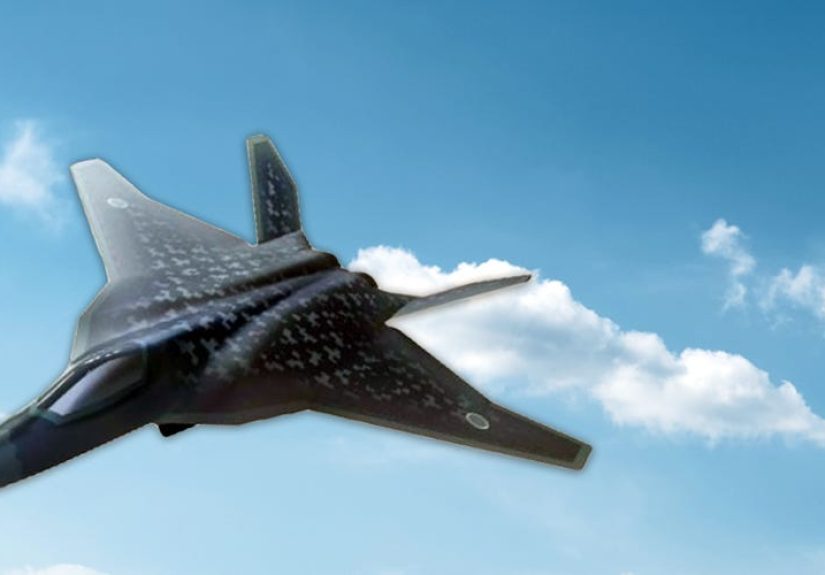
Publicly released concept models suggest a large, sleek, stealthy aircraft with a broad delta-like planform and internal weapons carriage. Analysts have noted that the shape appears to prioritize range, payload, and low observability over dogfight-era visual drama. Translation: this jet is not trying to look pretty at an airshow. It is trying to survive in a sensor-saturated war.
Other details that have emerged publicly include a digital cockpit, a strong emphasis on sensor fusion, and potential use of advanced pilot interfaces including augmented or virtual-reality-style information presentation. The general direction is clear even where exact specifications remain classified: the pilot will not just fly the aircraft, but manage a wider combat ecosystem.
That is why so much attention is going into electronics, communications, weapons integration, and propulsion. In older eras, the plane was the star and the subsystems supported it. In GCAP, the platform is almost the stage on which the subsystems perform.
What About Weapons?
The fighter is expected to carry advanced weapons internally and support future effects integration, though not every missile or munition choice has been publicly locked in. MBDA and Mitsubishi Electric have already worked on the “effects” domain to support weapons integration for the core platform.
That matters because one of the quiet truths of fighter design is this: a stealth jet without well-integrated weapons is basically an expensive way to make adversaries nervous for a few seconds.
Can Japan Export the Fighter?
Yes, and that is a significant political development. In 2024, Japan approved changes that allow future fighter exports tied to the program. This was a notable shift from Japan’s more restrictive postwar defense-export posture.
Why does that matter? Because export potential can reduce per-unit costs, expand production, support the domestic industrial base, and make the program more sustainable over time. It also shows that Tokyo sees this fighter not only as a defense asset, but as part of a broader strategy to strengthen Japan’s defense industry and international role.
The Big Question: Will It Arrive on Time?
Officially, the target remains 2035. Unofficially, that timeline looks ambitious. And “ambitious” in fighter-jet language often means “please keep a backup plan nearby.”
Recent reporting has pointed to schedule pressure, funding timing issues, and delays tied to early design contracting. None of that means the program is collapsing. It does mean the road from glossy concept art to front-line squadron service remains full of familiar defense-program hazards: politics, budgets, industrial coordination, and the basic difficulty of inventing tomorrow’s aircraft today.
Japan appears aware of the risk. That is one reason reporting has mentioned possible stopgap thinking, including additional F-35 purchases or upgrades to existing fleets if the schedule stretches. For now, though, Tokyo continues to publicly back GCAP.
Why the F-X/GCAP Matters Beyond Japan
This fighter is about more than replacing the F-2. It represents a deeper shift in how Japan approaches defense technology, industrial partnerships, and allied interoperability. Japan has long worked closely with the United States, but GCAP marks a major strategic partnership with European allies in one of the most complex defense sectors on earth.
That makes the program important for three reasons. First, it strengthens trilateral industrial cooperation between Japan, the UK, and Italy. Second, it helps preserve sovereign aerospace skills in all three countries. Third, it offers an alternative model for future combat aviation outside a purely U.S.-led framework.
And yes, that is a big deal. Fighter jets are never just fighter jets. They are flying summaries of who trusts whom, who can build what, and who expects to matter in the next thirty years.
Experience and Perspective: What Following Japan’s New Fighter Feels Like
Watching the F-X story turn into GCAP has been a little like watching a home renovation become an international architecture project halfway through. At first, the storyline looked straightforward: Japan wanted a home-led replacement for the F-2, Mitsubishi Heavy Industries would anchor the effort, and the country would preserve key aerospace know-how. Then the walls came down, the floorplan changed, and suddenly Britain and Italy were in the kitchen discussing future combat air over blueprints and espresso.
From a defense-watcher perspective, the experience has been fascinating because the program sits at the intersection of technology, politics, and industrial strategy. One day the conversation is about stealth shaping and engines with huge electrical output. The next day it is about export rules, treaty structures, and joint ventures with names that sound like premium sneakers. That is the strange beauty of modern fighter programs: they are half aerospace engineering and half international negotiation.
For Japan, the experience appears especially significant. This is not just about receiving a new aircraft from abroad. It is about staying deeply involved in the design, upgrade path, maintenance base, and industrial life of the platform. That desire shows up again and again in the language around freedom of modification, domestic readiness, and technology base preservation. Tokyo is not trying to be a passenger on this plane. It wants a hand on the controls, metaphorically speaking.
There is also a very human side to the story. A program like this means years of work for engineers, software teams, materials specialists, engine designers, electronic warfare experts, test planners, and supply-chain managers across three countries. It means arguing over standards, translating requirements, sharing risk, solving problems that have not existed before, and pretending every schedule slide is “a natural adjustment.” Somewhere in a secure conference room, a very patient person is explaining why a subsystem cannot violate physics just because a deadline is feeling optimistic.
For readers, the F-X/GCAP journey is compelling because it shows how air power is changing in real time. The conversation is no longer just about speed, turn rate, or how many missiles fit under a wing. It is about data, software, drones, cloud-like networks, and whether a fighter can function as the brain of a larger combat web. In that sense, Japan’s new fighter is not exciting only because it is new. It is exciting because it captures where combat aviation is going next.
And that may be the best way to understand the entire project. The F-X began as Japan’s future fighter. GCAP turned it into a shared sixth-generation bet on how future war in the air will actually work. Whether the aircraft arrives exactly on schedule or not, the experience of building it is already reshaping the defense industries and strategic relationships behind it.
Final Take
Japan’s new fighter jet is still widely called the F-X, but the more accurate label now is GCAP’s Japanese-led next-generation fighter effort. The aircraft is being shaped as a sixth-generation system built for stealth, data fusion, electronic warfare, software-driven upgrades, and manned-unmanned teaming. Mitsubishi Heavy Industries remains Japan’s core industrial builder, while BAE Systems and Leonardo are equal heavyweight partners in the broader tri-national program.
The official goal is still a 2035 entry into service. Whether that date holds will depend on funding discipline, industrial execution, and how well the partners keep a very ambitious multinational program moving. But the strategic direction is already clear. Japan is not just replacing the F-2. It is helping build one of the world’s most consequential next-generation combat aircraft programs.
Which is a polite way of saying this jet is trying to be stealthy, smart, upgradeable, connected, exportable, and on time. In defense procurement, asking for all of that at once is bold. In 2026, it is also probably necessary.