Table of Contents >> Show >> Hide
- Yes, Your Instant Pot Can Slow Cook, but It Has Its Own Personality
- What You Need Before You Start
- How to Use an Instant Pot as a Slow Cooker: Step by Step
- Instant Pot Slow Cooker Conversion Cheat Sheet
- Best Foods to Make in an Instant Pot Slow Cooker
- Recipes That Need More Caution
- Common Mistakes to Avoid
- A Simple Example: Converting Beef Stew
- Is an Instant Pot a Perfect Slow Cooker Replacement?
- Real-World Experiences Using an Instant Pot as a Slow Cooker
- Conclusion
If your slow cooker is buried behind a pile of baking sheets, holiday platters, and that one pan you swear you still use, good news: your Instant Pot can absolutely step in for low-and-slow duty. It is not a perfect clone of a traditional Crock-Pot, and that is the part people tend to discover at 6:47 p.m. when dinner is still acting suspiciously firm. But once you understand how the settings work, how the lid changes the cooking environment, and why timing needs a little finesse, using an Instant Pot as a slow cooker becomes surprisingly practical.
This is especially handy if you like kitchen gear that earns its counter space. One machine that pressure cooks on Tuesday, slow cooks chili on Wednesday, and sautés onions without dragging out another pan? That is not laziness. That is excellent life management.
Yes, Your Instant Pot Can Slow Cook, but It Has Its Own Personality
The first thing to know is that slow cooking in an Instant Pot is not exactly the same as slow cooking in a traditional slow cooker. A classic slow cooker is built for gentle, steady heat over a long stretch of time. An Instant Pot is a multicooker first, which means its slow cook function works, but it may heat differently, preheat longer, and sometimes need a small timing adjustment to land in the same delicious place.
That does not mean it is bad at slow cooking. It just means you should stop expecting a perfect one-to-one copy of your old slow cooker and start treating the Instant Pot like a smart substitute with its own rules. Once you do that, the whole process gets easier and your pot roast stops filing formal complaints.
What You Need Before You Start
Before you convert your Instant Pot into a slow cooker, gather the right setup:
- Your Instant Pot inner pot: Stainless steel, clean, and properly seated.
- A lid that makes sense for slow cooking: A tempered glass lid is ideal, but the regular lid can work on many models when used correctly.
- Enough liquid: Not soup-level flooding, but enough moisture to support long cooking without scorching.
- A recipe suited to slow cooking: Think stews, shredded meats, soups, beans, braises, sauces, and cozy things that smell like you have your life together.
If your model has an Ultimate Lid or a newer interface, follow the built-in prompts. If you have a more classic model, you will usually be working with a Slow Cook button and a setting like Less, Normal, More or Low, Medium, High depending on the version.
How to Use an Instant Pot as a Slow Cooker: Step by Step
1. Use Sauté First When Flavor Matters
If your recipe starts with browning meat, softening onions, or waking up garlic and spices, use the Sauté function before you switch to slow cooking. This step adds flavor and helps the cooking process get moving faster. In fact, one of the smartest tricks with Instant Pot slow cooking is to give the ingredients a head start instead of asking the machine to do all the warming from a cold start.
For beef stew, chili, pulled pork, or chicken cacciatore, browning first makes a huge difference. For something gentler, like applesauce or a simple bean dish, you can skip it.
2. Add Ingredients and Check the Liquid Level
Once your aromatics are ready, add the remaining ingredients. Unlike pressure cooking, you do not need to obsess over hitting a precise minimum line for steam production, but you still want enough liquid for proper slow cooking. Broth, sauce, tomatoes, wine, or even the moisture released from onions and meat can help.
A good rule is to avoid making the mixture too dry. The Instant Pot’s slow cook function tends to behave best when the food has enough moisture to transfer heat evenly. If your usual slow cooker recipe is almost dry at the beginning, add a little extra liquid in the Instant Pot version.
3. Pick the Right Lid
A glass lid is the easiest choice because it lets steam escape naturally and allows you to peek without turning dinner into a drama series. If you do not have a glass lid, many home cooks use the regular Instant Pot lid with the valve set to venting rather than sealing, depending on the model.
The big idea here is simple: slow cooking is not pressure cooking. You do not want to trap the pot in full pressure mode when your goal is a long, gentle simmer.
4. Choose the Correct Slow Cook Setting
This is where a lot of recipes go sideways. On many Instant Pot models, the slow cook settings are not labeled exactly like a traditional slow cooker. Instead of a simple Low and High, you may see:
- Less
- Normal
- More
For most recipe conversions, think of them like this:
- Less = very gentle heat, often too low for many standard slow cooker recipes
- Normal = closest to traditional slow cooker Low
- More = closest to traditional slow cooker High
On newer models, you may see Low, Medium, and High instead. That is easier on the brain and kinder to weeknight cooks everywhere.
5. Set the Time and Let It Preheat
After choosing your setting, set the cook time. This is the moment to remember that Instant Pot slow cooking may need a little more time than a stand-alone slow cooker, especially on higher heat settings. The machine often takes time to build up heat before it settles into the long cook.
If your recipe says 6 to 8 hours on Low in a traditional slow cooker, starting with 6 to 8 hours on Normal is usually reasonable. If the recipe says 4 hours on High, use More and consider extending the time slightly if the dish tends to run behind in your model.
6. Finish Strong
When the cooking time ends, check for tenderness, seasoning, and thickness. If your stew is thinner than you want, use Sauté for a few minutes at the end to reduce and concentrate the sauce. If the meat is close but not shreddable yet, give it another 30 to 60 minutes. Slow cooking rewards patience. It does not respond well to panic.
Instant Pot Slow Cooker Conversion Cheat Sheet
| Traditional Slow Cooker Recipe | Instant Pot Slow Cook Setting | Timing Tip |
|---|---|---|
| Low for 6 to 8 hours | Normal or Low/Medium depending on model | Start with the same time, then adjust after one test run |
| High for 3 to 4 hours | More or High | Add a little extra time if food is not as tender as expected |
| Recipe begins with browning | Sauté first, then Slow Cook | This boosts flavor and helps the pot heat up faster |
| Recipe uses a glass lid | Use glass lid or vented setup | Avoid full pressure sealing for standard slow cooking |
Best Foods to Make in an Instant Pot Slow Cooker
Some recipes are especially well suited to this setup. If you want a confident first attempt, start with dishes that benefit from time and moisture:
- Beef stew
- Pulled pork
- Chicken thighs in sauce
- Chili
- Lentil soup
- Beans and smoked meat
- Braised short ribs
- Tomato-based sauces
These meals are forgiving, flavorful, and usually happy to simmer for hours. They are less likely to punish a minor timing error than delicate seafood or pasta dishes.
Recipes That Need More Caution
Not everything loves the Instant Pot slow cook function equally. Foods that can overcook fast or fall apart early need more strategy:
- Dairy-heavy recipes: Add cream, milk, or cheese near the end.
- Quick-cooking vegetables: Zucchini, peas, spinach, and broccoli should go in late.
- Pasta and rice: Add them only when the timing works, or they can turn soft and gloomy.
- Lean chicken breast: It can dry out during long cooking. Thighs are friendlier.
If your goal is “set it and forget it,” choose recipes built for long braises, not fragile ingredients that thrive on perfect timing.
Common Mistakes to Avoid
Assuming Low Means Low
On an Instant Pot, labels do not always match a traditional slow cooker. That is how people accidentally turn dinner into an edible mystery.
Skipping the Preheat Mindset
An Instant Pot may warm more slowly at the beginning, which is why the Sauté step can help. Starting cold with a very full pot can drag out the cook longer than expected.
Using the Wrong Lid Setup
Slow cooking needs venting, not pressure. Use the right lid approach for your model and avoid treating a slow cook cycle like a pressure cook cycle wearing a fake mustache.
Underestimating Liquid
Too little liquid can lead to uneven heating, thicker sauces too early, or scorching around the edges.
Overfilling the Pot
Give ingredients room to heat properly. A packed pot cooks more slowly and less evenly.
Adding Everything at Once
Some ingredients belong at the start. Others are late arrivals. Potatoes can handle a long simmer. Heavy cream cannot.
A Simple Example: Converting Beef Stew
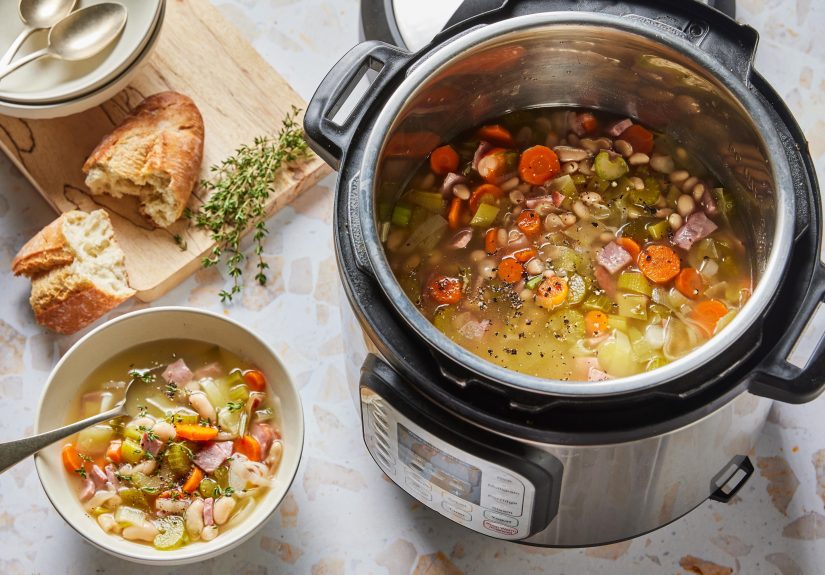
Say your favorite slow cooker beef stew recipe calls for browning chuck roast, then cooking it on Low for 8 hours with onions, carrots, potatoes, broth, tomato paste, and herbs.
To make that in the Instant Pot as a slow cooker:
- Use Sauté to brown the beef and soften the onions.
- Deglaze the pot with a splash of broth so all the flavorful bits lift off the bottom.
- Add the remaining stew ingredients.
- Cover with a glass lid or use the standard lid in the correct vented setup for your model.
- Choose Slow Cook Normal or the closest equivalent to Low.
- Cook for about 8 hours, then test the meat. If it is not fork-tender yet, add another 30 to 60 minutes.
If you want a thicker stew at the end, switch back to Sauté for a few minutes or stir in a cornstarch slurry. This is one of the nicest parts of the Instant Pot system: you can brown, simmer, and finish in the same vessel without turning the sink into a side quest.
Is an Instant Pot a Perfect Slow Cooker Replacement?
For some cooks, yes. If you want one appliance that can handle multiple cooking methods, an Instant Pot is a strong kitchen multitasker. It can absolutely make slow-cooked meals, and once you learn its quirks, it becomes a convenient substitute.
But if you only care about classic slow cooking and do it several times a week, a dedicated slow cooker is still simpler and more intuitive. It is built specifically for that one job. The Instant Pot is more like the overachiever who is good at everything but still needs clear instructions.
So the honest answer is this: the Instant Pot can work beautifully as a slow cooker, but success comes from understanding the appliance instead of assuming it behaves exactly like the old ceramic crock on your counter.
Real-World Experiences Using an Instant Pot as a Slow Cooker
In real kitchens, the experience of using an Instant Pot as a slow cooker usually begins with optimism, followed by mild confusion, followed by a breakthrough meal that makes everything click. The first attempt is often something like chili or shredded chicken. A cook loads the pot in the morning, presses Slow Cook, and walks away feeling very efficient. Then dinner time arrives and the ingredients are technically cooked, but not quite in that rich, fall-apart, “my house smells amazing and my decisions are excellent” way a traditional slow cooker can deliver on autopilot.
That moment is not failure. It is orientation.
Once people realize the Instant Pot slow cook function likes a little help, the entire experience improves. Browning onions first adds depth. Searing beef before the long cook makes stew taste fuller. Bringing the ingredients up to heat with Sauté before switching modes can make the difference between “pretty good” and “wow, this actually works.” After that first adjustment, the machine starts to feel far less mysterious.
Another common experience is falling in love with the convenience of the stainless steel insert. Traditional slow cookers often make you choose between a separate skillet for browning and the crock for the long cook. The Instant Pot lets you do both in one place. That means fewer dishes, fewer transfers, and fewer opportunities to splash braising liquid on your shirt ten minutes before work. In household terms, this is called progress.
There is also a confidence curve. The more often someone uses the Instant Pot as a slow cooker, the more personal their timing becomes. They learn that their favorite pot roast needs an extra 45 minutes. They figure out that beans do better with a hotter setting. They discover that creamy soups should be finished late, not started early. This is the part where the appliance stops being a gadget and starts becoming a tool you actually know how to use.
Some cooks end up using the Instant Pot as their weekday slow cooker and keeping a dedicated slow cooker for holidays, parties, or giant batches of meatballs. Others go all in and never look back because the convenience of one machine outweighs the learning curve. And some decide that while the Instant Pot is excellent for pressure cooking, they still prefer the pure simplicity of a classic slow cooker for all-day braises.
All of those experiences are valid. What matters is that the Instant Pot can absolutely handle slow-cooked meals when you work with it instead of against it. The best experience usually comes from small adjustments, not kitchen heroics: choose the right lid, use the right setting, start with enough liquid, and do not be afraid to finish with Sauté. Once that rhythm clicks, the appliance becomes a reliable way to make soups, stews, shredded meats, beans, and sauces with the kind of low-effort comfort that slow cooking is famous for.
And honestly, that may be the most relatable kitchen victory of all: learning that dinner did not need a brand-new appliance, just a better understanding of the one you already own.
Conclusion
If you have been wondering how to use an Instant Pot as a slow cooker, the answer is simple once you know the rules. Use the right slow cook setting, vent appropriately, give the pot enough liquid, and do not hesitate to start with Sauté for better flavor and faster heat. With those adjustments, your Instant Pot can handle many of the same cozy, make-ahead meals that a traditional slow cooker does.
It may not be an identical replacement in every recipe, but it is absolutely capable. Learn the personality, test a couple of favorites, and soon enough your Instant Pot will be making tender stews, saucy chicken, and all-day comfort food like it has been doing it for years. Which, to be fair, is exactly the kind of kitchen confidence we are all after.