Table of Contents >> Show >> Hide
One day your backyard tree is throwing perfect shade over the patio, and the next it looks like something
out of a spooky movie. Is it dead, just stressed, or dramatically “resting” like a teenager on a Saturday
morning? Knowing how to tell if a tree is dead isn’t just a matter of curiosityit’s a big deal for your
safety, your house, and your wallet.
Arborists and university extension services across the United States all say the same thing: don’t guess
with trees. A dead or dying tree can drop branches or topple in a storm, causing serious damage. The good
news? You can pick up a lot of tree-detective skills just by learning a few simple signs and tests.
In this guide, we’ll walk through six major warning signs that a tree may be dead, how to tell the difference
between dead and dormant, and when it’s time to bring in a professional arborist. No botany degree required
just your eyes, your hands, and maybe a small pocket knife for a classic “scratch test.”
Before You Start: Safety First
Before you get too up-close and personal with your tree, take a quick safety check:
- Look up for large hanging branches (“widow-makers”) that could fall.
- Avoid climbing a tree that you suspect is dead or badly decayed.
- Stay away from trees leaning over homes, power lines, or play areas.
If anything about the tree looks immediately dangerousbig cracks, fresh major lean, mushrooms at the base
of a huge treeskip the DIY level and call a certified arborist for an inspection.
The 6 Biggest Signs a Tree Might Be Dead
1. The Scratch Test Shows No Green
The “scratch test” is one of the simplest ways to check if parts of your tree are still alive. Many extension
services and tree-care companies recommend it as a first step when a tree fails to leaf out or looks suspicious.
How to do a scratch test:
- Pick a small twig or young branch about the width of a pencil.
- Use your fingernail or a small knife to gently scrape away a thin strip of outer bark.
- Look at the tissue underneath.
Healthy wood just under the bark (the cambium) should be moist and green or greenish-white. If it is brown,
dry, and brittle, that section of the tree is dead. Don’t stop at one twig, thoughtrees can have individual
dead branches while the rest is still alive. Test several twigs around the canopy.
If most or all of the twigs you test are dry and brown under the bark, especially on different sides of the
tree, that’s a strong sign the whole tree may be dead.
2. No Leaves or Buds During the Growing Season
A bare tree in January is just living its best winter life. A bare tree in late spring, when every neighbor’s
maple is in full leaf, is a red flag.
Arborists often look at the canopy first: is it full, thin, or completely bare? A tree that fails to leaf out,
or that only produces leaves on a few branches, may be severely stressed, diseased, or dead in sections.
Things to look for:
- Total leaf failure: If the tree has no leaves at all during your area’s normal growing season
(and it’s not a species that leafs out very late), it may be dead. - Patchy canopy: Big bare sections, especially toward the top of the tree, suggest dieback,
disease, or root problems. - No visible buds: Healthy deciduous trees form buds before leaf-out. If twigs lack buds or
the buds are dry and crumbly, the tree may be in serious trouble.
When in doubt, compare your tree to others of the same species in your neighborhood. If all the oaks on the
block are fully leafed out and yours still looks like a stick figure, that contrast tells you a lot.
3. Brittle, Dead Branches and Thinning Crown
Dead branches don’t bend; they snap. Tree-care experts often comb through the crown (top of the tree) looking
for limbs that are dry, brittle, and leafless while the rest of the tree is still trying to grow.
Signs of trouble in the branches:
- Small twigs that snap off easily with no flexibility.
- Dead branches concentrated in the upper crown.
- Lots of fallen dead branches around the base of the tree.
- A noticeably thinner canopy year after year.
Some deadwood is normal, especially in older trees. But if more than about a quarter to a third of the crown
is dead, that’s beyond “normal aging” and into “please have an arborist look at this” territory. Large dead
limbs high in the canopy are also a safety hazard, even if the trunk is still alive.
4. Peeling Bark, Deep Cracks, and Trunk Wounds
Think of bark as the tree’s skin. It protects the living tissue underneath from pests, diseases, and weather.
When big sections of bark peel away or crack deeply, they can expose the inner wood and signal serious stress
or decay.
Tree-care organizations and extension services list these trunk symptoms as common red flags:
- Peeling or missing bark that doesn’t grow back over time.
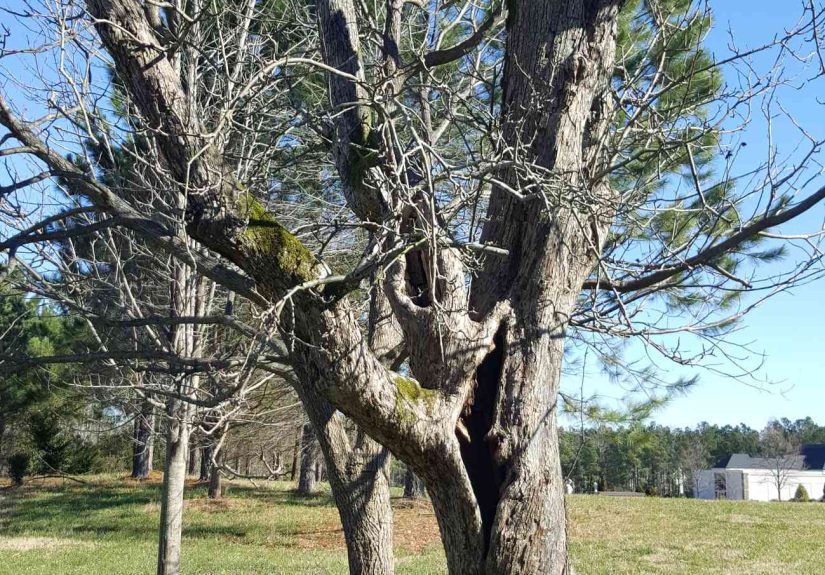
- Vertical cracks running along the trunk.
- Cavities or hollows where wood is missing.
- Oozing sap, dark stains, or sawdust (which may indicate insects or internal decay).
Not every trunk wound means the tree is doomedtrees can seal over damage by forming “wound wood” around the
edges. But when wounds are large, not closing, or associated with soft, crumbly wood, decay may be spreading
inside the trunk. That decay can weaken the tree’s structure even if some parts are technically still alive.
5. Fungi, Mushrooms, and Soft, Decaying Wood
Mushrooms are lovely on pizza, less lovely at the base of a large tree next to your house. Many arborists
list fungal growth as one of the strongest clues that a tree has internal decay or serious root problems.
Watch for:
- Bracket fungi or conks (those shelf-like mushrooms) growing from the trunk or main branches.
- Mushrooms at the base of the tree, especially recurring in the same spot year after year.
- Soft, spongy, or crumbly wood when you gently press or probe around decayed areas.
Fungi feed on dead or dying wood. By the time you see big fruiting bodies on the trunk, there is often
significant internal decay that you can’t see. That doesn’t always mean the tree is already dead, but it
usually means its structural strength is compromised and it needs professional evaluation.
6. Leaning, Heaving Soil, and Root Problems
A tree with a dramatic new lean is like a dog suddenly walking on three legsit’s trying to tell you something
is very wrong.
Tree-care companies and extension services warn that a sudden lean, especially after storms or in wet soils,
often points to failing roots or unstable soil.
Look closely at the base of the tree:
- Soil that is cracked or heaving on one side of the trunk.
- Exposed, broken, or decayed roots.
- Large sections of bark missing near the root flare.
If the tree is leaning more than about 15 degrees from vertical and it wasn’t always like that, it may be at
risk of failing. Combine that with mushrooms at the base or soft, decayed wood, and you’re firmly in “call an
arborist immediately” territory.
Dead or Just Dormant? How to Tell the Difference
One of the trickiest questions homeowners face is whether a leafless tree is dead or simply dormant. This comes
up a lot after harsh winters, late spring frosts, or droughts.
Use these steps to sort it out:
Check the Calendar and the Species
Some trees naturally leaf out later than others. Oaks and hickories, for example, are often slower than maples
or ornamental cherries. If your tree is one of the late-bloomers, give it a little extra time compared with
other species in the yard.
Combine the Scratch Test with Bud Checks
As university horticulture experts suggest, scrape a twig to look for green tissue and also cut a bud open.
A healthy bud should be moist and green inside; a dead one will be dry and brown.
If both the cambium and buds are dead on many branches, especially across the whole tree, that’s a strong sign
it’s more than just slow to wake up.
Look for New Growth Low on the Trunk
Sometimes you’ll see vigorous shoots sprouting from the base of a tree while the upper canopy is bare. That
often means the top has died back or is dying, but the root system is still sending up new shoots. The tree
isn’t completely dead, but it may be severely compromised or no longer structurally sound.
When to Call an Arborist
You don’t have to call in a pro every time a twig snaps, but there are situations where expert help is worth
every penny:
- The tree is large and close to your home, power lines, or public spaces.
- You see mushrooms, big trunk cavities, or extensive peeling bark.
- The tree has started leaning or the soil at the base looks lifted or cracked.
- More than a quarter of the canopy looks dead or bare.
Certified arborists use formal inspection methods to assess tree risk and can recommend whether your tree can
be treated, pruned for safety, or should be removed.
Practical Tips to Help Trees Stay Alive Longer
While this article focuses on spotting a dead tree, a lot of problems are preventable with basic care:
- Water deeply, not constantly: Long, occasional soakings are better than frequent shallow
sprinkles, especially during drought. - Mulch smart: A 2–3 inch layer of mulch around (but not touching) the trunk helps keep roots
cool and moist. - Avoid “volcano mulching”: Piling mulch against the trunk can cause rot and invite pests.
- Prune with purpose: Remove dead, damaged, and rubbing branches, but avoid severe topping, which
can stress trees and lead to weak regrowth. - Protect the root zone: Limit heavy traffic, construction, and soil compaction under the canopy.
Healthy trees handle storms, pests, and disease betterand you spend less time asking, “Is this thing dead?”
Real-World Experiences: What Homeowners Learn From “Mystery Trees”
Tree problems rarely show up like a clear on/off switch. Most of the time, people notice a small change, shrug
it off, and only later realize the tree has been quietly declining for years. Here are some common real-world
scenarios and what they teach us about spotting a dead or dying tree early.
The “I Thought It Was Just Late” Maple
A typical story starts like this: a homeowner notices that one maple in the front yard is slower to leaf out
than the others. At first it seems harmless“Maybe it’s just behind schedule this year.” But by June, only a
few sad leaves cling to the lower branches, and the top half of the tree is completely bare.
When someone finally does a scratch test on several twigs, everything above a certain height is brown and dry.
A closer look reveals peeling bark on the trunk and a few discreet mushrooms at the base. In hindsight, the
signs were all there months earlier: thinning canopy, smaller leaves, and more dead branches after every
storm.
Lesson learned: If one tree of the same species is noticeably behind its neighbors every year,
that’s not just “personality”it may be chronic stress or disease. Comparing trees side by side is one of the
easiest DIY diagnostics you can do.
The Storm Survivor That Wasn’t
Another common story: a major storm blows through, and a large backyard tree ends up leaning a little more
than it used to. It’s still standing, so the owner assumes it “survived.” Over the next year or two, more
branches die, the lawn around the base stays wet and squishy, and mushrooms pop up along one side of the root
flare.
When an arborist finally gets called, they find that the roots on one side failed during the storm. The tree
didn’t fall that day, but the compromised roots slowly decayed. Now the tree is structurally unsound, even
though it still has some green leaves.
Lesson learned: A tree that leans after a stormor shows heaving soil and exposed rootsdeserves
a professional checkup, even if it’s still leafing out. Structural problems often show up below ground or inside
the trunk long before the canopy looks “dead.”
The “Half-Alive” Yard Tree
In many neighborhoods, you can spot a tree that looks like a mullet haircut: party at the bottom, business is
definitely over at the top. New shoots sprout from the base or lower trunk, but the upper crown is mostly
bare, with dead branches pointing at the sky.
Homeowners sometimes assume this means the tree is “coming back,” but in reality, those basal shoots are
usually a stress response. The tree is redirecting energy to whatever tissue is still alive, often below a line
of disease, decay, or insect damage higher up the trunk.
Lesson learned: Green growth alone doesn’t mean a tree is safe. Where the green growth appears
(only at the base vs. all through the crown) is just as important.
Why Early Detection Matters
The big takeaway from these experiences is that trees almost never fail “out of nowhere.” Long before a trunk
snaps or a massive limb breaks, you can usually spot warning signs: thinner foliage, more deadwood, peeling bark,
fungus, or small changes in the tree’s posture.
Catching these signs early does two things for you:
- It gives you more optionssometimes pruning, watering adjustments, or treating a disease can stabilize a tree
that isn’t too far gone. - It helps you planif removal is inevitable, you can schedule it on your terms instead of during a 3 a.m.
emergency call after a storm.
Once you know how to read the cluesscratch tests, leaf patterns, bark condition, fungi, and root issuesyou go
from guessing about your trees to making informed decisions. And that means a safer yard, healthier trees, and
fewer surprises when the wind picks up.
Conclusion
Learning how to tell if a tree is dead is mostly about observation and a few simple tests. No single sign is
perfect on its own, but when you combine the scratch test, canopy health, bark condition, fungal growth, and the
stability of the trunk and roots, you get a pretty reliable picture of your tree’s true condition.
When something feels offbare branches in June, new lean, mushrooms at the basetrust that instinct and take a
closer look. If the signs suggest serious decay or structural problems, call a certified arborist. Trees add
beauty, shade, and value to your property, but only as long as they’re safe and healthy. Once they’re dead or
too far gone, the kindest thing you can do for your yard (and your roof) may be to let them go.