Table of Contents >> Show >> Hide
- Step 1: Make a Backyard Beehive Plan (Rules, Budget, and Expectations)
- Step 2: Choose the Right Hive Location (Neighbors, Sun, Water, and Safety)
- Step 3: Get the Right Gear and Bees (Then Install Them Smoothly)
- Step 4: Learn Simple Inspections and Keep Your Hive Healthy (Especially Against Varroa)
- Step 5: Harvest Honey Responsibly and Prepare for Winter
- Conclusion: Your Backyard Hive Can Thrive (If You Keep It Simple and Consistent)
- Real-World First-Year Experiences ( of “Yep, That Happened”)
Starting a backyard beehive is a lot like getting a tiny, winged livestock operation… except the livestock can fly,
make their own snacks, and occasionally remind you that you’re not the queen.
The good news: you don’t need a farm, a beard, or a medieval hat to keep honey bees successfully.
You do need a plan, a little patience, and a willingness to learn new words like “brood,” “super,” and “varroa”
without sounding like you’re casting a spell.
This guide breaks backyard beekeeping into five genuinely simple stepssimple as in “you can do it,” not as in
“nothing will ever surprise you.” (Spoiler: bees love surprises.) We’ll cover what to check before you buy anything,
how to set up a hive so your neighbors stay friendly, how to install bees without panic-sprinting across the lawn,
and how to keep your colony healthy through the first year so you actually get the fun parts: watching them work,
helping pollinators, andeventuallyharvesting honey responsibly.
Step 1: Make a Backyard Beehive Plan (Rules, Budget, and Expectations)
Before you fall in love with a cute hive on the internet, do the “adulting” part first: confirm that you’re allowed
to keep bees where you live, and decide what “success” looks like for year one.
Your goal for the first season is usually not a pantry full of honeyit’s a healthy colony that survives winter and
becomes stronger next spring.
Check local rules (yes, really)
Backyard beekeeping is regulated differently depending on where you live. Cities may have rules about how many hives
you can keep, how far they must be from property lines, and whether you need a water source or a “flyway barrier”
(a fence/hedge that makes bees fly up and away from people). Some states also require apiary registration.
Translation: spend 20 minutes now so you don’t spend 20 days later arguing with paperwork.
Decide: one hive or two?
Many beginners start with one hive, and that’s perfectly fine. Starting with two can make learning easier because you
can compare colony strength and brood patterns side-by-side. The downside is cost, time, and twice the opportunities
to say “why are you doing that?” to insects who cannot hear you.
Pick a hive style you can manage
- Langstroth hive: the most common in the U.S., easy to find parts, lots of learning resources.
- Top-bar or other styles: can be great, but make sure local mentors/resources match your setup.
Budget realistically (so you don’t rage-quit in July)
A basic starter setup often costs a few hundred dollars once you include hive boxes, frames/foundation, a hive stand,
protective gear, a smoker, feeders, and bees. You can reduce costs by buying used woodenware (with caution) or
joining a local beekeeping club for group orders. But don’t skimp on safety gear. Confidence is wonderful; a full-face
sting is… educational.
Step 2: Choose the Right Hive Location (Neighbors, Sun, Water, and Safety)
Your bees will adapt to a lot, but smart placement makes everything easier: calmer colonies, happier neighbors,
fewer “why are bees in my kiddie pool?” texts, and less stress during inspections.
What a great backyard beehive spot looks like
- Morning sun: helps bees get flying earlier and keeps the hive drier.
- Some wind protection: a fence, shrubs, or a structure can cut down on chill and drifting.
- Good drainage: avoid low, soggy areas where moisture lingers.
- Easy access for you: you’ll carry boxes, tools, feeders, and (eventually) honey.
Direct the flight path up and away
If your hive entrance faces a busy walkway, patio, or your neighbor’s “I meditate here” spot, you’re asking for drama.
Instead, point the entrance toward a fence, hedge, or wall so bees lift their flight path above head level.
This is one of the simplest ways to keep bees and humans out of each other’s business.
Provide water before they “choose” a water source for you
Bees need water for cooling the hive and feeding larvae. If you don’t provide it, they’ll find itoften in places that
annoy people. Set out a shallow water source near the hive with landing spots (pebbles, corks, floating wood).
Refresh it regularly. The goal is “convenient for bees,” not “bee spa resort at your neighbor’s birdbath.”
Reduce pesticide risk (and improve forage)
A backyard hive thrives when there’s steady nectar and pollen nearby. Plant bee-friendly flowers, keep a variety of
bloom times, and avoid spraying insecticidesespecially when plants are flowering or bees are actively foraging.
If you hire lawn care, ask what they apply and when. “Bee-safe” labels are nice; “no spray during bloom” is nicer.
Step 3: Get the Right Gear and Bees (Then Install Them Smoothly)
This step is where your dream becomes a real box of buzzing reality. There are two big decisions: what equipment you
need to start, and what type of bees you’re bringing home.
Beginner beekeeping equipment checklist
- Hive components: bottom board, hive bodies (brood boxes), frames, foundation, inner/outer cover
- Hive stand: keeps the hive off damp ground and makes inspections easier
- Protective gear: veil (non-negotiable), gloves (optional over time), jacket/suit
- Tools: smoker + fuel, hive tool, brush (or gentle feather), frame grip (optional)
- Feeding setup: in-hive feeder or jar feeder, plus sugar for syrup
Choose how you’ll start your colony: nuc vs. package
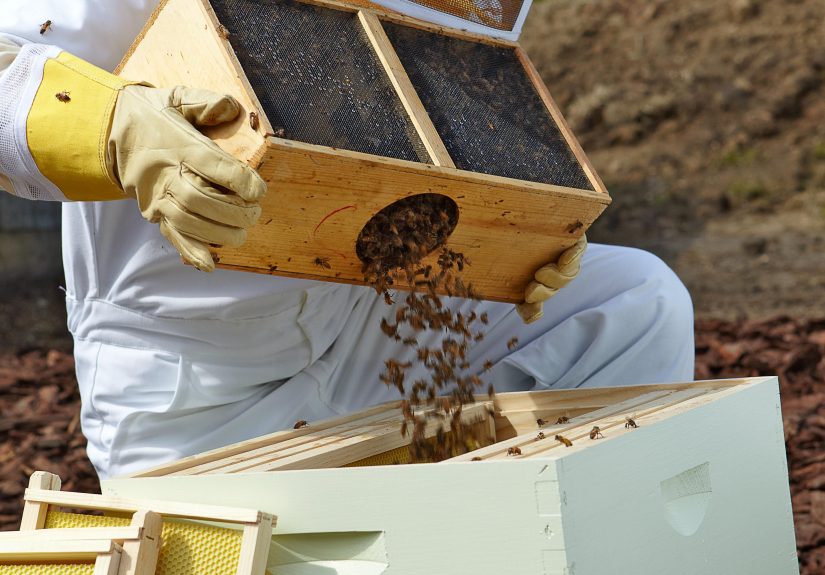
Most beginners do best with a nucleus colony (nuc) because it comes with drawn comb, brood in various stages,
food stores, and a laying queenbasically a colony with momentum. A package is a box of bees plus a caged queen,
and they have to build everything from scratch. Packages can work well, but they typically require more feeding and
patience while the colony gets established.
When to order and when to install
In many regions, people order bees in winter for spring pickup because popular suppliers sell out.
Installation usually happens when the weather is reliably warm and local plants are starting to bloom.
If you’re not sure, your local beekeeping association or extension office can help you time it to your area.
Installation day: keep it calm and simple
Pick a mild day with low wind if possible. Have your hive assembled and level before the bees arrive.
Install the bees, then feed if needed. New colonies often benefit from spring feeding (commonly a 1:1 sugar-water mix)
to help them draw comb and avoid starvation during bad weather stretches. Keep entrances reduced if robbing is a concern
and avoid leaving syrup exposed.
Beginner reality check: The first install feels intense because you’re doing it for the first time.
The bees? They’re mostly focused on “Where’s home?” and “Who moved my queen?”
Work smoothly, don’t rush, and remember: confident motions beat frantic ones.
Step 4: Learn Simple Inspections and Keep Your Hive Healthy (Especially Against Varroa)
This is the step that separates “cute backyard project” from “healthy, thriving colony.”
Honey bees don’t usually fail because the keeper didn’t love them enough.
They fail because problems weren’t noticed earlyespecially varroa mites, the #1 stressor behind many colony losses.
A simple inspection schedule for beginners
In the active season, many new beekeepers inspect about once a week or every other week.
You’re looking for big-picture signals, not perfection.
What to look for during a basic hive inspection
- Eggs and young larvae: tells you the queen was recently laying (even if you don’t see her)
- Brood pattern: a solid pattern usually indicates good queen performance
- Food stores: nectar/honey and pollencolonies can starve faster than you think
- Space: are they crowded and needing another box, or still building out frames?
- Temperament: cranky can mean weather, nectar dearth, or a colony issuenote patterns over time
Varroa mites: monitor, don’t guess
Varroa management isn’t optional in most of the U.S. The key is to measure mite levels rather than relying on vibes.
Common sampling methods include alcohol wash and powdered sugar roll. Many extension services consider alcohol wash the
most reliable option for monitoring adult bee infestation levels.
If mite levels are above recommended thresholds for your region and season, use an approved treatment strategy and
follow the label. Treatments vary by temperature range and whether honey supers are on the hive.
If that sentence made your eyes cross, you’re not alonethis is exactly why local mentors and extension guides are gold.
Feeding and “when to stop”
Feeding is a tool, not a lifestyle. In spring, syrup can help draw comb and prevent starvation when weather blocks
foraging. Many beekeepers stop routine feeding once the colony has enough comb built and a natural nectar flow is on,
and they avoid feeding when honey supers are installed for harvest.
Keep your backyard hive “neighbor-proof”
- Work the hive when neighbors aren’t hosting a party next door.
- Keep a water source available all season.
- Maintain that flyway barrier (fence/hedge) if your yard is tight.
- Be the kind of beekeeper people like: calm, tidy, and not leaving sticky equipment around.
Step 5: Harvest Honey Responsibly and Prepare for Winter
Here’s the part everyone daydreams about: honey. But harvesting too early or too aggressively can set a young colony
backor even doom it. Think of your first year as “establish the household,” and your second year as “throw the honey party.”
When can you harvest honey?
Many new colonies don’t produce surplus honey their first year, especially if they started as a package and had to
build comb. If they do make surplus, only harvest from honey supers, and only when frames are mostly capped.
The brood boxes are the bees’ pantry for winter; your job is to avoid taking what they need to survive.
How much honey should you leave?
The amount depends on climate, hive size, and winter length. As a general beginner guideline, beekeeping educators
often describe leaving substantial storescommonly the equivalent of roughly a full deep box of honey in colder regions,
or a range of tens of pounds per brood box depending on local conditions.
Your local extension or beekeeping club can give you a target that matches your area.
Simple winter prep checklist
- Confirm colony strength: a healthy queen and a good population going into fall
- Monitor and manage mites: low mite loads dramatically improve winter survival odds
- Make sure stores are adequate: feed if needed to reach winter weight targets
- Reduce moisture and drafts: ventilation and weatherproofing matter more than people think
- Secure the hive: straps if winds are strong; keep the lid tight
A quick “first-year timeline” example
- Spring: install bees, feed as needed, build comb, add brood box when ~80% of frames are drawn
- Early summer: manage space, monitor mites, add honey super if colony is strong
- Late summer/fall: monitor mites again, treat if needed, ensure winter stores
- Winter: minimal disturbance, protect from moisture, plan for spring
Conclusion: Your Backyard Hive Can Thrive (If You Keep It Simple and Consistent)
Starting a beehive in your backyard isn’t about doing everything perfectlyit’s about doing the basics reliably:
follow local rules, set up a smart hive location, start with quality bees and safe equipment, inspect with purpose,
and take varroa monitoring seriously. If you do those things, your bees will do the rest of the magic:
building comb, raising young, storing food, and turning flower nectar into a jar of sunshine you can spread on toast.
Also: be kind to your future self. Join a local beekeeping association, read extension resources, and find a mentor.
Backyard beekeeping is easier when you can text someone, “Is this normal?” and get a reply that isn’t just
“Bzzzz.”
Real-World First-Year Experiences ( of “Yep, That Happened”)
If you ask a room full of beekeepers what their first season was like, you’ll hear the same theme over and over:
“I thought I was prepared… and then the bees taught me humility.” Here are a few first-year experiences that
beginners commonly reportshared here so you can recognize them early and respond like a calm beekeeper, not a
panicked raccoon.
1) The “They’re Ignoring My Water Source” phase
You set up a perfect little water stationpebbles, shallow tray, fresh refillsand the bees still choose the
neighbor’s pool like it’s a five-star resort. This usually happens because bees recruit each other to reliable
sources, and once they’ve “trained” on one spot, they keep returning. The fix is persistence: keep your water source
constant, add a tiny scent cue (like a pinch of salt or a drop of lemongrass essential oilvery sparingly and not as
a weekly perfume bath), and don’t remove it. Many beekeepers find that once a nearby source stays dependable, the bees
eventually switch. Also, floating corks are not decorationbees love an easy landing pad.
2) The “I can’t find the queen” spiral
New keepers often assume that every inspection must include spotting the queen, as if she’s a celebrity doing meet-and-greets.
In reality, she’s busy, and your job is to look for evidence: fresh eggs, young larvae, and a healthy brood pattern.
Plenty of successful beekeepers rarely see the queen directly. The first time you accept that “eggs = queen was here
recently,” your blood pressure improves noticeably.
3) The “Why are they so grumpy today?” surprise
Bees can be sweethearts one week and moodier the next. Beginners often learn that temperament isn’t only about the
beesit’s about weather, nectar flow, and timing. A thunderstorm rolling in, a sudden nectar dearth, or working the
hive at the wrong time of day can flip the vibe fast. Many first-year keepers learn to watch conditions:
warm, sunny, and calm tends to equal calmer bees. Cool, windy, or stormy tends to equal “maybe we do this tomorrow.”
4) The “Comb-building is slower than I thought” lesson
If you start with a package, comb building can feel painfully slow at first. Beginners sometimes worry the colony is
failing when it’s actually just doing the foundational workliterally. This is where feeding (when appropriate),
patience, and not opening the hive “just to check” every two days matters. Bees build faster when they’re not
constantly interrupted. It’s the insect version of “Please stop walking into the kitchen while I’m cooking.”
5) The “Mites are real” wake-up call
Many new beekeepers expect their biggest challenge to be stings or swarms. Then they learn that varroa mites are the
quiet problem that can snowball. The first year often includes a moment when a mentor says, “Let’s test,” and the
numbers are higher than expected. The experience is uncomfortablebut it’s also empowering. Once you begin monitoring
on a schedule and responding based on thresholds, you stop guessing and start managing. Your bees don’t need you to
be fearless; they need you to be consistent.
The best part of these first-year stories is what comes next: confidence. The second season feels dramatically
different because you’ve seen the patterns. You understand that a hive is a living systemone that rewards steady
attention and punishes panic. And at some point, you’ll catch yourself calmly doing something you once thought was
impossible, like pulling a frame covered in bees, noticing the brood pattern, and thinking, “Okay… I’ve got this.”
That’s when you officially become a beekeeper.