Table of Contents >> Show >> Hide
- What a Border Garden Is (and Why It Works So Well)
- Step 1: Pick the Right Spot (Sunlight Is the Boss Here)
- Step 2: Decide the “Vibe” and Choose a Color Strategy
- Step 3: Build the Border Like a Movie Cast (Anchors, Supporting Roles, Cameos)
- Step 4: Plan Plant Height (So Everyone Can Be Seen)
- Step 5: Aim for Season-Long Color (Not a Two-Week Fireworks Show)
- Step 6: Prepare the Bed (Because Plants Have Standards)
- Step 7: Lay Out Plants Before You Dig (This Is Your Free Redo)
- Step 8: Plant Correctly (Depth Matters More Than Pep Talks)
- Step 9: Mulch and Water (The Two Habits That Make You Look Like a Pro)
- Two Sample Border Plans You Can Steal (With Pride)
- Maintenance That Keeps Color Coming Back
- Troubleshooting: Fix the Most Common Border-Garden Problems
- Conclusion: Your Yard, But Make It Colorful
- Border-Garden “Field Notes”: Lessons Gardeners Learn the Fun Way (Extra Experiences)
- 1) The “one of everything” phase is real (and curable)
- 2) The mature-size reality check (a.k.a. “Why is this plant eating my walkway?”)
- 3) Color isn’t just flowersfoliage saves the border between bloom waves
- 4) Watering the first season is the difference between “established” and “stressed”
- 5) Borders love a “mid-season haircut”
- 6) The best borders are edited borders
A border garden is the landscaping equivalent of a great haircut: it frames everything, makes the whole yard look more put-together,
and somehow convinces people you “really have your life together” (even if your junk drawer says otherwise).
Done right, a flower border delivers color for months, softens hard edges like fences and foundations, and gives pollinators a daily reason to show up.
This guide walks you through planning, prepping, planting, and keeping a border garden looking vibrantwithout turning your weekends into a full-time weeding internship.
What a Border Garden Is (and Why It Works So Well)
A border garden is a planting bed that runs along an edgethink driveway, walkway, fence line, patio, or the front of your house.
Unlike an “island bed” (viewed from all sides), a classic border usually has a clear front and back, which makes it easier to create layers: short plants up front, tall plants in the back.
The result is a tidy, intentional look that reads as “designed,” even if you built it in sneakers and mild panic.
Border gardens also shine because they’re naturally organized: the edge gives you a built-in boundary, and the long shape is perfect for repeating colors and plant groups
so the bed looks cohesive rather than like a plant adoption center.
Step 1: Pick the Right Spot (Sunlight Is the Boss Here)
Before you buy a single plant, watch the light. Most flowering plants want at least 6 hours of sun (often labeled “full sun”),
while many shade favorites prefer 3–4 hours or filtered light (“part shade”).
A border that gets blazing afternoon sun will behave very differently than one tucked under trees.
Quick site checklist
- Sun: Note morning vs. afternoon sun and any big shade changes.
- Water: Do you have a hose nearby? Does rainwater collect there?
- Visibility: Where will you see it mostfront door, kitchen window, sidewalk?
- Space: A narrow 2–3 foot border can still be gorgeous; wider borders allow richer layering and longer bloom sequences.
Step 2: Decide the “Vibe” and Choose a Color Strategy
Color is where border gardens go from “nice plants” to “wow, what is happening here?”
The trick is to choose a simple color plan and repeat itbecause repetition reads as design.
You can absolutely break rules later, but starting with a plan keeps the border from becoming visually chaotic.
Three easy color schemes that rarely disappoint
- Analogous (harmonious): Colors next to each other on the wheellike pink/purple/blue or yellow/orange/red.
This feels smooth and “flowy.” - Complementary (high impact): Opposites on the wheellike purple/yellow or orange/blue.
This pops from the curb (and from across the street). - Monochromatic (elegant): One main color in multiple shadeslike white with cream and pale yellow, or lavender through deep purple.
Texture and foliage do a lot of the heavy lifting here.
Pro tip: treat green foliage as your “background paint.” Flowers come and go, but foliage is there all season.
Varied leaf shape (spiky, rounded, feathery) and leaf color (chartreuse, burgundy, blue-green) can make the border look colorful even between bloom waves.
Step 3: Build the Border Like a Movie Cast (Anchors, Supporting Roles, Cameos)
Great borders usually have three layers of structure:
anchors (plants that hold the design together), seasonal performers (the long-blooming stars),
and accents (short bursts of drama).
1) Anchors (structure)
Anchors are often small shrubs, dwarf evergreens, or ornamental grasses. They give your border shape when flowers aren’t blooming
and help it look intentional in early spring and late fall.
2) Seasonal performers (the color workhorses)
These are your reliable perennials and long-blooming annualsthe plants that carry color week after week.
Think salvias, coneflowers, coreopsis, black-eyed Susans, catmint, zinnias, and cosmos (choose according to sun/shade).
3) Accents (the fun extras)
Accents include bulbs (spring fireworks), a few bold annuals, or plants with standout foliage.
Used sparingly, accents keep the border from feeling flat. Used everywhere, accents become… a lot.
Step 4: Plan Plant Height (So Everyone Can Be Seen)
A classic border is designed from short to tall: low plants along the edge, medium in the middle, tall in back.
This layering creates depth and prevents your favorite blooms from being swallowed by taller neighbors.
If your border is visible from both sides (like along a path), put tall plants in the center and step down to shorter plants on both edges.
Simple height guideline
- Front edge: 6–18 inches (groundcovers, low perennials, compact annuals)
- Middle: 18–36 inches (most flowering perennials live here)
- Back: 3–6+ feet (tall perennials, grasses, shrubs)
Design trick that instantly improves most borders: plant in groups of 3–7 (or more for small plants) instead of one-and-done singles.
Drifts and repeats look calmer, fuller, and more “designer.”
Step 5: Aim for Season-Long Color (Not a Two-Week Fireworks Show)
Many perennials bloom hard and then bow out. That’s normalplants aren’t obligated to perform 365 days a year.
Your job is to stagger bloom times so something is always stepping up.
A simple three-season plan
- Spring: bulbs (daffodils, tulips), early perennials (bleeding heart, creeping phlox), flowering shrubs
- Summer: long bloomers (salvia, coneflower, daylily, coreopsis), annuals for continuous color
- Fall: asters, sedum/stonecrop, ornamental grasses, mums (plus seed heads for birds)
If you want color without constant replanting, mix mostly perennials with a few annual “fillers” the first year while perennials size up.
Borders often look better in year two and year three because plants knit together and fill space.
Step 6: Prepare the Bed (Because Plants Have Standards)
You can plant into tough soil and hope for the best, but preparing the bed is how you get healthier plants, better blooms, and fewer headaches.
Think of it like making the bed before guests arrivesure, you could skip it, but you’ll feel it in your soul.
Remove turf and define the edge
Mark the border shape with a hose or rope, then remove sod/grass. A crisp edge makes the whole border look cleaner and helps keep grass from creeping in.
Loosen soil and add organic matter
Loosen the soil (even if you’re not tilling deeply) and mix in compost or well-rotted organic matter.
A common approach is adding roughly 2–3 inches of compost over the bed area and working it into the top layer.
The goal is better structure, better drainage, and better moisture retentionbasically, soil that behaves like it wants plants to live there.
Consider a soil test (especially if plants struggle in your yard)
A soil test can tell you pH and nutrient needs so you’re not guessing. If your hydrangeas look grumpy or your flowers bloom like they’re rationing petals,
testing can save you time and money.
Step 7: Lay Out Plants Before You Dig (This Is Your Free Redo)
Set plants (still in their pots) on top of the prepared bed and arrange them until it looks right.
Walk to the spots you’ll view it from: the sidewalk, driveway, front window. Take a quick photophotos reveal awkward gaps and “why is that neon plant screaming?”
Spacing that prevents future regret
- Follow mature width on the plant tag, not the “cute baby plant” size you see today.
- Leave airflow between plants to reduce disease and make maintenance easier.
- Repeat key plants every few feet so the border feels unified.
Step 8: Plant Correctly (Depth Matters More Than Pep Talks)
- Water plants in their pots before planting if they’re dry.
- Dig a hole about as deep as the root ball and wider than the pot.
- Set the plant so the top of the root ball sits level with (or slightly above) surrounding soil.
- Backfill gently, firming lightly to remove air pocketsdon’t compact it like you’re building a patio.
- Water deeply after planting to settle soil around roots.
If you’re planting shrubs or small trees as anchors, pay close attention to depthplanting too deep is a common reason woody plants struggle.
Step 9: Mulch and Water (The Two Habits That Make You Look Like a Pro)
Mulch
Apply a 2–3 inch layer of organic mulch across the bed to help hold moisture and reduce weeds.
Keep mulch pulled back from plant stems and trunks so you’re not creating a damp collar that encourages rot and pests.
Water
For the first growing season, consistent watering is the difference between “thriving border” and “why is everything crispy?”
Many gardens do well with roughly an inch of water per week (rain plus irrigation), but adjust for your soil type, heat, and rainfall.
Water deeply and less often rather than frequent light sprinklesroots learn to go down instead of hovering at the surface like they’re afraid.
Two Sample Border Plans You Can Steal (With Pride)
Plan A: Sunny “Hot Colors” Border (bold, cheerful, pollinator-friendly)
- Back (structure): switchgrass (Panicum), dwarf shrub rose, or a compact evergreen
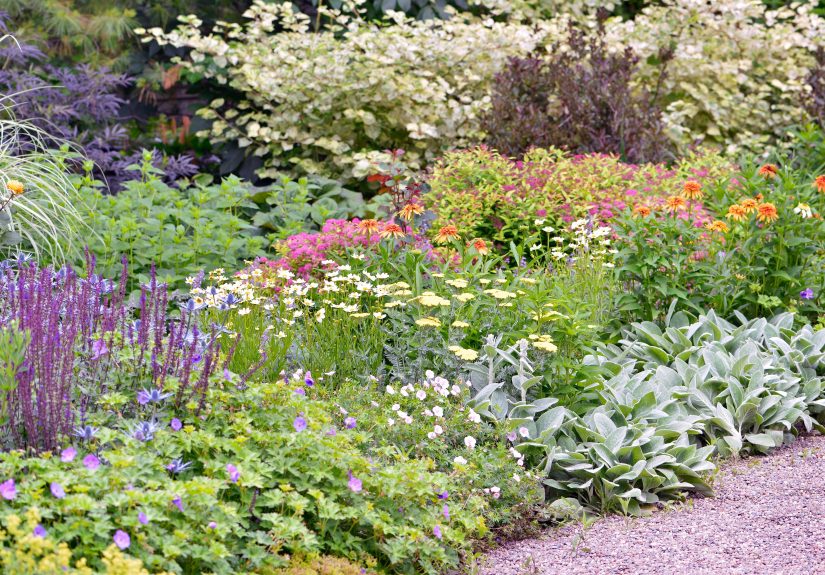
- Middle (main bloom): salvia (blue/purple spikes), coneflower (pink/purple), coreopsis (yellow), black-eyed Susan (gold)
- Front (edge softeners): creeping thyme, catmint, low sedum, or hardy geranium
- Accents: alliums in spring; zinnias or dahlias for summer color bursts
Why it works: warm colors energize the border, blues/purples keep it from feeling like a traffic cone, and repeated plant groups make it look planned.
Plan B: Shade “Cool + Foliage” Border (calm, elegant, low-glare)
- Back (structure): hydrangea (choose types suited to your region), or a small ornamental tree
- Middle (texture + bloom): hosta (leaf power), astilbe (feathery blooms), heuchera (colorful foliage)
- Front (ground layer): ferns, ajuga, lamium, or sweet woodruff
- Accents: spring bulbs where light allows; pops of white flowers to brighten shade
Why it works: shade borders win on texture and leaf color. Flowers come in waves, but foliage keeps the border interesting all season.
Maintenance That Keeps Color Coming Back
Deadhead (selectively)
Removing spent flowers can encourage some plants to bloom longer. But consider leaving some seed heads for winter interest and birds.
A “some deadheading, some wildlife” approach is a great middle path.
Weed early, mulch consistently
The first year is when weeds try to move in like they’re paying rent. Stay on top of them early, refresh mulch as it breaks down,
and you’ll dramatically reduce weeding later.
Divide perennials when they outgrow their space
Many perennials benefit from dividing every few years. If a plant blooms less, develops a dead center, or crowds neighbors,
it may be telling you it’s time to split and share (or expand your border… purely for the plant’s emotional well-being).
Troubleshooting: Fix the Most Common Border-Garden Problems
“My border looks messy.”
- Repeat fewer plant types in larger groups.
- Add a crisp edge or low edging plant to define the front.
- Include 1–3 anchor plants for structure.
“Something is always blooming… but it still looks dull.”
- Increase foliage contrast (chartreuse, burgundy, blue-green).
- Add a few bright accent plants in small doses.
- Use complementary color pairings (like purple + yellow) in repeating pockets.
“Plants keep dying.”
- Check sun exposure (too much shade for sun lovers is a slow heartbreak).
- Improve drainage with organic matter and proper bed prep.
- Water deeply during establishmentnew plants need consistency.
Conclusion: Your Yard, But Make It Colorful
Planting a border garden is part design project, part soil improvement, and part patience.
Start with the site and a simple color plan, layer plants by height, prep the bed well, and rely on repetition to create a polished look.
With smart plant choices and good early care, your border will reward you with color from spring through falland make the rest of your landscape look better by association.
Border-Garden “Field Notes”: Lessons Gardeners Learn the Fun Way (Extra Experiences)
Garden advice sounds wonderfully tidy on paperuntil real life enters the chat. Here are experience-based lessons many gardeners share after planting a border:
the little surprises, the “oops,” and the habits that quietly turn a good border into a great one.
1) The “one of everything” phase is real (and curable)
A common first-time border mistake is adopting single plants like you’re collecting souvenirs: one lavender, one daisy, one random red flower that was “on sale,”
one thing that looked like fireworks in the nursery. Individually, they’re fine. Together, they can look like a plant audition.
The fix is almost always the same: pick a few favorites and repeat them in groups. When gardeners go back and add two or three more of the same salvia or coneflower,
the border suddenly feels intentionallike it had a plan all along.
2) The mature-size reality check (a.k.a. “Why is this plant eating my walkway?”)
Plants grow. Bold statement, I know. But in year one, everything looks perfectly spaced because everything is tiny.
Then year two arrives with confidence. Daylilies widen, catmint flops, and that “compact” shrub turns out to be compact only in a very generous interpretation of the word.
Gardeners who end up happiest tend to do two things: (1) they actually check mature width before planting,
and (2) they leave a little breathing room near paths and edging so maintenance doesn’t become a daily shoulder squeeze.
If your border is already planted, the good news is that editing is normalmoving a plant in fall or early spring is practically a gardening rite of passage.
3) Color isn’t just flowersfoliage saves the border between bloom waves
Many gardeners notice this after the first big bloom: the border had a “wow” week… and then it felt flat.
That’s when foliage becomes the secret weapon. Adding a burgundy heuchera, a blue-green hosta, a silver lamb’s ear, or a grass with airy seed heads
keeps the border visually active even when fewer flowers are open. It’s also why “all one color of flowers” can still look rich if leaf shapes and textures vary.
In other words: leaves are not background extras. They’re the supporting cast that makes the star look better.
4) Watering the first season is the difference between “established” and “stressed”
Experienced gardeners often say the first season is all about roots. When new plants dry out repeatedly, they may survivebut they rarely thrive.
The border that gets deep, consistent watering early on typically fills in faster and blooms better the next year.
One practical habit that comes up again and again: after watering, gardeners poke a finger (or a trowel) a few inches into the soil to see if moisture actually reached root level.
Surface-wet soil can be misleading, especially in hot weather or windy sites.
5) Borders love a “mid-season haircut”
Some plantsespecially certain long-blooming perennialsbenefit from light trimming after their first flush.
Gardeners often learn this accidentally: one section gets lightly cut back (maybe after a storm), and that area comes back tidy and blooming again.
Not every plant likes this, but many do. The broader lesson: borders aren’t set-and-forget.
A quick tidy in early summerremoving spent stems, nudging floppy growth, and deadheading where it helpskeeps the whole border looking fresh.
6) The best borders are edited borders
After a year, gardeners can see what actually worked: which plants bloomed when expected, which struggled, which colors clashed, which were surprisingly amazing.
Great borders usually aren’t perfect on day onethey’re refined. A plant that hates your soil isn’t a personal failure; it’s just not a good match.
Swapping it for something better suited to your light and moisture is smart gardening, not defeat.
The most colorful landscapes you admire were almost certainly adjusted over timebecause that’s how real gardens become beautiful.