Table of Contents >> Show >> Hide
- What Counts as “Antique” vs. “Vintage” (and Why It Matters)
- Start With the Material: Your Doll’s “Skin” Tells a Story
- Where to Look for Marks (and What They Usually Mean)
- Read the Face: Features That Date a Doll
- Check the Body: Construction Clues Collectors Love
- Clothing and Accessories: Helpful, but Also a Trap
- Condition vs. Age: The Difference Between “Antique” and “Looks Like It Fought a Raccoon”
- Spotting Reproductions and Franken-Dolls
- Quick Identification Checklist
- Getting a Confident ID (Without Getting Hustled)
- Conclusion
- Experience-Based Notes: Real-World Scenarios You’ll Run Into (and What to Do)
If you’ve ever picked up an old doll at an estate sale and thought, “Are you a 120-year-old treasure… or a 1987 souvenir with a dramatic backstory?”welcome. Antique doll identification is part detective work, part art history, and part learning how to politely ignore the little voice that whispers, “She’s definitely haunted.”
This guide walks you through how to identify antique dolls (especially porcelain and bisque), using the same clues seasoned collectors look for: materials, construction, maker’s marks, country stamps, facial features, and good old-fashioned common sense. You’ll also learn how to spot reproductions and “Franken-dolls” (a.k.a. dolls made of unrelated parts that got married sometime after 1950).
What Counts as “Antique” vs. “Vintage” (and Why It Matters)
In collecting, “antique” typically means 100+ years old. “Vintage” is often used for notable mid-century pieces or older collectibles that haven’t hit that century mark. That’s not just word nerd stuffit affects pricing, appraisal categories, and how sellers describe items (sometimes… creatively).
Quick reality check: a doll can look “old” because it’s worn, stored badly, or lovingly played with by three generations of kids and one enthusiastic terrier. Age and condition are related, but they’re not the same thing.
Start With the Material: Your Doll’s “Skin” Tells a Story
Before you chase marks, start with the simplest question: what is the doll made of? Materials are one of the fastest ways to narrow the era and type.
Porcelain, China, and Bisque: Same family, different vibes
Collectors toss around “porcelain” like it’s one thing, but the finish matters:
- China (glazed porcelain): Shiny, glossy finish. Often seen on “china head” dolls with molded hairstyles and painted features. These dolls were frequently produced in Europe (notably Germany) and sometimes the limbs are glazed too.
- Bisque (unglazed porcelain): Matte finish that can look more skin-like. Bisque became popular because it looked more realistic than glossy china. Many classic late-19th/early-20th-century heads are bisque.
- Porcelain (modern usage): In everyday speech, people call both china and bisque “porcelain,” and sometimes reserve “porcelain” for later collectible dolls. Don’t panicjust focus on glaze vs. matte when you’re identifying.
Hands-on clue: bisque often has a fine, velvety matte texture, and you may notice tiny pores that collect dust over decades. Glazed china tends to reflect light more sharply and feels slick.
Parian and other pale cousins
You’ll hear “parian” used for untinted white bisquethink marble-like complexion, often with painted hair or a bald head meant for a wig. Whether you label it “parian” or “untinted bisque,” treat it as a bisque family member for identification purposes.
Composition dolls: the “I swear I’m unbreakable” era
Composition is a molded mixture (often glue and fillers like sawdust) used heavily for doll heads and bodies in the early-to-mid 20th century. Many American manufacturers produced composition dolls, and they ruled the market for decades.
Signature issue: crazingfine crackling in the finish from humidity and temperature changes. Light crazing can be acceptable to collectors; lifting or chipping usually lowers value.
Celluloid and early plastics: light, fragile, and a bit dramatic
Celluloid is an early synthetic plastic (lightweight, moldable, and famously flammable). Most celluloid dolls you’ll run into were produced in the early 1900s through the 1940s, with production continuing into the 1950s in some cases.
Common tells: thin walls, very light weight, and seams from molding. Many are small dolls (including kewpies and souvenir types). Condition matters a lot because celluloid can crack, yellow, or deteriorate with moisture.
Papier-mâché, cloth, wood, wax: older doesn’t always mean porcelain
Antique dolls aren’t all ceramic. Earlier dolls may use papier-mâché heads, wooden bodies, cloth bodies (stuffed), or even wax elements. Material alone won’t give you a precise date, but it can eliminate whole decades of guesses fast.
Where to Look for Marks (and What They Usually Mean)
Marks are helpful, but not magical. Some genuine antiques are unmarked, and some reproductions are “marked” in ways that look convincing. Still, checking for marks is step one in antique doll identification.
Most common mark locations
- Back of the head or neck (often under the wig)
- Between the shoulder blades or on the upper back
- Bottom of the feet
- Clothing tags (more common on later dolls)
- Inside the head cavity or on the shoulder plate
Numbers vs. names: mold numbers, size numbers, and “helpful” mysteries
Marks can be letters, numbers, a full company name, or combinations (like initials plus a mold number). Here’s how to read them without spiraling:
- Name or full company mark: Best-case scenario. It can point you straight to a maker.
- Initials + numbers: Often a company abbreviation plus a mold number.
- Numbers only: Frequently mold numbers or size designations. Useful, but you’ll need references (books, databases, collector communities) to translate them.
Pro tip: Don’t ignore the wig. Many marks hide under it. If the wig is loose, lift gently; if it’s firmly glued, don’t pry like you’re opening a can of beansdamage costs real money.
Country-of-origin stamps: the doll’s “passport”
Country markings can help date some dollsespecially those made for export to the United States. U.S. import rules generally require foreign-made items entering the U.S. to be marked with the English country name unless an exception applies. In practice, you’ll often see stamps like “Germany” on many exported doll heads and bodies from the late 19th century onward.
But: absence of a country mark doesn’t automatically mean “older.” Some items weren’t marked, marks wore off, heads were sold separately, and bodies were swapped. Treat country stamps as a clue, not a court ruling.
Read the Face: Features That Date a Doll
Faces are the most “dated” part of a dollstyles change, factories evolve, and collectors can often narrow an era by eyes, mouth, and painting technique.
Eyes: painted, glass, paperweight, sleep, side-glance
- Painted eyes: More common on many earlier doll types (including some china dolls and earlier bisque examples).
- Glass eyes: Often appear on later 19th-century and early 20th-century dolls, ranging from stationary to “sleep eyes” that close when laid down.
- Paperweight eyes: A glass eye style with depth and realism, often prized by collectors.
Look closely at how the eyes are set. Are they fixed? Do they move? Are there mechanisms? The engineering can hint at production period and quality level.
Mouth: closed, open, teeth, and personality
A closed mouth can be found across many eras, but an open mouth with visible teeth often suggests later developments in realism and higher-end production on many bisque dolls. Teeth should look crisp and intentionalnot like someone painted Tic Tacs in there during a 1970s craft night.
Brows and lashes: the “too perfect” warning
Antique painted brows can be delicate, asymmetrical, and softly feathered. Extremely uniform, ultra-black brows and lashes can be a sign of later repainting or a modern reproduction aestheticthough there are exceptions. Use this as a “look closer” trigger, not a final verdict.
Check the Body: Construction Clues Collectors Love
Two dolls can share a similar head but have wildly different bodiesand that changes both identification and value. Construction is where a lot of “gotcha” situations hide.
Shoulder head vs. socket head
- Shoulder head: The head includes a shoulder plate and is attached to a cloth or leather body. Often seen on many china heads and some bisque types.
- Socket head: The head fits over a neck or neck ball and is held by stringing or a mechanism. Common on many later bisque dolls, including child dolls with more poseable bodies.
Body materials that hint at era
- Cloth body: Common across many types; check stitching style, fabric age, and whether it looks original to the head.
- Leather (kid) body: Seen on certain earlier and higher-end dolls; often stuffed and stitched with distinctive construction.
- Wood or composition body: Very common on many late-19th and early-20th-century dolls, sometimes with ball-jointed systems for posing.
- All-bisque: Entire doll (or most of it) is bisque, often with strung limbs. Small all-bisque dolls can be especially collectible when complete and original.
Joints and stringing
Examine how limbs connect:
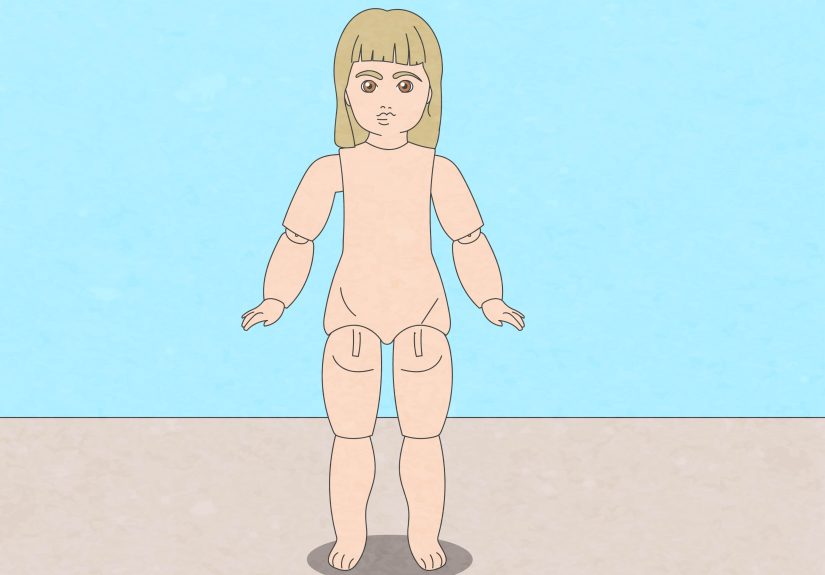
- Five-piece bodies (head, torso, two arms, two legs) are common in many quality dolls.
- Extra joints at elbows or knees can indicate higher craftsmanship, though not all dolls have them.
- Re-stringing is common maintenance, but mismatched limbs or odd proportions may indicate swapped parts.
Clothing and Accessories: Helpful, but Also a Trap
Original clothing can be a big value driverbut it’s also the easiest thing to replace, “improve,” or accidentally mismarry. Use clothing as supporting evidence:
- Fabric and construction: Look for period-appropriate textiles, hand stitching, and closures (hooks/eyes, early snaps, etc.).
- Wear patterns: Natural fading at folds and consistent aging across pieces can indicate authenticity.
- Too perfect: A pristine outfit on a heavily worn body can be totally possible… but it’s also a reason to check whether the outfit is a later addition.
Condition vs. Age: The Difference Between “Antique” and “Looks Like It Fought a Raccoon”
Condition is where value gets real. Two dolls from the same maker can be separated by thousands of dollars because of cracks, repairs, and originality.
Porcelain/bisque condition checks
- Hairline cracks: Use a bright light and look around the eyes, ears, and neck.
- Chips and flakes: Especially on fingers, toes, and the rim of the neck opening.
- Repairs: Overpainting, filled cracks, and replaced parts are common. Some repairs are acceptable; others are value-killers.
Composition condition checks
- Crazing: Fine crackle in the finish is common and sometimes acceptable.
- Lifting/cracking: When the composition layer separates or chunks are missing, value typically drops.
Spotting Reproductions and Franken-Dolls
Reproductions can be lovelyand sometimes they’re clearly labeled as such. The problems start when a reproduction is sold as antique, or when parts are mixed to create a doll that never existed in one piece.
Common red flags
- Fresh-looking paint with no natural wear, yet the body is “aged”
- Uniform “antique” staining that looks applied rather than accumulated
- Perfect, modern symmetry in brows and lashes (paired with suspiciously new-looking eyes)
- Mismatched materials (e.g., a head style typical of one era on a body style typical of another)
- Marks that don’t match the build (a “Germany” stamp paired with construction that screams later mass production)
Simple tools that help (without turning your kitchen into a lab)
- Magnifier or jeweler’s loupe: Helps spot repainting, crack fills, and surface texture differences.
- Good light: Side lighting makes hairline cracks and repairs easier to see.
- Gentle handling: The best tool is patience. Many antiques are fragile, even if they look tough.
Quick Identification Checklist
If you want a fast, repeatable process, use this checklist in order. It keeps you from falling into the “I found a number so I’m done” trap.
- Identify the material: glazed china? matte bisque? composition? celluloid?
- Check the head construction: shoulder head or socket head?
- Look for marks: head/neck, back, feet, under wig, clothing tags.
- Study facial features: eyes type, mouth style, painting technique.
- Inspect the body: cloth/leather/wood/composition, joints, stringing.
- Assess condition: cracks, chips, crazing, repairs, replacements.
- Compare to references: reputable databases, collector guides, auction archives, clubs.
- Decide what you have: antique, vintage, reproduction, or a mixed-parts doll.
Getting a Confident ID (Without Getting Hustled)
If you’re stuck, don’t guesstriangulate. Use multiple sources and compare them.
- Collector organizations and shows: Great for learning, seeing verified examples, and meeting specialists.
- Auction archives: Help you compare marks, molds, and construction to documented listings.
- Professional appraisers: Worth it for high-value dolls, rare makers, or insurance needs.
- Reference guides: Maker marks and mold numbers are often cataloged; you just need the right reference for your doll type.
And remember: a good identification is usually a stack of clues, not a single smoking gun.
Conclusion
Learning how to identify antique dollsporcelain, bisque, composition, celluloid, and beyondgets easier once you know what to look for: material, construction, marks, facial features, and condition. Start broad (material and build), then go specific (marks and maker research). Most importantly, treat every clue like a piece of the puzzle, not the whole picture.
And if you ever find yourself whispering, “Why does this doll have a head from 1890 and shoes from 1930?”congratulations. You’ve just met your first Franken-doll. They’re common, they’re educational, and they are absolutely not allowed to drive the pricing conversation.
Experience-Based Notes: Real-World Scenarios You’ll Run Into (and What to Do)
Once you start hunting antique dolls in the wildestate sales, antique malls, thrift stores, family atticsyou quickly learn that identification is less like a neat classroom lesson and more like a scavenger hunt where the clues sometimes lie. Here are experience-based situations collectors regularly face, plus the smart moves that keep you from overpaying or accidentally “restoring” your way into regret.
Scenario 1: The doll looks antique, but the outfit screams “recent craft fair.”
This happens constantly. Clothing is the easiest part to replace, and many dolls have been redressed over the decades. The move: ignore the outfit at first. Identify the head material and construction, then check for marks under the wig or at the neck opening. If the doll’s face and body show consistent aging but the outfit is pristine, assume the clothing is laterunless you can confirm it’s original through construction details and wear patterns. A modern outfit doesn’t automatically make the doll modern; it just means someone liked dressing her up (which is honestly relatable).
Scenario 2: “No marks anywhereso it must be super old, right?”
Not necessarily. Many legitimate antique dolls are unmarked, but plenty of later dolls are unmarked too. When marks are missing, experienced collectors lean on “construction signatures”: shoulder head vs. socket head, how the head is attached, eye type, body material, and how the limbs are jointed and strung. In other words, you stop asking, “What does the stamp say?” and start asking, “How was this made?” That shift is where most people level up fast.
Scenario 3: The seller says “porcelain,” but it feels… different.
In the real world, “porcelain” is often used for anything hard and doll-ish. Some modern dolls are glazed and shiny; some are matte; some are resin or composite materials that mimic ceramics. Your best defense is the finish: glazed “china” reflects light like a teacup; bisque looks softer and more skin-like. If it’s very light and thin-walled, consider early plastics like celluloid (and handle carefully). When you can’t confidently categorize the material, slow downmisidentifying material is the fastest way to misdate a doll.
Scenario 4: You find a crackand your heart breaks a little.
Welcome to collecting. Hairline cracks around the neck or eyes are common on genuine older dolls. The key is learning the difference between “age happens” and “this will haunt resale value.” Tiny, stable hairlines may be tolerated; major cracks, repairs, and heavy repainting usually matter more. Always check the rim of the neck opening and the earsthose areas love to chip. A bright flashlight and a patient inspection beat regret every time.
Scenario 5: The doll is “almost right,” but something feels off.
Trust that instinct. Mixed-part dolls are common: a great head paired with a later body, or original limbs swapped after damage. It doesn’t make the doll worthless, but it changes what it isand what it’s worth. Compare color tone across head and limbs, look at proportion, and check whether the wear patterns match. If the head looks like refined bisque artistry and the body looks like it came from a different decade, you’re probably not imagining it.
Scenario 6: You’re tempted to clean it immediately.
The “clean it now” impulse is powerful. Resist. Aggressive cleaning can remove original face paint, blush, or surface patina that collectors expect. The experienced move is to document first: take photos of marks, condition, and clothing details before doing anything. If you clean at all, start with the gentlest methods and keep restoration separate from identification. Many collectors would rather buy an honest, slightly dusty antique than a “freshened up” doll with altered original features.
In short: antique doll identification becomes easier the more you see, compare, and question. You’re not just learning dollsyou’re learning patterns. And once you start spotting those patterns, you’ll walk past the “too perfect to be true” dolls with a smile and head straight for the one in the corner that looks like it has a story (and, ideally, its original shoes).