Table of Contents >> Show >> Hide
- What You’ll Learn
- What You’re Drawing: The Classic Mortarboard (In Plain English)
- Tools and Setup
- Tutorial 1: Super-Easy Cartoon Graduation Cap (Front Angle)
- Tutorial 2: Slightly More Realistic Graduation Cap (3D Perspective)
- Add Personality: Decorations, Year Numbers, and School Colors
- Common Mistakes (And How to Fix Them Fast)
- Mini FAQ: Graduation Cap Drawing Questions
- Practice Prompts (So You Improve Quickly)
- Experiences: What Drawing a Graduation Cap Feels Like ()
- Conclusion
A graduation cap is one of the most recognizable hats on Earth. It’s basically a fancy square
hovering over your head like a polite UFOcomplete with a tassel that swings around like it has
its own opinions.
In this guide, you’ll learn two simple ways to draw a graduation cap (also called a
mortarboard): one cute, cartoon-style version that’s great for cards and doodles, and one
slightly more realistic 3D version that looks like it belongs on an actual graduate (or at least on a
graduation-themed cupcake topper).
What You’re Drawing: The Classic Mortarboard (In Plain English)
Before we start, let’s break the cap into easy parts. Once you see the pieces, drawing it feels a lot
less like “advanced geometry” and a lot more like “oh, it’s just shapes.”
Key parts of a graduation cap
- Top board: The flat square (usually drawn as a diamond/parallelogram in perspective).
- Cap band: The part that wraps around the head (a short rectangle or curved band).
- Button/knot: A small circle or tiny shape in the center of the top board.
- Tassel: A string that hangs down with little strands at the end.
Optional fun detail: In many U.S. graduation ceremonies, undergrads start with the tassel on the
right and move it to the left after the degree is conferred. If you draw a cap for a card,
you can even choose a “before” or “after” tassel side as a tiny storytelling touch.
Tools and Setup
You can draw a great graduation cap with anythingfrom a #2 pencil to the pen you stole from a hotel
that claims “it’s complimentary.” Here are the best options:
- Pencil + eraser: Best for sketching and fixing angles.
- Fine-liner or marker: Great for clean outlines.
- Ruler (optional): Helpful if your “straight lines” tend to wobble like a shopping cart wheel.
- Colored pencils/markers: For shading, school colors, or cap decorations.
Quick setup tip
Lightly sketch your first shapes. Think “whisper lines,” not “carve-it-into-stone lines.” You’ll darken
the final outline later.
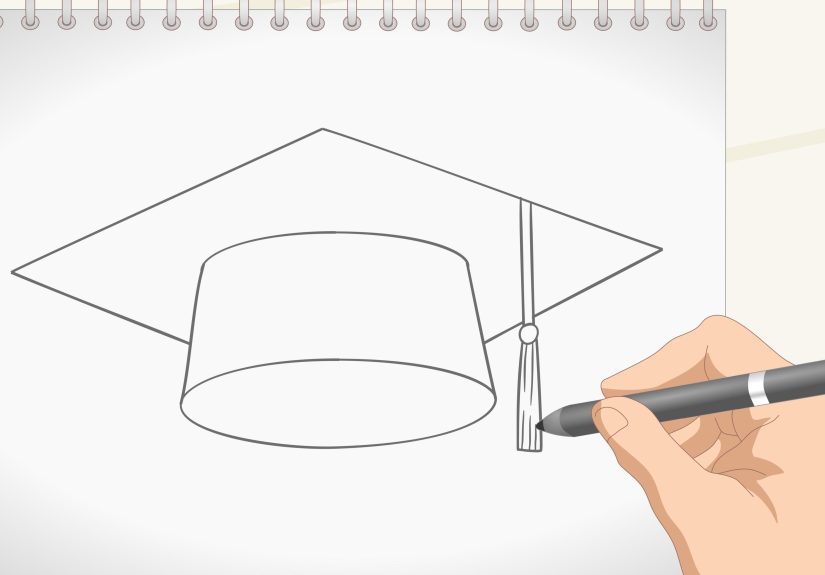
Tutorial 1: Super-Easy Cartoon Graduation Cap (Front Angle)
This version is perfect for beginners, kids, greeting cards, or anyone who wants quick success without
opening a math textbook. The goal is a clean, recognizable cap with simple shading.
Step-by-step (cartoon style)
-
Draw the top board (a tilted diamond).
Start with a rhombus (a slanted square). Make the top edge slightly longer than the bottom edge
to suggest perspective. Keep it neat, but don’t stressgraduation is about “good enough,” right? -
Add thickness to the board.
Under the diamond, draw a second, slightly lower line that parallels the bottom edge. Connect the
corners so the top board looks like it has a little depth (like a thin piece of cardboard). -
Draw the cap band (the head part).
Below the board, sketch a short rectangle centered under it. If you want a softer cartoon look,
curve the bottom edge slightly like a gentle smile. -
Connect the band to the board.
Add small diagonal lines from the board’s underside down to the band, so it looks attached instead
of floating like a magic trick. -
Add the center button/knot.
Place a small circle (or tiny oval) near the center of the top board. This is where the tassel
string begins. -
Draw the tassel string.
From the button, draw a thin line that drapes toward one side. Let it curve naturallytassels are
basically tiny pieces of drama. -
Finish the tassel.
At the end of the string, draw a small “knot” shape (a short oval). Then add several short,
straight strands beneath it. Keep strands uneven for a more natural look. -
Outline and erase guidelines.
Darken the final lines you want. Erase the sketchy extras. Congratulations: your cap is officially
less messy than most graduation speeches.
Easy shading (optional but awesome)
Shade the underside of the top board lightly. Add a darker tone on one side of the band to suggest a
light source. Even simple shading can make your drawing pop like it just got accepted to grad school.
Quick variation ideas
- Cap-in-the-air version: Tilt the board more dramatically and make the tassel swing upward.
- Card version: Add “Congrats!” and a small diploma scroll next to the cap.
- Personalized cap: Draw tiny stars, a year (“2026”), or a simple quote on the top board.
Tutorial 2: Slightly More Realistic Graduation Cap (3D Perspective)
This second tutorial gives your cap a more “real object sitting on a desk” look. Still simplejust a
little more intentional about angles and depth.
Step-by-step (3D look)
-
Lightly draw a tilted parallelogram.
Make the top shape a wide parallelogram (like a slanted rectangle). This will be the top board
viewed at an angle. Keep lines light and adjustable. -
Establish the center point.
Draw two faint diagonal lines across the board (corner to corner). Where they cross is the center
the best place for the button and tassel. -
Add board thickness.
From the bottom edge of the top board, draw a second edge slightly below it, then connect corners.
Keep the thickness consistentthin like cardboard, not thick like a sandwich. -
Sketch the band as a tapered box.
Under the board, draw the band like a short 3D box: a front face (rectangle) plus a side face
(a smaller angled shape). This adds realism immediately. -
Attach the band to the board.
Use short connecting lines from the underside of the board down to the band, matching the
perspective. If something looks “off,” it’s usually because one connecting line is leaning the wrong way. -
Draw the button (center knot).
Add a small circle or slightly rounded square at the center point. In realistic drawings, a tiny
shadow under the button helps it feel attached. -
Plan the tassel direction.
Decide where the tassel falls. A relaxed tassel curves downward. A windy or “cap toss” tassel curves
outward. Draw one clean guiding curve from the button. -
Build the tassel.
Add a small knot near the end of the string and then draw strands that flare slightly. In a more
realistic style, strands can overlap and vary in length. -
Add shadows for a 3D punch.
Shade the underside of the board, the side face of the band, and the area where the band sits under
the board. Keep one light direction consistent (e.g., light from top left). -
Refine edges and clean up.
Darken the closest edges slightly more than the far edges. Erase construction lines. Your cap now
looks like it can actually sit on someone’s headmission accomplished.
Make it even more realistic (fast)
- Add a soft highlight: Leave a thin unshaded strip on the top board.
- Deepen cast shadow: Draw a shadow under the cap band if the cap is “resting” on a surface.
- Texture hint: A few faint strokes can suggest fabric on the band.
Add Personality: Decorations, Year Numbers, and School Colors
Graduation caps are famous for being decoratedquotes, photos, glitter, flowers, you name it. If you’re
drawing a cap for a specific person, personalization instantly makes it feel meaningful.
Simple decoration ideas you can draw
- Big year: “2026” in bold letters across the top board.
- Short quote: “Done & Dusted,” “I Did the Thing,” or “Now What?”
- Mini icons: Stars, hearts, a tiny book, a laptop, a coffee cup (the real MVP).
- School colors: Keep the cap black, but use your school color for the tassel or outline.
Tip: If the decoration is detailed, keep the cap outline simple. If the cap is detailed (realistic shading),
keep the decoration simple. It’s like fashiondon’t wear five statement pieces unless you’re deliberately
trying to start a conversation in the elevator.
Common Mistakes (And How to Fix Them Fast)
Mistake 1: The top board looks like a kite
Fix: Flatten it. Make the top edges more parallel and widen the shape. Graduation caps are broad and
fairly flat, not pointy.
Mistake 2: The band is centered wrong
Fix: Draw a faint vertical center line through the top board and align the band under it. Small shifts
make a big difference.
Mistake 3: Tassel looks like a stiff stick
Fix: Use a gentle curve for the string. Tassels hang, sway, and bendlike they’re reacting to gravity
(which is, frankly, rude but consistent).
Mistake 4: Shading makes it look dirty
Fix: Shade lightly in layers. Start soft, then darken only where shadows are deepest (under the board,
on the far side of the band). Avoid scribbling with heavy pressure.
Mini FAQ: Graduation Cap Drawing Questions
What’s the easiest way to draw the cap straight?
Use a ruler for the first try, then freehand the next. Your brain learns the angles quickly when it can
compare “guided” vs. “natural.”
How do I draw a tassel that looks realistic?
Draw the string as a single curve, then add a knot and multiple strands. Vary strand lengths and let a
few cross slightly. The little imperfections make it believable.
What if I want a side view?
Start with a thin diamond for the top board, then show more of the band’s side face. Let the tassel hang
closer to the viewer for depth.
Practice Prompts (So You Improve Quickly)
- Draw 3 cartoon caps: tassel right, tassel left, tassel mid-swing.
- Draw 2 realistic caps: one with strong shadows, one with soft shading.
- Design 1 decorated cap with a year and a short quote.
- Draw a cap + diploma scroll combo as a small “graduation icon.”
Remember: repetition is the secret sauce. Not glamorous, but neither is studying for finals.
Experiences: What Drawing a Graduation Cap Feels Like ()
Graduation cap drawings show up in the wild in a funny wayusually right when you’re busiest. One day you’re
minding your own business, and the next day you’re making a card, a poster, or a last-minute party sign that
needs a graduation cap immediately. And somehow, a simple square hat becomes the official symbol of
“we survived.”
A lot of people’s first experience drawing a graduation cap happens on a homemade card. You want something
instantly recognizable, but you also don’t want to spend three hours building a masterpiece when the ceremony
is basically tomorrow. That’s where the cartoon-style cap shines: a few clean shapes, a tassel, and boomyour
drawing communicates “Congrats!” faster than you can say “Where did I park?”
Then there’s the moment you realize the tassel has personality. You draw it once and it looks like a straight
line. You draw it again with a curve and suddenly the cap looks alivelike it’s mid-celebration. That tiny
swinging string can make the difference between a drawing that feels stiff and one that feels like a snapshot
from graduation day. If you’ve ever tried to draw hair, you already know the secret: movement sells the story.
People also tend to connect graduation cap drawings to memories, not just the object. Some think about the
stress right before the ceremony (the frantic “Do I have everything?” checklist). Others picture the proud
photo moment: cap tilted slightly, tassel hanging, big smile, maybe a diploma in hand. And for many families,
the cap is tied to a traditionlike the symbolic “turning of the tassel,” where the tassel shifts sides to mark
the moment someone officially becomes a graduate.
Another surprisingly common experience: cap decorating. Even if you’re not copying an exact real-life design,
it’s hard to resist adding a name, a year, or a tiny quote. When you draw those details, the cap stops being a
generic icon and becomes someone’s cap. It’s the same reason we love personalized jerseys and monogrammed
mugs. Humans enjoy making things feel owned, meaningful, and specific.
Finally, drawing a graduation cap is one of those skills that gets better ridiculously fast. The first one might
look a little crooked. The second one looks more balanced. By the third one, you start shading with confidence,
and suddenly your cap has depth. It’s the perfect example of why drawing is less about “talent” and more about
practice: your hand learns the angles, your eye catches what’s off, and your brain starts predicting the right
shapes before you even finish the lines. And that’s a pretty graduation-worthy lesson on its own.