Table of Contents >> Show >> Hide
- Step 1: Choose the Right Ham (Because Labels Are Basically Homework)
- Step 2: Plan Your Ham Timeline (So Dinner Isn’t Served at “Whenever” O’Clock)
- Step 3: The Classic Oven Method (Juicy, Glazed, and Holiday-Official)
- Step 4: Glazing Without Burning (A Sweet, Sticky, Shiny Masterpiece)
- Step 5: Alternatives to the Oven (Because Kitchens Are Busy During the Holidays)
- Step 6: Carving, Serving, and Keeping It Juicy
- Step 7: Leftovers That Feel Like a Second Holiday
- Troubleshooting: Common Ham Problems (and the Fixes)
- of Holiday Ham Experiences (Because We’ve All Been There)
- Final Thoughts
Ham is the holiday main dish equivalent of showing up to the party in a great outfit: it looks impressive,
smells amazing, andif you do it rightrequires way less stress than a turkey. The secret is that most
“holiday hams” are already cooked. Your job isn’t to “cook” so much as reheat gently, add flavor, and
avoid drying it out. In other words: low drama, high applause.
This guide walks you through choosing the right ham, baking it perfectly, glazing it without creating a
sugary lava flow, carving like you meant to do that, and turning leftovers into the gift that keeps on giving.
Let’s make your holiday table smell like a postcard.
Step 1: Choose the Right Ham (Because Labels Are Basically Homework)
Read the label first: “Ready-to-eat” vs. “Cook before eating”
Hams come in two big categories, and the label matters more than the recipe headline:
-
Ready-to-eat / fully cooked: This is the classic holiday ham. You’re reheating it and
adding glazenot cooking it from raw. -
Cook before eating / cook thoroughly: This ham needs full cooking, not just warming.
These are less common for holiday centerpieces, but they exist (and they can be fantastic).
If your ham is fully cooked, your biggest risk is drying it out. If it’s not, your biggest risk is… well,
not cooking it. So we’ll cover both temperature targets later, but the label tells you which lane you’re in.
Bone-in vs. boneless: flavor vs. convenience
-
Bone-in: More flavorful, more “holiday centerpiece,” and the bone can level up soups,
beans, and broths later. -
Boneless: Easier to carve, more uniform slices, slightly less “wow” on the platter,
but still delicious.
Spiral-sliced vs. whole: easy serving vs. easy moisture
-
Spiral-sliced: Carving is basically done for you. The tradeoff is it can dry out faster
because there’s more exposed surface area. -
Whole (un-sliced): Often stays juicier because it’s intact, but you’ll carve it yourself.
(You can do it. I believe in you and your knife.)
City ham vs. country ham: mild and juicy vs. salty and bold
Most American “holiday hams” are city hamswet-cured, usually smoked, and generally mild,
juicy, and crowd-friendly. Country ham is dry-cured, much saltier, and often served in thin
slices (more like prosciutto energy). Country ham can be an amazing tradition, but it may require soaking or
different prep depending on how it’s sold.
Step 2: Plan Your Ham Timeline (So Dinner Isn’t Served at “Whenever” O’Clock)
How much ham per person?
A solid rule for a holiday dinner is:
- Bone-in: about 3/4 pound per person
- Boneless: about 1/2 pound per person
That usually leaves leftoversaka tomorrow’s best sandwichwithout turning your fridge into a ham storage facility.
Thawing (if frozen)
If your ham is frozen, thaw it in the fridgenot on the counter. Plan roughly 4–6 hours per pound
in the refrigerator for large cuts, which often means 2–4 days for a whole holiday ham. If you’re
reading this while your ham is still rock-solid and guests arrive tomorrow, take a deep breath and pivot to “plan B”
(see the “experiences” section laterwe’ve all been there).
Bring it closer to room temp (briefly) before baking
Let the ham sit out 30–60 minutes before it goes into the oven. This helps it heat more evenly.
(It’s also a great time to set the table, hide the clutter, and pretend you’re effortlessly calm.)
Step 3: The Classic Oven Method (Juicy, Glazed, and Holiday-Official)
If you want a classic holiday ham, the oven is your best friend. The goal is gentle heat and steady moisture:
think “spa day,” not “high-intensity workout.”
What you’ll need
- Roasting pan (with rack if you have one)
- Heavy-duty foil (or a tight-fitting lid)
- Instant-read thermometer (your holiday MVP)
- Optional: a small amount of liquid for the pan (water, apple cider, or broth)
Step-by-step: how to bake a fully cooked ham
- Preheat the oven to 325°F. This is the sweet spot for warming without drying.
-
Position the ham. Place it cut-side down (or flat side down) in the roasting pan.
This helps protect the most exposed area from drying out. -
Add a splash of liquid (optional but helpful). Pour about 1/2 to 1 cup water, cider,
or broth into the bottom of the pan. It won’t “boil the ham,” but it can create a gentler environment. - Cover tightly with foil. Tight coverage is how you keep the ham juicy, especially for spiral-sliced.
-
Warm until the right internal temperature. Use a thermometer and check the thickest part,
avoiding the bone. - Glaze near the end. Uncover and glaze during the last 15–30 minutes so the sugars don’t burn.
- Rest before carving. Let it sit 10–15 minutes so juices redistribute and slices stay succulent.
Ham internal temperature targets (don’t guessmeasure)
The “done” moment depends on whether your ham is fully cooked or needs cooking:
-
Fully cooked ham (reheating): Heat to 140°F if it was packaged in a USDA-inspected plant
(many are). Otherwise, safety guidance commonly uses 165°F for reheating. When in doubt, follow the label. - Raw/fresh ham: Cook to 145°F with a 3-minute rest.
- “Cook thoroughly” ham (label-driven): Some products specify higher targets on-package. Follow that label.
Translation: your thermometer is not optional. It’s how you avoid serving ham that’s dry, underheated, or still cold
in the middle like a culinary plot twist.
About time-per-pound (a helpful guideline, not a law of physics)
For a fully cooked ham at 325°F, many cooks use about 10–15 minutes per pound as a planning
estimate. But ovens vary, pans vary, and spiral slicing changes everythingso treat time like a calendar reminder, not a contract.
| Ham Size | Rough Warm-Up Time at 325°F (Fully Cooked) | Best “Done” Signal |
|---|---|---|
| 5–7 lb | About 1.5–2 hours | Thermometer hits target temp |
| 8–10 lb | About 2–2.5 hours | Thermometer hits target temp |
| 11–14 lb | About 2.5–3.5 hours | Thermometer hits target temp |
Step 4: Glazing Without Burning (A Sweet, Sticky, Shiny Masterpiece)
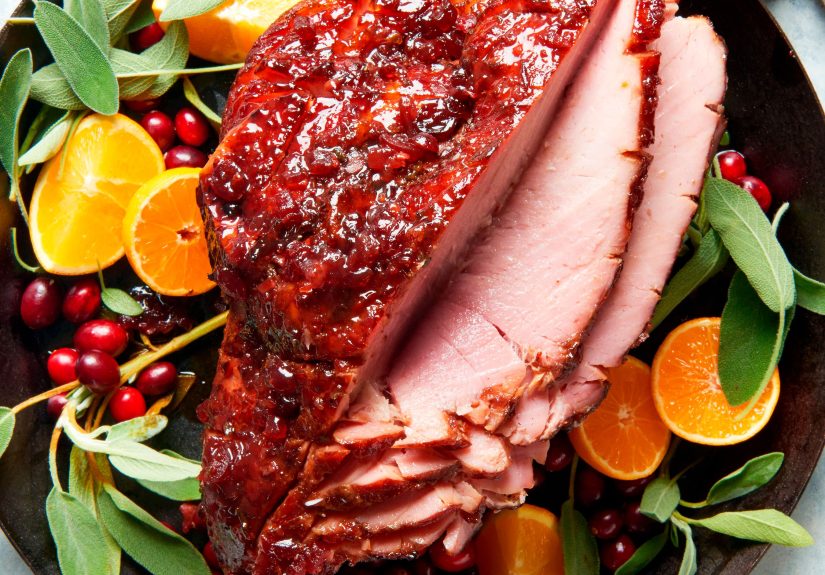
Glaze is the ham’s holiday tuxedo. But sugary glazes can burn if you apply them too early at high heat.
The simplest strategy: heat the ham covered, then glaze uncovered near the end.
When to apply glaze
- Last 30 minutes is a safe window for most glazes.
- If you want multiple layers, brush on glaze every 10 minutes during that final window to build a glossy crust.
The “build-a-glaze” formula (works with whatever’s in your pantry)
Great glaze usually includes:
- Sweet: brown sugar, honey, maple syrup, jam
- Tang: Dijon mustard, apple cider vinegar, orange juice
- Warm spice: clove, cinnamon, allspice, black pepper
- Optional depth: bourbon, cider, cola, or a splash of soy sauce
Example glaze #1: Brown sugar–Dijon shine (classic, not complicated)
Stir together:
- 1 cup brown sugar
- 2–3 tablespoons Dijon mustard
- 2 tablespoons honey (or maple syrup)
- 1–2 tablespoons apple cider vinegar
- Pinch of black pepper
Brush it on during the last 30 minutes, then return the ham to the oven uncovered. If it starts to get too dark,
tent loosely with foil and keep going.
Example glaze #2: Citrus-clove holiday vibe (smells like December)
- 3/4 cup brown sugar
- 1/3 cup orange juice
- 1 tablespoon orange zest
- 2 tablespoons honey
- 1 teaspoon ground cloves (or stud whole cloves into scored fat)
This one caramelizes fast, so keep it in that final 15–25 minute zone. Your kitchen will smell like a seasonal candle,
but the edible kind.
Step 5: Alternatives to the Oven (Because Kitchens Are Busy During the Holidays)
Slow cooker method (great when the oven is booked)
A slow cooker can keep ham wonderfully moistespecially smaller hams that fit comfortably.
- Place ham cut-side down (trim if needed to fit).
- Add 1/2 cup liquid (cider, broth, or water).
- Cook on LOW until it reaches the right internal temperature for your ham type.
- Optional: finish with glaze under the broiler for 2–4 minutes for shine.
Grill or smoker (for the “I brought the flavor” energy)
Use indirect heat, keep the lid closed, and treat it like oven-warming outdoors. Glaze at the end
and watch carefullysugar and open flame love each other a little too much.
Ham steaks (fastest route to “we’re eating in 20 minutes”)
For smaller gatherings, ham steaks are a shortcut: quick skillet sear, quick glaze, big payoff. Warm through,
then brush with a simple glaze and let it bubble for a minute. Done.
Step 6: Carving, Serving, and Keeping It Juicy
Rest before carving
After the ham hits temperature, rest it 10–15 minutes. This helps the juices settle so your slices stay tender.
How to carve a bone-in ham without panic
- Set ham on a stable cutting board and locate the bone direction.
- Slice downward to create broad slices, then cut away from the bone as you go.
- For a spiral ham, slice around the bone to loosen sections, then lift slices off in stacks.
How to keep ham warm on the table
- Serve on a warm platter if possible.
- Cover loosely with foil between rounds of serving.
- If using a warming tray, keep it gentlehigh heat can dry slices fast.
Step 7: Leftovers That Feel Like a Second Holiday
Ham leftovers are basically a culinary cheat code. Store them safely, then enjoy the encore.
Smart leftover storage
- Refrigerate within about 2 hours of serving.
- Slice and store in shallow containers so it cools quickly.
- Use within a few days, or freeze in meal-sized portions.
Leftover ideas (beyond “another sandwich,” though that’s still valid)
- Breakfast: omelets, scrambles, breakfast casseroles
- Dinner: ham and bean soup, split pea soup, creamy pasta
- Snacks: ham-and-cheese sliders, pinwheels, quesadillas
- Bonus: simmer the bone with onions, celery, and bay leaf for a rich broth
Troubleshooting: Common Ham Problems (and the Fixes)
“My ham is dry.”
- Next time: cover tighter with foil and stop cooking by temperature, not time.
- Right now: serve with pan juices, warm broth, or a quick mustard-cider sauce.
“My glaze burned.”
- Glaze later (final 15–30 minutes) and keep an eye on it.
- If it’s getting too dark, tent with foil and lower the rack position.
“The spiral slices are drying out on the edges.”
- Wrap tightly in foil for most of the cook time.
- Consider placing the ham cut-side down and basting lightly before serving.
“It’s too salty.”
- Country ham or very cured ham can be salt-forward. Serve in thinner slices.
- Pair with sweet sides (sweet potatoes, fruit, rolls) and a tangy glaze to balance.
of Holiday Ham Experiences (Because We’ve All Been There)
There’s a special kind of holiday confidence that appears the moment you say, “I’ll do the ham.”
It’s the same confidence that convinces you that gift wrap will magically wrap itself and that
you’ll remember where you put the good serving platter. Spoiler: you won’t. But hamif you treat it gently
is still one of the most forgiving holiday mains, which is why so many home cooks swear by it.
A very common ham experience starts with a spiral-sliced ham and the phrase, “It’s already cooked, so this is easy.”
That’s true… until you realize spiral ham has approximately one thousand little slice-edges just begging to dry out.
The good news is that one simple habit changes everything: wrap it tightly in foil while it warms.
People who skip that step often end up “carving around the crispy parts” like it’s a normal tradition. It isn’t.
Foil is your friend. Moist heat is the whole game.
Another classic moment: glaze ambition. The holidays make us feel artistic. Suddenly you’re considering a glaze with
pineapple juice, espresso, three kinds of mustard, and “just a touch” of hot honey. I support your creativity.
I also support your smoke alarm’s desire to remain silent. When home cooks talk about glaze disasters, it’s rarely the
flavorsit’s timing. Sugary glaze needs the final stretch, not the whole marathon. If you’ve ever scraped burnt sugar off
a ham while whispering, “It’s fine, it’s fine,” you already know the rule: glaze late, watch closely.
There’s also the great holiday fear: “What if it’s cold in the middle?” This is where the thermometer becomes
the calm friend who doesn’t panic. Plenty of people “trust the minutes-per-pound” and end up with a ham that’s warm on
the outside and chilly near the bone. The fix isn’t cooking it longer until it’s dry; it’s checking early,
then giving it the time it actually needs. When you cook to temperature, you stop arguing with the oven and start winning.
And finally, the best experience: leftovers. Ham is the rare holiday main that gets even more useful after the party.
People plan entire post-holiday weeks around itbreakfast scrambles, quick soups, pasta, sliders, and that one
“accidental” extra plate you make because you’re “just tasting.” If you keep the ham bone, you’ve got a built-in flavor
booster for beans or broth that tastes like you worked harder than you did. In the end, that’s the real holiday magic:
a beautiful centerpiece dinner today, and easy comfort food tomorrowwithout cooking a whole new main from scratch.
Final Thoughts
A classic holiday ham doesn’t need complicated tricksjust smart label reading, gentle heat, a reliable thermometer,
and a glaze that shows up fashionably late. Do those things, and your ham will be juicy, glossy, and worthy of a dramatic
entrance to the dinner table (applause optional, but encouraged).