Table of Contents >> Show >> Hide
- Why Batman and Fine Art Belong in the Same Frame
- Eight Famous Paintings Gotham Would Happily Borrow
- 1. The Starry Night as Gotham’s Restless Ceiling
- 2. Nighthawks as Gordon’s 3 A.M. Diner Briefing
- 3. American Gothic as Wayne Manor’s Strict Domestic Drama
- 4. The Scream as Gotham’s Commuter Experience
- 5. The Old Guitarist as Gotham’s Forgotten Soul
- 6. Christina’s World as Catwoman’s Impossible Distance
- 7. The Persistence of Memory as Bruce Wayne’s Internal Clock
- 8. Washington Crossing the Delaware as a Bat-Family Charge
- What Makes a Batmanized Painting Actually Work
- The Experience of Walking Through a Batmanized Museum
- Conclusion
Some mashups feel forced. Peanut butter and pickles? Suspicious. Socks with sandals? A cry for help. But famous paintings reimagined as scenes from Batman? That idea works alarmingly well. In fact, it works so well that it almost feels like the art world and Gotham City have been low-key dating behind our backs for decades.
Think about it. Batman lives in a universe of dramatic lighting, moral ambiguity, theatrical poses, grief, grandeur, and people who absolutely refuse to dress casually. Fine art is not exactly allergic to any of those things. Classic painting loves symbolism, mood, iconic silhouettes, and people staring into the middle distance like they just remembered a terrible prophecy. Batman, meanwhile, is basically a moving monument to shadows, architecture, and unresolved childhood trauma. In other words: he fits right in.
This is not an official museum exhibition, sadly. No one has yet announced From Renaissance to Riddler: A Curated Evening of Extremely Concerned Men in Capes. But as a creative thought experiment, the concept is pure gold. When you drop Batman, Gotham, Catwoman, Joker, Gordon, and the Bat-Signal into the visual language of famous paintings, something delightful happens. The paintings become more cinematic, and Batman somehow becomes even more dramatic, which is honestly impressive for a man who already enters rooms like thunder is his publicist.
Why Batman and Fine Art Belong in the Same Frame
The best Batman stories are built on tone. Gotham is not just a backdrop; it is a psychological weather system. The city is full of spires, alleys, rooftops, neon reflections, and the kind of architecture that looks like it was designed by a committee of gargoyles. That atmosphere gives Batman more in common with expressionist painting, urban realism, and surrealist symbolism than with bright, straightforward heroics. Superman saves the day in clean daylight. Batman broods in a skyline that looks painted by insomnia itself.
That is why this crossover idea has such legs. Famous paintings already come preloaded with visual shorthand. A diner at midnight suggests loneliness. A stormy sky suggests unrest. A rigid portrait suggests social tension. A surreal landscape suggests fractured time or memory. Batman stories thrive on exactly those emotional cues. He is a detective, yes, but he is also a symbol machine. He turns fear into costume, grief into mission, and architecture into theater.
There is another reason this works: parody and reinterpretation depend on recognition. We respond to the joke, the homage, or the remix because we know the original image and can enjoy the twist. When a painting is iconic enough, even a small change can completely reroute its meaning. Add a cowl, a cape, or one unsettling Gotham moon, and suddenly a museum masterpiece starts telling a comic-book story without losing its original power.
Eight Famous Paintings Gotham Would Happily Borrow
1. The Starry Night as Gotham’s Restless Ceiling
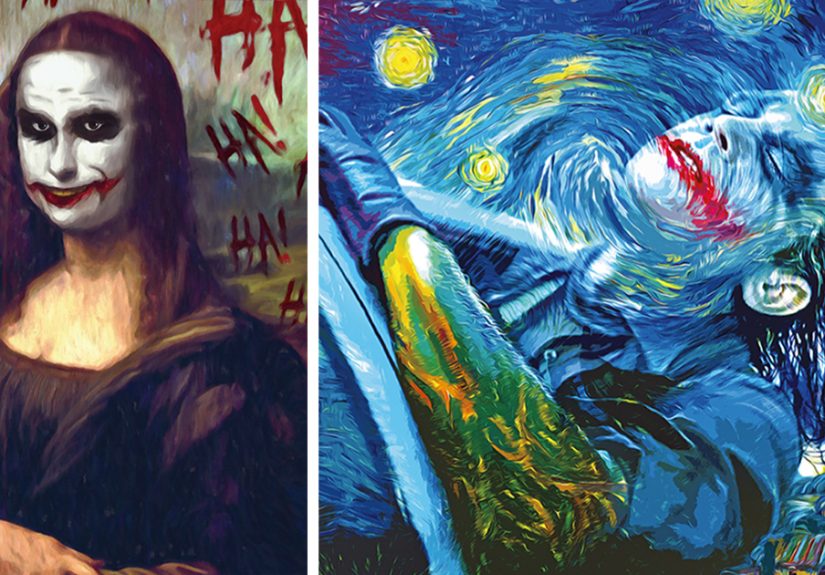
Vincent van Gogh’s The Starry Night already feels like a Batman backdrop waiting for a casting call. The swirling sky, the exaggerated light, the emotional turbulence baked into the brushworkthis is not a calm evening. This is a city on the verge of hearing bad news over a police scanner.
Reimagined through Batman, the moon becomes a harsher witness, the stars pulse like surveillance lights, and the village below turns into a darkened Gotham district holding its breath. You can practically see the Bat-Signal rippling through those blue spirals. Batman would not even need to pose. He would simply appear as a sharp silhouette on a rooftop, cape pinned by the wind, while the sky performs a full orchestral panic behind him. It is moody, unstable, and deeply theatrical. In other words, it is Gotham with better brushwork.
2. Nighthawks as Gordon’s 3 A.M. Diner Briefing
Edward Hopper’s Nighthawks may be the easiest Batman conversion in the entire museum. The painting already gives us isolation, glass, light, urban quiet, and the feeling that everyone in the room is either hiding something or too tired to explain it. Replace the anonymous customers with Jim Gordon, a worried beat cop, a sleepless reporter, and maybe Selina Kyle in a hat sharp enough to file taxes, and you are halfway to a graphic novel cover.
The brilliance of a Batman-flavored Nighthawks is restraint. Batman does not even need to sit at the counter. Frankly, he would never order pie like a normal person. He belongs outside the window as a reflection, barely there, turning the diner into both sanctuary and evidence locker. Suddenly the painting is not just about loneliness. It is about vigilance. Gotham never sleeps, and if it does, it definitely sleeps with one eye open.
3. American Gothic as Wayne Manor’s Strict Domestic Drama
Grant Wood’s American Gothic has been parodied so many times that it practically arrives with its own remix license. Its stiff posture, stern faces, and pitchfork-like vertical emphasis make it a dream for character casting. In a Batman version, the obvious move is Alfred and Bruce Wayne standing in front of Wayne Manor. Alfred holds the same unshakable dignity. Bruce stands beside him with the expression of a man who has not had a peaceful breakfast since the 1980s.
You could swap the pitchfork for a batarang, but the better move is to keep the pose and let the tension do the work. The humor comes from contrast. The original painting is rooted in ideas about American identity, discipline, and rural image-making. A Gotham adaptation turns that seriousness into aristocratic gloom. It says: yes, this house is old, yes, the curtains cost more than your car, and yes, there is almost certainly a cave under the property.
4. The Scream as Gotham’s Commuter Experience
Edvard Munch’s The Scream may be the most honest painting ever made about hearing one piece of news too many. In Batman terms, it barely needs translation. This is the face of a Gotham citizen learning that the Joker has escaped again, the Scarecrow has released another fear toxin, and the mayor is somehow still pretending things are under control.
In a Batman reimagining, the bridge becomes a Gotham overlook, the orange sky turns radioactive with emergency light, and the central figure becomes the visual embodiment of citywide dread. Batman himself works best as a distant presence here, perhaps one dark shape far behind the panic. That distance matters. Batman stories often revolve around the gap between symbol and safety. He inspires fear in criminals, but he does not necessarily make ordinary life feel normal. The Scream captures what Gotham would feel like from street level, not rooftop level. That is why it stings.
5. The Old Guitarist as Gotham’s Forgotten Soul
Pablo Picasso’s The Old Guitarist brings a quieter kind of Batman energy. It is not about spectacle; it is about urban sorrow. The bent figure, the blue palette, the fragility, and the stubborn presence of the instrument all suggest a city that has worn someone down without fully erasing them.
In Gotham, this painting could become a street musician playing beneath an elevated track while Batman watches from above, not intervening because there is no punchable villain in sight. And that is exactly why the image would work. Batman is not only about action. He is about the city he cannot fully repair. A Batmanized The Old Guitarist would highlight the people who live under Gotham’s mythology: the exhausted, the invisible, the ones surviving in the cold blue spaces between headlines.
6. Christina’s World as Catwoman’s Impossible Distance
Andrew Wyeth’s Christina’s World is famous for its emotional distance. A figure stretches through an open field toward a house that feels near and impossibly far at the same time. It is a painting about longing, limitation, and the ache of wanting to reach a place that remains just out of comfort’s range.
Now place Catwoman in that composition. Instead of a Maine field, imagine a pale Gotham rooftopscape. Instead of a farmhouse, the destination is Wayne Manor, lit but unreachable. That twist turns the painting into something almost painfully on-brand for Batman lore. Bruce and Selina are the patron saints of almost. Almost trust. Almost romance. Almost timing. The composition already knows how that relationship feels. You barely have to touch it. The distance does the storytelling for you.
7. The Persistence of Memory as Bruce Wayne’s Internal Clock
Salvador Dalí’s The Persistence of Memory is tiny, surreal, and much stranger than its pop-culture fame sometimes suggests. That makes it perfect for Batman, whose life is ruled by ritual, trauma, precision, and a frankly aggressive relationship with time.
Imagine the melting clocks draped over Batcave equipment, a cowl resting where the strange central creature lies, and a cave horizon glowing faintly with computer light. This becomes a portrait of Bruce Wayne’s inner life: every mission scheduled, every wound remembered, every anniversary impossible to ignore. Batman is a man who turned one night into an entire operating system. Dalí’s dream logic exposes the cost of that choice. Memory in Gotham does not stay still. It sags, loops, distorts, and keeps showing up to work anyway.
8. Washington Crossing the Delaware as a Bat-Family Charge
Emanuel Leutze’s Washington Crossing the Delaware is the grand heroic tableau, the kind of image that seems to shout before you even get close to it. That makes it ideal for a full Bat-Family reinterpretation. Batman stands at the prow, obviously, because subtlety left the room several sections ago. Nightwing, Batgirl, Robin, and Red Hood fill the boat in varying degrees of competence and emotional baggage. Gotham floods around them. The mission is impossible. Naturally, they proceed.
What makes this one especially fun is that the original painting is already larger than life. It is about mythmaking, courage, and dramatic leadership under pressure. A Batman version would preserve that structure while giving it a new civic mission. Instead of revolutionary war, the threat is Gotham-scale chaos. Instead of frozen river heroism, it is tactical family heroism with better gadgets and significantly worse communication skills.
What Makes a Batmanized Painting Actually Work
The trick is not slapping bat ears onto everything like a sleep-deprived sticker designer. A good reinterpretation respects the original painting’s emotional engine. If the source image is about alienation, the Batman version should deepen alienation. If the original is about ritual or identity, Gotham should sharpen those themes rather than bulldoze them with fan service.
Composition matters too. Nighthawks works because Batman should be almost absent. The Scream works because Batman should not be the screamer. Christina’s World works because distance is the point. And The Persistence of Memory works because Bruce Wayne is one of pop culture’s great overachievers in the category of “cannot emotionally move on.”
Most importantly, the best mashups understand that Batman is both a character and a visual language. He brings shadow, silhouette, architecture, and dread. When those things line up with the original artwork, the result is not just funny or clever. It is strangely persuasive. You stop thinking, “What a neat parody,” and start thinking, “Wait, why does this museum piece know Gotham better than half the movies?”
The Experience of Walking Through a Batmanized Museum
Imagine entering a gallery where every famous painting has been quietly, expertly rerouted through Gotham City. At first, you laugh. Of course you do. There is Batman glowering in a frame where he absolutely has no business being, and yet somehow he looks like he paid museum membership dues years ago. But after the first wave of amusement, something more interesting kicks in. You start seeing how naturally these worlds speak to each other.
You would move from room to room and feel the temperature change. In one gallery, the sky would swirl with the psychological electricity of The Starry Night, but your eye would keep drifting toward one impossible black shape on a chimney line. In another, the fluorescent hush of Nighthawks would make you slow down, as if raising your voice might disturb an investigation already in progress. Every painting would keep its original grammar, but Gotham would alter the accent.
The strangest part of the experience would be how quickly Batman stops feeling like an intrusion and starts feeling like a key. In ordinary pop culture, Batman often arrives as action, plot, and franchise machinery. In a museum setting, stripped down to silhouette and implication, he becomes what he has always been at his best: a symbol. He is grief with a cape. He is order trying to negotiate with chaos. He is architecture made emotional.
That museum walk would also remind you how flexible great art really is. Masterpieces survive parody not because they are fragile, but because they are durable. They can absorb satire, homage, remix, costume, meme, and reinterpretation without losing their core identity. If anything, the best reimaginings prove the original’s strength. You recognize the painting instantly, and then you enjoy the shock of seeing it tell a new story. The original remains intact; the meaning simply picks up a side quest.
There is also something genuinely fun about watching “high art” and “comic art” stop pretending they belong in separate lunchrooms. Museums have long trained viewers to respect composition, mood, symbolism, and visual storytelling. Comics do that too. Batman, especially, has spent generations borrowing from noir cinema, gothic design, pulp illustration, and theatrical staging. Put him inside the visual traditions of painting and the walls between disciplines start to look pretty flimsy. Turns out, a cape and an art history survey course can get along beautifully.
By the end of the exhibit, the experience would feel less like a joke and more like a revelation with excellent lighting. You would leave thinking about how many paintings already contain Batman energy without ever meaning to. Lonely interiors, haunted skies, fragile bodies, heroic postures, impossible distances, theatrical shadowsGotham has been hiding in plain sight all along. Batman does not cheapen the paintings. The paintings, if anything, remind us why Batman endures: he is one of modern culture’s most adaptable images, forever ready to step into a new frame and somehow look like he was there first.
Conclusion
Famous Paintings Reimagined As Scenes From Batman works as an idea because both sides of the mashup understand drama. Great paintings distill emotion into image. Great Batman stories do the same, just with more grappling hooks and a much higher cape budget. When the pairing is done well, it reveals something fresh about both traditions: masterpieces are more flexible than they look, and Batman is more mythic than he sometimes gets credit for.
So if someone ever does build this exhibition for real, please clear my schedule. I would like to stand in front of a Gotham-flavored Nighthawks, whisper “this is ridiculous,” and then spend twenty minutes admiring how completely right it feels.