Table of Contents >> Show >> Hide
- What “heat storage” cooking really means (and why your roast suddenly behaves)
- Everhot 110+ overview: size, layout, and what you’re actually buying
- Temperatures and cooking zones: how the Everhot 110+ behaves day to day
- Energy use and running cost: a smarter way to estimate what it’ll cost in the U.S.
- Installation and home-fit notes for U.S. households
- Everhot 110+ vs Everhot 110i: which one fits your cooking style?
- Who the Everhot 110+ is perfect for (and who should politely back away)
- Care, habits, and keeping it enjoyable (not intimidating)
- Experiences: what living with an Everhot 110+ tends to feel like (about )
- Bottom line
Some appliances “help you cook.” The Everhot 110+ Series heat storage range cooker quietly changes how you live in the kitchen.
It’s the kind of cast-iron, always-warm workhorse that doesn’t just wait for dinnerit’s already ready, already steady, already giving off that cozy
“bake something” energy before you’ve even decided what’s for dinner.
If you’ve only used a conventional U.S.-style range (preheat, cook, shut it down), a heat storage range can feel like a different species:
less “on/off,” more “set the rhythm of the house.” The Everhot 110+ is designed to fit a 110 cm space and is built around
cast-iron thermal massmeaning it stores heat and releases it gently and consistently for cooking across multiple ovens and hot plates.
What “heat storage” cooking really means (and why your roast suddenly behaves)
Traditional ovens mostly heat air. Heat storage ranges lean hard into radiant heat coming off hot cast iron.
In practice, that can mean fewer temperature swings, a more even “all-around” warmth on food, and less drying compared with many fan-assisted setups.
Think of it as the difference between standing in a warm room versus standing in a direct breeze: both can be hot, but only one feels like it’s
heating you from the inside out.
This is also why heat storage cooking tends to reward timing and positioning.
Instead of constantly chasing a dial, you often control the pace by choosing the right oven and shelf height, using lids on the plates,
and letting stored heat do what stored heat does best: stay stable.
Everhot 110+ overview: size, layout, and what you’re actually buying
Dimensions, fit, and the “yes, it’s really that heavy” reality
The Everhot 110+ is built to fit a 110 cm opening (approximately 43 inches wide). A commonly listed spec set is:
1090 mm wide, 600 mm deep, and 900 mm high to the hob surface (about 43" W × 23.6" D × 35.4" H).
With the lids up, height is often listed around 1530 mm (about 60.2").
Weight is typically quoted at around 400 kg (roughly 880+ lbs), which is part of the heat-storage magicmass matters.
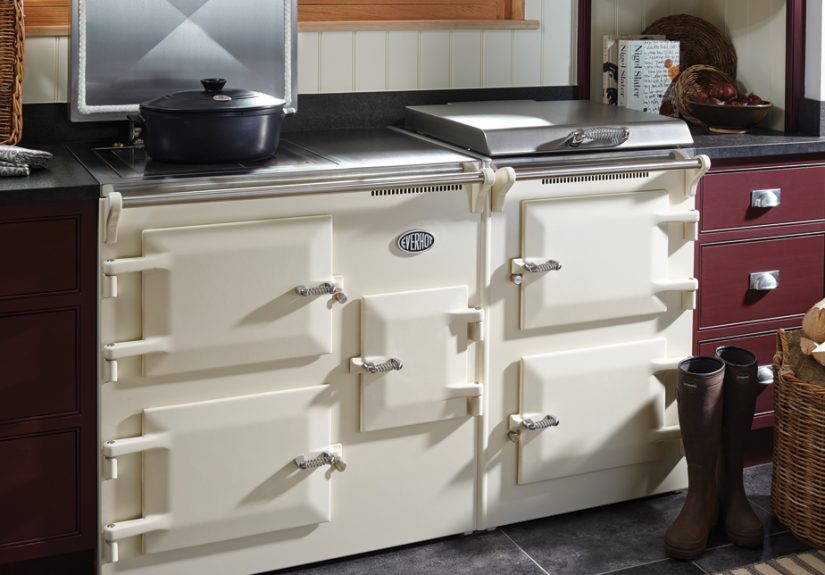
Classic 110+ configuration: hot plate + simmer plate, three ovens, and a serious grill
The Everhot 110 Series is positioned as a bigger sibling to the Everhot 100, with increased oven space and a layout aimed at everyday multi-tasking.
The 110+ is commonly described as a “classic” setup: two cast-iron plates under lids (hot/boiling plate and simmer plate) plus
three ovens behind cast-iron doors, with a powerful grill integrated into the top oven.
Translation: you can roast, bake, and slow-cook at the same time without playing musical chairs with sheet pans.
It’s dinner-party-friendly without requiring you to earn a degree in juggling.
Temperatures and cooking zones: how the Everhot 110+ behaves day to day
Factory-style “default” temps (the baseline many owners start from)
Everhot dealers commonly reference a set of recommended, factory-style running temperatures as a starting point:
around 220°C (about 428°F) for the top oven, 100°C (about 212°F) for the bottom/slow oven,
about 290°C (about 554°F) for the hot plate, and roughly 200°C (about 392°F) for the simmer plate.
Exact behavior and adjustability depend on model configuration and how you set it up for your home and cooking habits.
What you cook where (practical examples)
-
Roasting oven: Great for crisp skin and browned edgesthink sheet-pan chicken thighs, roasted root vegetables,
or a lasagna that bubbles like it has something to prove. - Baking/moderate oven: Cookies, muffins, cornbread, casseroles, and “I forgot we had bananas” banana bread.
-
Slow/low oven: Braises, beans, stock reduction, pulled pork, yogurt experiments, and the kind of stew that tastes better
because it had time to think about its choices. -
Hot plate vs simmer plate: The hot plate is your fast lanesearing, boiling, quick sautéing.
The simmer plate is the gentle laneholding sauces, simmering soups, keeping gravy warm without turning it into wallpaper paste.
A sample “real kitchen” cooking day
Here’s a realistic way the 110+ earns its keep:
-
Morning: Set a kettle on the hot plate. Warm plates in a low oven. Toss oats into the slow oven for an overnight-style bake,
or keep a pot of stock gently moving without babysitting it. -
Afternoon prep: Brown short ribs on the hot plate, then slide the pot into the slow oven.
Use the moderate oven for a tray of roasted carrots and onions that will later join the party. -
Dinner: Crisp something in the hotter oven (broiled fish, roasted chicken, finishing the veg),
while the slow oven keeps the main pot calm and steady. Finish sauce on the simmer plate. Serve like you planned it all week.
Energy use and running cost: a smarter way to estimate what it’ll cost in the U.S.
One reason Everhot gets attention is that it publishes model-by-model consumption guidance using factory-style settings and an overnight ECO schedule.
For the 110+, published figures commonly show about 90 kWh per week when using factory-set ECO timings overnight (often stated as 9pm–6am).
That’s not a promise; it’s a baseline that assumes a particular schedule and temperature strategy.
Use this simple calculator (and you’ll never be surprised again)
Weekly cost ≈ (weekly kWh) × (your electricity rate)
Annual cost ≈ (weekly cost) × 52
Example using the 90 kWh/week baseline:
if your electricity costs $0.18/kWh, then weekly cost ≈ 90 × 0.18 = $16.20/week,
and annual ≈ $16.20 × 52 = $842/year.
Your real number can be higher or lower depending on:
your thermostat settings, ambient kitchen temperature, how often you lift lids and doors, how aggressively you use ECO mode,
and (big one) your local electricity rate.
What ECO mode is doing (and why it matters)
Dealers describe ECO mode as a planned temperature dropoften overnightto reduce consumption while keeping the cooker warm enough
to recover smoothly for daytime cooking. If you’re the kind of person who loves a cozy kitchen but doesn’t love paying for “cozy” twice,
this feature is doing a lot of heavy lifting.
Installation and home-fit notes for U.S. households
No flue doesn’t mean “no ventilation”
Because Everhot is electric, it’s commonly described as flue-free. That simplifies placement compared to some fuel-burning appliances.
But cooking still creates moisture, odors, and airborne particlesso a properly vented range hood is still a smart move.
If you’re planning a kitchen around a heat storage range, treat ventilation as part of the “total system,” not an afterthought.
Practical sizing guidance often uses cooktop width as a starting point. A common recommendation is roughly
100 CFM per linear foot of range width for wall installations (with higher needs for island setups),
plus extra capacity if duct runs are long or full of bends.
Electrical reality check: confirm compatibility before you fall in love
Everhot specifications commonly mention a 13A supply for certain models in its home market.
Many U.S. electric ranges, by contrast, are commonly installed on a 240V circuit with a higher amperage and
a dedicated receptacle style used for ranges/dryers.
So if you’re in the U.S. and considering an Everhot 110+ (especially via import or a specialty dealer),
treat the electrical plan as step one:
verify voltage requirements, serviceability, parts support, and warranty coverage.
A licensed electrician should review the appliance requirements and confirm the correct circuit, protection, and connection method.
Weight and flooring
With published weights around 400 kg, this is not a “two friends and a YouTube tutorial” installation.
Some sources suggest the weight is distributed in a way that often avoids structural drama, but it’s still a heavy appliance.
If your home is older, has unusual floor framing, or you’re installing on an upper level, consult a qualified professional.
The best-case scenario is you over-planned and now get to sleep peacefully.
Everhot 110+ vs Everhot 110i: which one fits your cooking style?
The Everhot 110 Series is often presented in two main flavors:
110+ (classic cast-iron hot plates) and 110i (a hybrid approach that adds induction zones).
If you love traditional plate cooking and want that iconic “lift the lid, get to work” feel, the 110+ is the straightforward choice.
If you want faster, more controllable boil performance in hot weather or simply want more flexible hob space, the induction-equipped option can be attractive.
A practical way to decide:
- Choose 110+ if you want the pure heat-storage experience and love cast-iron plate cooking.
- Choose 110i if you want a hybrid hob setup and more on-demand responsiveness from induction.
Who the Everhot 110+ is perfect for (and who should politely back away)
You’ll probably love it if…
- You cook most days and like having multiple ovens ready without preheat anxiety.
- You’re into bread, roasts, braises, or slow cooking that benefits from steady, radiant heat.
- You like the idea of your range also being gentle background heat in the kitchen.
- You prefer durable “buy it once” appliances over fragile, feature-bloated gadgets.
You should think twice if…
- You only cook occasionally and want true “off until needed” behavior.
- You live somewhere with very high electricity rates and don’t plan to use ECO mode strategically.
- Your kitchen struggles with heat in summer and you’re sensitive to added warmth.
- You want instant temperature changes like a high-powered gas burner on demand.
Care, habits, and keeping it enjoyable (not intimidating)
Heat storage ranges reward small habits:
keep lids down when you don’t need the plate, use the right oven for the job,
and plan “carryover” cookingfinishing a sauce with residual heat, resting food in warmth, holding dishes without blasting them.
Cast iron’s superpower is heat retention. That’s great for stability, but it also means it changes temperature more slowly.
Once you embrace that (instead of fighting it), the cooking feels less like controlling a machine and more like steering a very cooperative ship.
A big, warm, delicious ship.
Experiences: what living with an Everhot 110+ tends to feel like (about )
The most common “first week” experience people describe isn’t actually about a specific recipeit’s about the mental switch.
With a conventional range, you start cold and build heat. With a heat storage range, heat is the default, and your job becomes deciding
how to use it efficiently. Many new owners say the first big win is realizing they can stop “waiting for cooking to start.”
The oven is already ready, the plates are already warm, and the kitchen workflow becomes smootherespecially on busy nights.
Another frequent experience is discovering the power of the simmer plate.
People who used to scorch sauces on high-output burners often find themselves finally able to keep gravy, chili, or marinara warm for an hour
without hovering. It’s the kind of low-drama cooking that feels like cheatingin a good way. The same goes for holding sides:
mashed potatoes staying warm while you carve, or a pot of beans quietly improving while you handle everything else.
There’s also a learning curve around door discipline.
Because stored heat is precious, repeated door opening is like letting the cozy out of your house in January.
Many owners say they become better planners: staging sheet pans, using the right cookware, and checking food less often because
the environment is more stable. (It’s amazing how quickly you develop patience when the reward is consistently better roasts.)
Comfort is a real theme. People who like the “warm kitchen” vibe often love how a heat storage range makes the space feel lived-in,
especially in cooler months. It can turn the kitchen into the gravitational center of the housewhere someone sits with a cup of tea,
where conversation happens, where “I’ll just warm this up” becomes “I baked a tray of cookies because the oven was right there.”
On the flip side, warm-weather strategies come up a lot: using ECO mode more aggressively, cooking earlier in the day,
leaning on the simmer plate instead of the hottest zones, and making sure ventilation is doing its job.
A practical “experience” people don’t always anticipate is the satisfaction of multi-oven logic.
Once you get used to assigning tasksroast here, bake there, hold warm over thereweeknight cooking feels less chaotic.
You stop timing everything to one oven and start timing dinner as a system. A tray of vegetables can roast while a stew finishes low and slow,
and dessert can bake without negotiating for space. It’s not just convenience; it’s a different pace that makes cooking feel calmer.
Finally, people often mention that owning a cooker like this encourages better habits: batch cooking because the heat is available,
warming plates because it’s easy, making stock because it’s effortless to keep a pot at a gentle temperature.
The appliance doesn’t magically make you a better cookbut it can remove friction, and friction is what ruins many good intentions.
Bottom line
The Everhot 110+ Series heat storage range cooker is for cooks who want steadiness, warmth, and multi-oven flexibility more than
instant on-demand changes. If your dream kitchen includes cast iron, radiant heat, and a cooker that feels like part appliance and part hearth,
the 110+ is worth serious considerationespecially if you plan your ventilation and electrical setup thoughtfully.