Table of Contents >> Show >> Hide
- What you’ll get from this guide
- First: who is Carl Auböck, and why does the workshop keep showing up?
- What makes a Carl Auböck magazine rack feel so… right?
- Key models and variations you’ll actually see (with real dimensions)
- How to style a Carl Auböck magazine rack (without turning your home into a design showroom)
- Buying guide: how to shop like a collector (even if you’re just trying to tame paper chaos)
- Care and maintenance: keep the brass handsome and the leather happy
- Why copies don’t hit the same (and why the original keeps winning)
- Living With a Carl Auböck Magazine Rack: Real-World Experiences
- Conclusion
Some people buy a magazine rack to tidy up. Other people buy a Carl Auböck magazine rack to tidy up
and quietly flex that they know what “Werkstätte” means without opening a dictionary.
Either way: welcome. This is the story of a deceptively simple object that behaves like functional sculpture
the kind that makes a stack of newspapers look like it’s posing for an editorial shoot.
First: who is Carl Auböck, and why does the workshop keep showing up?
The Werkstätte Carl Auböck: a century-old workshop with a sense of humor
When people say “Carl Auböck,” they’re often talking about more than one personand almost always talking
about the same workshop. Werkstätte Carl Auböck is a multi-generation Viennese workshop known for modernist
objects that mix craft, practicality, and a wink of whimsy. [1] Depending on the source, the workshop’s
origin is described around the early 1900s, with accounts emphasizing its early bronze work and later evolution
into the distinctly Auböck “functional art object” language. [1][2]
The big turning point: Carl Auböck II (1900–1957) brought a Bauhaus-educated, modernist viewpoint back into the
workshop and helped define the look people now associate with “Auböck”clean geometry, tactile materials, and
forms that sometimes disguise their function on purpose. [1][2][3]
Carl Auböck II: Bauhaus training, brass obsession, and everyday objects upgraded to art
Carl Auböck II’s biography reads like a design-history greatest hits: apprenticeship in the family workshop,
serious art study, then Bauhaus exposure through Johannes Itten’s circle. [2][3] The result wasn’t
sterile minimalismit was modernism with personality. The workshop is repeatedly described as witty and playful,
turning ordinary categories (ashtrays, desk accessories, bar tools, small furnishings) into objects that feel
“alive” in daily use. [1][2]
By the 1940s and 1950s, Auböck’s metal objects were already being talked about as functional pieces that also
stand on their own visuallypractical, yes, but also sculptural. [2][10] That tensionuseful + artful
is exactly what makes the magazine rack so compelling.
What makes a Carl Auböck magazine rack feel so… right?
It’s “functional sculpture,” not “storage bin with opinions”
A typical magazine rack is an apology in furniture form: “Sorry, I exist only because your pile is out of
control.” A Carl Auböck rack is the opposite. It’s built like it expects to be noticed. The geometry is
confident, the negative space is intentional, and the materials do most of the talking.
There’s a recurring idea in writing about Auböck objects: they don’t behave like mere décor props. They’re
meant to interact with people in everyday lifepicked up, moved, used, and enjoyed. [2] The magazine
rack is basically that philosophy with a handle.
Brass + leather: the material combo that ages like a good story
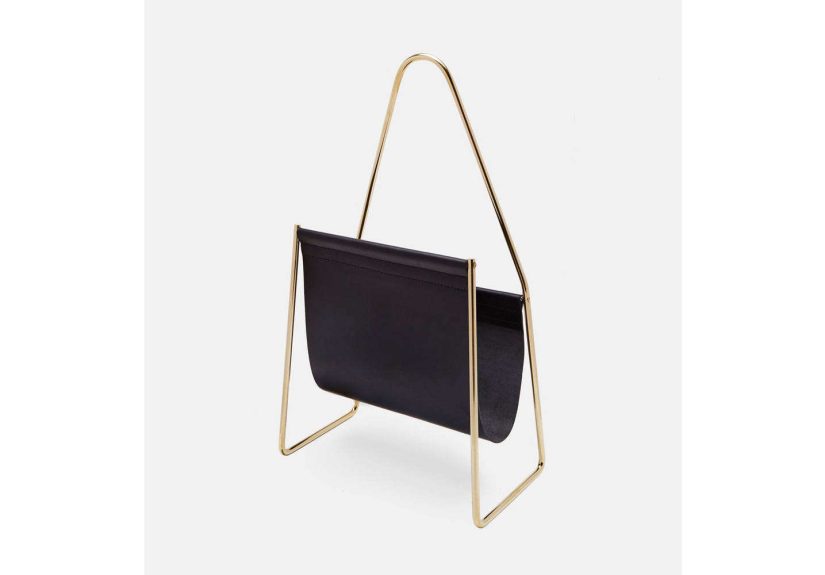
Many of the most recognizable Auböck magazine racks pair a brass frame with a leather sling. [4][5]
It’s not just a “luxury” moveit’s a sensory one. Brass gives you weight and crisp edges; leather gives you
warmth, flex, and that soft curve that makes a stack of paper look intentional.
And then there’s patinathe unofficial co-designer. Vintage pieces often show gentle wear and darkening on the
brass and a deepening tone on the leather. Sellers frequently describe this aging as part of the charm, not a
flaw. [4][5][6]
Key models and variations you’ll actually see (with real dimensions)
Auböck magazine racks show up in a handful of recognizable model numbers and formats. Think of them like
“silhouettes” rather than strict templates: proportions matter, craftsmanship matters, and small differences
(finish, stitching, plating) can change the personality a lot.
Model 4101: the “double-sided” classic (the one collectors stalk)
If you’ve seen a large, double-sided Auböck magazine rack that looks like it could host a serious newspaper
collection without breaking a sweat, you’ve probably met model 4101. Listings describe it as a 1950s
double-sided rack in brass and leather, designed and made in Vienna. [4]
- Typical materials: brass frame + leather [4]
- Example dimensions: about 19″ H × 23″ W × 12″ D [4]
- Collector vibe: “statement piece,” but still genuinely useful
Auction references also place model 4101 around c. 1950 in leather and brass, underscoring that this isn’t a new
“retro-inspired” shapeit’s a period design that got it right the first time. [12]
Model 3808: tall, narrow, and architectural
Model 3808 is a favorite for smaller rooms because it’s compact in footprint while still giving you that tall,
sculptural presence. It’s frequently described as a 1950s brass-and-leather rack with a well-balanced, modernist
formand it tends to photograph absurdly well from almost any angle. [5]
- Example dimensions: about 20″ H × 12″ W × 6″ D [5]
- Design note: the height makes it feel like a “mini sculpture” beside a chair or desk
Model 4020: all-brass minimalism (no leather, no problem)
Want the Auböck attitude with an even cleaner material story? All-brass versions like model 4020 show up as
minimalist, heavy, smooth-to-the-touch racks from the 1950s. [6] These lean harder into “metal object”
territorygreat if your space already has leather elsewhere and you don’t want to repeat the texture.
- Example dimensions: about 18.11″ H × 11.02″ W × 5.51″ D [6]
- Style effect: crisp, architectural, and very “mid-century without trying”
Nickel-plated and custom-scale pieces: the rarities
Not all Auböck magazine racks are “standard.” Some appear in nickel-plated brass with topstitched leather and
unusually large proportions. Dealers have even described certain examples as possibly custom due to their scale
relative to what’s commonly seen. [7] That’s a big part of the fun: you’re shopping a design language,
not a single factory SKU.
Modern production: yes, you can buy a new one
The workshop continues to produce classic designs, and modern retail partners sometimes offer made-to-order
magazine racks in polished brass and leather. [1][8] For example, one contemporary offering lists a
made-to-order rack in polished brass and leather with dimensions around 19″ H × 11″ L × 6″ W and a short lead
time. [8] If you want the look without the vintage hunt, this route is legitimately appealing.
How to style a Carl Auböck magazine rack (without turning your home into a design showroom)
The “reading nook anchor” move
Put the rack next to a lounge chair with a throw and a small side table. The rack becomes a vertical accent that
visually “frames” your reading corner. Bonus: it makes your magazines look curated, even if you bought them
because the cover promised “11 pasta recipes in 11 minutes” and you panicked at the grocery checkout.
The office upgrade that doesn’t scream “corporate”
In a home office, an Auböck rack works as a paper corral for catalogs, sketchbooks, oversized notebooks, or
printouts you swear you’ll file later. Brass and leather also play nicely with walnut desks, black steel task
lamps, and warm-white lightingclassic modernist ingredients.
The fireplace / living room “functional sculpture” placement
If you have a fireplace wall, the rack can sit near the hearth as a sculptural object that also happens to store
reading material. This is where patina really earns its keep. A slightly aged brass finish reads warm and lived-in,
not shiny and precious. [4][6]
Buying guide: how to shop like a collector (even if you’re just trying to tame paper chaos)
1) Confirm what “Carl Auböck” means in the listing
Many magazine racks are credited specifically to Carl Auböck II, and the workshop continued through later
generations. [1][3] It’s normal to see “Werkstätte Carl Auböck” listed as maker/manufacturer, with the
design attributed to Auböck II depending on the era and model. [4][5] If a listing is vague, ask for
documentation, model number references, and close-up photos.
2) Look for model numbers, marks, and construction details
- Model numbers: You’ll often see 4101, 3808, 4020, and others referenced. [4][5][6]
- Marks: Some examples are described as marked on the base. [4]
- Leather work: Topstitching, rivets, and the way leather wraps or slings can be clues. [7]
- Weight and feel: Brass versions are often described as heavy and smooththis isn’t flimsy décor. [6]
3) Be honest about condition (patina is charming; damage is expensive)
Vintage listings regularly mention patina on brass and leather as expected age-related character. [4][5][6]
That’s normal. What you want to watch for: tears at stress points in the leather sling, loose joints, or aggressive
polishing that removed detail. Some sellers will offer to polish; others deliberately keep the aged finish because
collectors like it that way. [5]
4) Understand price signals (and why “cheap” can be suspicious)
Auction estimates and sale results can give a rough sense of market demand for specific models. For instance,
a documented model 4101 has appeared with an estimate in the low-thousands range, and model 4488 has shown strong
results in a curated design auction context. [12] That doesn’t mean every rack is worth the samecondition,
provenance, and rarity matterbut it does explain why “too good to be true” pricing deserves extra scrutiny.
5) Vintage vs. new: choose your adventure
If you love history, hunt vintagepatina, provenance, and that “this has lived” feeling. If you want clean
polish and predictable condition, modern made-to-order options exist, often listing materials, origin, and
dimensions clearly. [8] Either way, you’re buying into a design language that has stayed relevant for decades.
Care and maintenance: keep the brass handsome and the leather happy
Brass: decide your finish philosophy
A big part of Auböck charm is the way brass ages. Many owners intentionally keep patina because it softens the
look and makes the piece feel more “collected” than “newly unboxed.” [4][6] If you prefer shine, use a gentle
approach: spot-test, avoid harsh abrasives, and don’t erase character that took decades to earn.
Leather: treat it like a quality bag, not like a disposable strap
Keep leather out of prolonged direct sun, wipe dust with a soft cloth, and condition lightly if it looks dry.
Avoid soaking cleanersespecially near stitching or wrapped areas. If the rack is vintage, remember that leather
is part of the original “architecture,” not just decoration. [4][5][7]
Why copies don’t hit the same (and why the original keeps winning)
The simplest answer: proportion and craft. Even design writers who admire Auböck in broad terms point out that
imitations miss the subtle balance of the originals. [9] On a magazine rack, that balance shows up everywhere:
the handle feels right in the hand, the frame doesn’t wobble, the sling curves correctly under weight, and the
whole piece holds paper without looking like it’s doing chores.
There’s also institutional and cultural reinforcement. Museum contexts and design-world commentary keep Auböck
in the conversationwhether through modern design collections, exhibitions, or the general recognition of Auböck
metalwork as part of 20th-century applied arts. [1][10][11] Translation: this isn’t a fleeting trend item.
Living With a Carl Auböck Magazine Rack: Real-World Experiences
You don’t really “own” an Auböck magazine rack the way you own a plastic bin. You end up negotiating a small
relationship with itmostly because it keeps showing up in your life in surprisingly practical ways.
The first experience most people report (even if they don’t say it out loud) is the weight.
Brass has presence. When you lift a rack, it doesn’t float; it commits. All-brass versions are often described
as heavy and smooth, and that heft changes how you use it. [6] You’re less likely to kick it aside or shove it
into a corner, because it feels like a real object that deserves a real spot.
The second experience is the way it makes paper behave. Magazines and newspapers tend to look messy
because their edges flare and their covers fight for attention. A leather sling gently compresses a stack so it
reads like a single “bundle” instead of a paper avalanche. That’s why brass-and-leather examples are so beloved:
the material does organizational work without looking like office equipment. [4][5]
Then comes the sneaky surprise: the rack becomes a movement tool. On busy days, it works like a
portable reading stationcarry it from living room to desk, desk to bedroom, bedroom back to the living room
because you “definitely” weren’t going to read in bed and you “definitely” didn’t fall asleep two pages in.
The handle makes this feel intentional instead of improvised, and that’s part of the Auböck magic: it treats
everyday habits like they deserve good design.
Patina is the long-game experience. Vintage listings consistently describe age-related wear as normal and even
desirablebrass darkens, leather softens, and the piece starts to look like it belongs to your home rather than
merely sitting in it. [4][5][6] Owners who lean into patina often find the rack becomes more forgiving visually:
fingerprints don’t matter as much, tiny scuffs feel like “life,” and the whole object reads warmer. In contrast,
people who prefer polished brass tend to enjoy the rack as a crisp accentespecially in clean-lined, modern
interiors where bright metal provides a deliberate highlight. [8]
Finally, there’s the social experiencebecause someone will ask about it. An Auböck rack is recognizable enough
to start conversations, but not so loud that it feels like a novelty. It lives in that sweet spot where a guest
can admire it without feeling like they need a design degree to do so. And the best part? You get to answer
casually, like: “Oh, that? Just a little Viennese modernism.” (Say it with a straight face. This is important.)
Conclusion
A Carl Auböck magazine rack is one of those rare home objects that can be both intensely practical and quietly
iconic. It’s the intersection of Bauhaus-era modern thinking, Viennese craft, and the workshop’s signature humor
and material play. [1][2][3] Whether you buy vintage for the patina or buy new for the polish, you’re getting a
piece that turns the humble act of storing magazines into something that lookssomehowlike design.
And if nothing else, it will finally answer the age-old question: “Where do I put these magazines?” with a
response that feels suspiciously like a compliment.