Table of Contents >> Show >> Hide
- What “Hard Rock Maple” Really Means (and Why It’s a Big Deal)
- So What Does “Blended” Mean in Blended Hard Rock Maple?
- Where Blended Hard Rock Maple Shines
- Finish Choices: Oil vs. “Varnique” (Polyurethane) and How to Pick
- Care & Maintenance: The Low-Drama Routine That Keeps Maple Happy
- Why “North American” Matters: Sourcing, Quality, and Standards
- Buying Checklist: How to Choose the Right Blended Maple Top
- FAQs: Fast Answers to Common Questions
- Hands-On Experiences With Blended North American Hard Rock Maple (Extra ~)
- SEO Tags
“Blended North American Hard Rock Maple” sounds like a craft cocktail you’d order at a lumberyard speakeasy.
But in the real world, it’s a very specific (and very useful) way to build maple butcher block surfaces
the kind you see on kitchen islands, bakery tables, workstations, and anywhere life involves knives, dough,
hot mugs, and the occasional “oops” with a cast-iron pan.
This guide breaks down what the phrase actually means, why it’s popular, how it performs, and what you’re
signing up for in terms of looks and maintenance. Spoiler: it’s sturdy, it’s beautiful, and it will absolutely
develop “character” if you live like a normal human.
What “Hard Rock Maple” Really Means (and Why It’s a Big Deal)
“Hard rock maple” is a common industry nickname for hard maplemost often sugar maple
(Acer saccharum)a North American hardwood known for its density, abrasion resistance, and clean, tight grain.
It’s the maple you’ll find in heavy-duty applications like work surfaces, flooring, and sports courtsbasically,
places where wood goes to prove it’s not delicate.
Hard maple vs. soft maple: not a band feudan actual difference
“Hard maple” generally refers to sugar maple (and sometimes black maple), while “soft maple” is a category
that includes species like red maple and silver maple. Soft maple can still be a good wood, but it’s typically
less hard and less dense than sugar maple. For a countertop or a baker’s table that’s going to take daily use,
hard maple is the classic choice.
Key performance traits you’ll notice in everyday life
- Durability: Hard maple resists dents and abrasion better than many domestic hardwoodsgreat for busy surfaces.
- Uniform texture: Its fine, even grain sands smoothly and looks “clean” even in large panels.
- Color range: You’ll see creamy white to light reddish-brown tones, with occasional figuring like curly or bird’s-eye in some boards.
- Movement is real: Like all solid wood, maple responds to humidity. Smart construction and proper sealing help manage that.
So What Does “Blended” Mean in Blended Hard Rock Maple?
“Blended” here is about construction style and visual character, not a mystery mix of species.
In blended maple butcher block tops, manufacturers typically use:
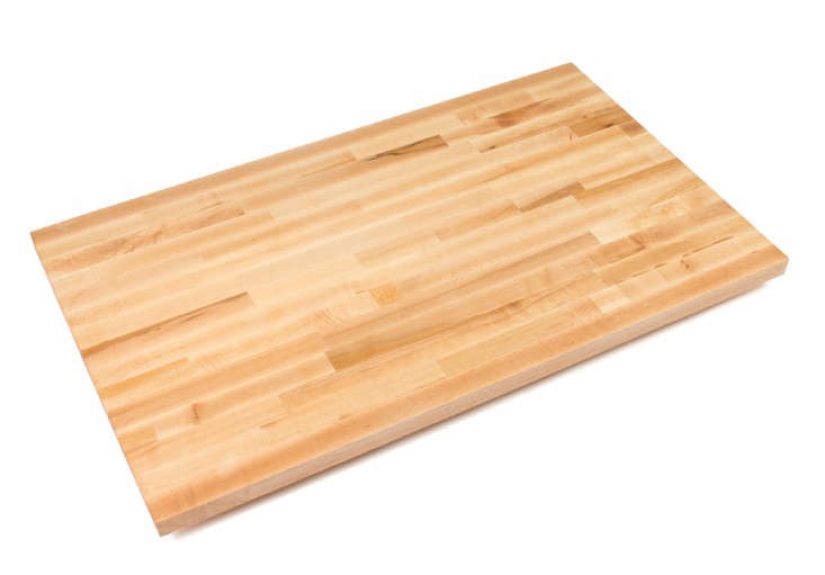
- Full-length exterior rails (long, continuous boards on the outer edges)
- Random finger-jointed interior rails (shorter pieces joined end-to-end inside the panel)
- A mix of heartwood and sapwood, which naturally creates more variation in color and mineral streaking
In other words: the perimeter looks more “continuous,” while the interior is a practical, stable mosaic of
shorter pieces. This is one reason blended tops are often marketed as a more affordable butcher block option
they make excellent use of high-quality maple while reducing waste from shorter lengths that might otherwise
be harder to use in long-rail construction.
Why finger-jointed interiors are common (and not a “cheap shortcut”)
Finger-jointing is a proven woodworking method that creates strong end-to-end joints and allows manufacturers
to build large, stable panels from shorter stock. Done well, it’s not flimsyit’s efficient engineering.
The bigger difference is aesthetic: blended tops show more “patchwork” variety, which many people love
because it feels warm, lived-in, and a little rustic.
Where Blended Hard Rock Maple Shines
1) Kitchen countertops and islands
If you want a surface that looks inviting and feels good to work onespecially for bakingmaple is a star.
Blended tops are popular for islands and long runs where you want the butcher block vibe without the premium
price tag of ultra-uniform, full-length rails.
Real-world example: A 1.5-inch blended maple island top becomes the “everything station”:
coffee in the morning, homework at night, and the weekend sourdough project that makes your kitchen look like
a tiny French bakery (even if your loaf looks like a confused frisbee).
2) Baker’s tables and commercial prep surfaces
Blended hard rock maple is common in bakery and restaurant work tables, where the surface needs to handle
repeated impact, rolling, and cleaning. Many of these tops are sold with oil finishes and certifications
aimed at foodservice settings, depending on the product line.
3) Workbenches, studios, and “serious hobby” spaces
Hard maple is a classic workbench material because it takes abuse without turning into splinters and regret.
A blended maple top can be a fantastic choice for craft rooms, sewing stations, garages, or maker benches where
you want a tough surface that still looks good indoors.
Finish Choices: Oil vs. “Varnique” (Polyurethane) and How to Pick
The finish determines whether your countertop behaves like a giant cutting board or like a sealed furniture top.
The two most common directions are:
Oil finish (the “I actually use this surface” option)
An oil finish soaks into the wood fibers and is designed to be renewed. It’s ideal if you plan to chop directly
on the surface, knead dough, or want a natural feel. The tradeoff is maintenance: you’ll re-oil periodically.
The upside is forgivenessscratches and dry spots can usually be spot-fixed without refinishing the whole top.
Film finish / polyurethane (“varnique”) (the “near the sink” option)
A film finish sits on top of the wood and seals it. If your butcher block is close to a sink, dishwasher steam,
or you simply want low maintenance, a sealed finish can be the calmer choice. You typically wouldn’t chop
directly on it (you’ll scar the finish), but it cleans easily with mild soap and water and handles everyday life
with less fuss.
Practical rule: If the surface will see standing water, frequent splashes, or sink cutouts,
lean toward a well-applied film finish (or be extremely disciplined about wiping and oiling an oiled top).
Care & Maintenance: The Low-Drama Routine That Keeps Maple Happy
Daily cleaning
- Wipe with a damp cloth and mild soap if needed.
- Dry itwood and lingering puddles are not friends.
- Avoid soaking or letting wet towels camp out on the surface.
Oiling schedule (for oil-finished tops)
New oil-finished wood often drinks oil like it just walked out of a desert. Expect more frequent oiling at first,
then taper off as the wood stabilizes. A common approach is “more early, less later,” and re-oil anytime the surface
looks dry or chalky.
Important: choose the right oil
Use food-safe mineral oil or a butcher block conditioner designed for wood surfaces. Avoid regular cooking oils
(like olive or vegetable oil) for maintenance because they can go rancid and leave odors or flavors behind.
Quick fixes you’ll actually use
- Light scratches: fine sanding in the direction of the grain, then re-oil.
- Water marks: often improve with gentle sanding and conditioning once the wood fully dries.
- Small dents: sometimes steam can lift fibers, but test cautiously and follow the finish type you have.
Why “North American” Matters: Sourcing, Quality, and Standards
Hard maple is widely harvested and manufactured across the U.S. and Canada. In some industrieslike athletic flooring
hard maple has strict standards and grading systems, and certain certifications focus on sourcing and manufacturing
location. If you care about sustainability, look for products that offer options like FSC-certified tops,
and ask suppliers about chain-of-custody documentation.
Also: maple’s legendary reputation isn’t just marketing. It became a staple in demanding applications (think factory floors
and sports courts) because it performs under repeated impact and wear. That same toughness is exactly why it’s so satisfying
in a kitchen or workshop.
Buying Checklist: How to Choose the Right Blended Maple Top
- Confirm it’s hard maple (sugar/rock maple): Don’t assume all “maple” is the same.
- Pick the finish based on reality: Oil for direct cutting and easy spot repair; film finish for low maintenance and wet zones.
- Check thickness: 1.5″ is common for countertops; thicker tops feel more substantial and can be more forgiving over time.
- Expect variation: “Blended” means mineral streaks, heartwood/sapwood contrast, and a more rustic look.
- Plan for movement: Use proper installation methods that allow seasonal expansion and contraction.
- Ask about certifications: NSF components (for some foodservice products) or FSC availability, depending on your needs.
FAQs: Fast Answers to Common Questions
Is blended maple “lower quality” than full-length rail tops?
Not automatically. Blended construction is often a value-driven design choice, not a structural downgrade.
The key is manufacturing quality: well-made finger joints and proper lamination create a strong panel. What changes most is the lookmore variation and a more “butcher block” mosaic feel.
Will it stain?
Maple can stain if liquids sit too longespecially on oil-finished tops. The fix is usually simple: wipe promptly, keep the surface conditioned, and don’t let tomato sauce host a weekend getaway on your countertop.
Can I put hot pans on it?
Don’t. Wood can scorch, finishes can haze, and you’ll end up with a “permanent memory” you didn’t ask for.
Use trivets and let the maple stay pretty.
Is it okay near a sink?
Yeswith the right finish and good habits. If it’s oil-finished, you must be diligent about wiping water and maintaining oil. If it’s film-finished, it’s generally better protected in splash zones, but you still need to prevent standing water and protect cut edges.
Hands-On Experiences With Blended North American Hard Rock Maple (Extra ~)
If you’ve never lived with a blended hard rock maple surface, here’s the most honest preview: it won’t stay “perfect,”
and that’s kind of the point. A blended maple top tends to age like a good leather jacketscuffs happen, but they tell
a story that looks better than sterile perfection.
The first thing most people notice is the visual personality. Because blended tops often combine heartwood
and sapwood (and because the interior rails are finger-jointed), you get natural color shiftscreamy sections, warmer
honey tones, and occasional mineral streaks that look like nature’s little lightning bolts. If you’re used to uniform
quartz or solid-surface counters, this can feel surprisingly “alive.” It’s wood doing wood things, in high definition.
Then comes the tactile part. Maple has a smooth, closed grain that feels great under your handsespecially if you bake.
Kneading dough on an oil-finished maple top is one of those small luxuries that doesn’t photograph as dramatically as marble,
but it’s more enjoyable at 6 a.m. when you’re half awake and your coffee is still negotiating with your brain.
Maintenance is where the relationship becomes official. An oil-finished surface will teach you a rhythm:
wipe, dry, oil when thirsty. In the beginning, the wood can absorb oil quickly, so you might oil it more often and wonder,
“Is this countertop drinking my paycheck?” After a bit, it settles down. You’ll learn the signals: when the surface looks a
little dull, when water stops beading, when the grain feels slightly rougher. That’s your cue to condition itnot because
it’s failing, but because it’s a working surface, like a cast-iron pan that appreciates a little care.
The first scratch is a rite of passage. It usually arrives during something joyful and chaoticholiday cooking, a dinner
party, a “quick” meal prep session that turns into a kitchen marathon. The good news? On an oil-finished top, minor scratches
are rarely tragic. A light sanding and re-oil can make them fade into the background. Even better: because blended tops already
have visual variation, tiny imperfections don’t scream for attention the way they might on a uniform slab.
Over time, your maple top develops a gentle patinasubtle darkening in areas that see more use, a slightly richer tone where
hands and oils naturally contact the wood. People often end up with “zones”: the coffee corner, the chopping lane, the baking
runway. That’s not damage; that’s a map of your habits.
The best part is how forgiving the material can be when you treat it like a tool, not a museum artifact. If you want a surface
that stays identical forever, wood will annoy you. But if you want something that feels warm, works hard, and can be refreshed
when life happens, blended North American hard rock maple is a satisfying, practical kind of beautiful.