Table of Contents >> Show >> Hide
- Understanding Knee Osteoarthritis (and Why Exercise Helps)
- Safety First: How to Exercise with Osteoarthritis Knee Pain
- Best Strengthening Exercises for Osteoarthritis Knees
- Stretching and Mobility Exercises for Stiff Osteoarthritic Knees
- Low-Impact Cardio: Moving Without Beating Up Your Knees
- Balance and Functional Exercises for Knee Osteoarthritis
- When to Adjust or Avoid Osteoarthritis Knee Exercises
- Real-Life Experiences and Tips for Sticking with Your Knee OA Exercises
- Bringing It All Together
If your knees could talk, they’d probably say something like, “Hey, can we please get a little help down here?” Osteoarthritis of the knee is incredibly common, and while it can be frustrating, the right exercises can make a huge difference in your pain, strength, and ability to move comfortably.
This guide walks you through the best osteoarthritis knee exercises, how to do them safely, and how to turn “ugh, my knees” into “okay, I can do this.” We’ll focus on low-impact, joint-friendly moves that strengthen your muscles, improve flexibility, and boost your confidence in everyday activities.
Understanding Knee Osteoarthritis (and Why Exercise Helps)
Osteoarthritis (OA) happens when the cartilage that cushions your knee joint wears down over time. That can lead to pain, stiffness, swelling, and a lovely soundtrack of pops and crackles when you move.
Here’s the important part: even though the cartilage wear can’t be reversed, movement is still one of the top recommended treatments for knee osteoarthritis. Clinical guidelines consistently recommend exercise, including strength training and low-impact aerobic activity, as a core therapy for knee OA, regardless of age or severity.
Why exercise works:
- Stronger muscles (especially your quadriceps, hamstrings, and glutes) act like shock absorbers for the knee.
- Better joint lubrication – movement helps circulate synovial fluid, which nourishes cartilage.
- Improved balance and control – this reduces the risk of falls and awkward movements that flare pain.
- Weight management and heart health – low-impact cardio supports overall health, which also helps your knees.
Safety First: How to Exercise with Osteoarthritis Knee Pain
Before getting into specific osteoarthritis knee exercises, a few ground rules will keep you on the safe side:
- Talk with your doctor or physical therapist first, especially if your pain is severe, you’ve had knee surgery, or you have other health conditions.
- Warm up gently for 5–10 minutes with light marching in place, a slow walk, or easy stationary cycling.
- Use the “good pain vs. bad pain” rule:
- Mild discomfort or muscle fatigue is okay.
- Sharp, stabbing, or worsening pain in the joint is a red flagstop that exercise.
- Start low and go slow: fewer reps, shorter holds, and smaller ranges of motion at first.
- Support yourself with a wall, counter, or sturdy chair when needed for balance.
If an exercise hurts, modify it, reduce the range of motion, or switch to a different move. No exercise should feel like your knee is being personally insulted.
Best Strengthening Exercises for Osteoarthritis Knees
Strength training is the star of the show for OA knee exercises. Targeting your quadriceps, hamstrings, glutes, and hips helps protect the joint and reduce pain.
1. Straight Leg Raises (Lying)
Best for: Early OA, higher pain days, or when bending the knee is uncomfortable.
- Lie on your back with one leg bent (foot on the floor) and the other leg straight.
- Tighten the thigh muscles of your straight leg.
- Slowly lift the straight leg about 8–12 inches off the floor.
- Hold for 3–5 seconds, then slowly lower.
- Aim for 8–12 reps per side, 1–3 sets.
Tip: Keep your lower back pressed gently toward the floor and move slowlymomentum doesn’t build muscle, it just cheats.
2. Seated Knee Extensions
Best for: People who feel unsafe on the floor or have trouble getting up and down.
- Sit tall in a sturdy chair, feet flat on the floor.
- Slowly straighten one knee until your leg is extended comfortably.
- Squeeze your thigh and hold for 3–5 seconds.
- Lower slowly and repeat on the other leg.
- Try 10 reps per side, 1–3 sets.
As you get stronger, you can add a light ankle weightbut only if it doesn’t increase joint pain.
3. Mini Squats (or Sit-to-Stand)
Best for: Building strength for everyday tasks like getting out of chairs and cars.
Option A: Mini Squats at a Counter
- Stand behind a sturdy counter or hold the back of a chair.
- Place your feet hip-width apart.
- Bend your knees slightly as if you’re starting to sit back into a chaironly go as low as feels comfortable.
- Keep your weight in your heels and your chest gently lifted.
- Return to standing. Aim for 8–10 reps, 1–3 sets.
Option B: Sit-to-Stand
- Sit on a sturdy chair with your feet flat and slightly back under your knees.
- Lean slightly forward from the hips and stand up using your legs as much as possible (use your hands on the chair only if needed).
- Slowly sit back down in a controlled way.
- Repeat 8–10 times.
This move mimics real lifebecause unfortunately, we can’t just stay on the couch all day.
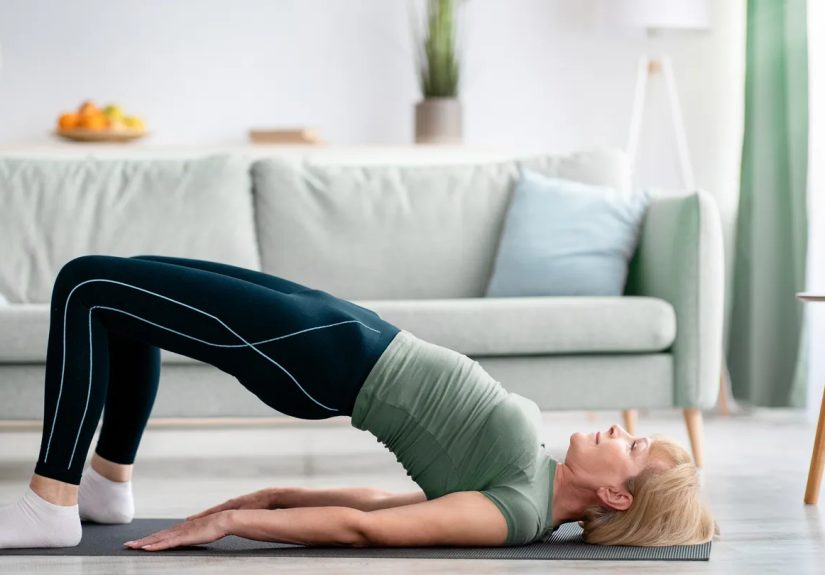
4. Bridges
Best for: Strengthening glutes and hamstrings to support the knees.
- Lie on your back, knees bent, feet hip-width apart on the floor.
- Tighten your core and squeeze your glutes.
- Lift your hips off the floor until your shoulders, hips, and knees form a gentle diagonal line.
- Hold for 3–5 seconds, then slowly lower.
- Do 10–12 reps, 1–3 sets.
If your knees complain, bring your feet slightly closer to your hips or don’t lift as high.
5. Step-Ups (Low Step)
Best for: Improving strength and balance for stairs and curbs.
- Use a low step or the bottom stair and hold onto a railing or wall for support.
- Step up with your affected leg first, then bring the other leg up to stand fully.
- Step back down with the non-affected leg first.
- Do 6–10 reps, then switch the leading leg.
Keep the step low. This is not the moment to pretend you’re in a high-intensity boot camp class.
Stretching and Mobility Exercises for Stiff Osteoarthritic Knees
Stretching the muscles around your knee can ease stiffness and improve range of motion. Gentle, consistent flexibility work pairs beautifully with strengthening exercises for knee osteoarthritis.
6. Hamstring Stretch (Seated)
- Sit at the edge of a chair.
- Extend one leg in front of you with the heel on the floor and toes pointing up.
- Keep your back straight and hinge forward at your hips (not by rounding your back) until you feel a gentle stretch in the back of your thigh.
- Hold 20–30 seconds and breathe. Repeat 2–3 times per leg.
7. Standing Calf Stretch
- Stand facing a wall with your hands on the wall for support.
- Step one foot back, keeping the heel on the floor and the back knee straight.
- Bend the front knee slightly until you feel a stretch in the calf of your back leg.
- Hold 20–30 seconds, repeat 2–3 times, then switch legs.
8. Quadriceps Stretch (Standing)
- Stand next to a wall or hold onto a chair for balance.
- Bend one knee and bring your heel toward your buttock.
- Grab your ankle (or use a strap/towel) and gently pull the heel closer until you feel a stretch in the front of your thigh.
- Keep your knees close together, and avoid arching your back.
- Hold 20–30 seconds, repeat 2–3 times per leg.
Never force a stretch; think “gentle lengthening,” not “I’m trying to fold myself like origami.”
Low-Impact Cardio: Moving Without Beating Up Your Knees
Strengthening is crucial, but the best osteoarthritis knee exercise programs also include low-impact aerobic activity. Evidence shows that low-impact cardio like walking, cycling, or water aerobics improves pain and function in knee OA and is recommended as first-line therapy.
Great options include:
- Walking: Start with 5–10 minutes on flat surfaces and build up as tolerated.
- Stationary or recumbent cycling: Gentle on the knees, and you can control resistance easily.
- Water aerobics or pool walking: Buoyancy takes pressure off the joint while still working your muscles.
- Elliptical trainer: A good option if walking on land is too jarring but cycling feels okay.
Aim for a total of about 150 minutes per week of moderate-intensity activity (like brisk walking), but build up gradually. Even 10 minutes at a time counts.
Balance and Functional Exercises for Knee Osteoarthritis
Balance work keeps you steady and confident, especially on stairs, uneven surfaces, or when your dog decides to yank you sideways on a walk.
9. Single-Leg Stand (Supported)
- Stand behind a chair or near a counter.
- Hold on lightly and lift one foot a few inches off the floor.
- Try to hold for 10–20 seconds without wobbling too much.
- Repeat 2–3 times per side.
As you improve, you can reduce how much you hold on or eventually try it without support.
10. Side Steps with Band (Monster Walk Lite)
Best for: Strengthening hips and glutes, which help control knee alignment.
- Place a light resistance band around your thighs (just above your knees) or ankles.
- Bend your knees slightly and hinge forward just a little at the hips.
- Take a small step to the side, then bring the other foot in.
- Take 8–10 steps in one direction, then go back.
Keep the steps small and controlledthis isn’t a giant monster stomp; think “gliding crab,” not “rampaging dinosaur.”
When to Adjust or Avoid Osteoarthritis Knee Exercises
While exercise is hugely beneficial, there are times when your knee is basically sending you a polite “not today, thanks.”
Pause or modify your exercises and talk with a healthcare professional if you notice:
- Sharp or worsening joint pain during or after exercise that doesn’t settle within 24 hours.
- Significant swelling, redness, or warmth in the knee.
- Sudden locking, catching, or giving way of the knee.
- New pain in the hip, back, or other areas from compensation.
Your plan should be personalized. A physical therapist can help fine-tune exercise selection, sets, reps, and progression so you’re working smart, not just hard.
Real-Life Experiences and Tips for Sticking with Your Knee OA Exercises
Knowing which exercises help knee osteoarthritis is one thing; actually doing them regularly is another story. Life is busy, motivation fluctuates, and some days your knees feel like they woke up on the wrong side of the bed.
Here are some realistic, experience-based strategies to help you stay consistent:
Make It Ridiculously Easy to Start
On tough days, tell yourself you only have to do one set or five minutes. Most people find that once they start, they end up doing more. If not, you still winyou kept the habit alive.
For example, you might say, “I’ll just do 8 straight leg raises per leg while I watch TV.” That’s under two minutes. No gym clothes. No drama. Just you, the couch, and slightly stronger quads.
Attach Exercises to an Existing Habit
Habit stacking is powerful. Try linking your knee osteoarthritis exercises to things you already do every day:
- Do seated knee extensions while your morning coffee brews.
- Add hamstring stretches after you brush your teeth at night.
- Sneak in a set of sit-to-stands during a TV commercial break.
When the exercises become part of your routine, they stop feeling like a big “project” and more like brushing your teethsimple, automatic, and non-negotiable.
Use Pain as Feedback, Not as a Verdict
It’s normal to worry: “If my knees hurt, shouldn’t I avoid moving them?” But with osteoarthritis, carefully chosen movement usually helps more than rest in the long run.
Try to think of pain like a volume knob, not an on/off switch:
- If your pain stays mild (say, 0–3 on a 0–10 scale) and settles down after you’re done, you’re probably in a good zone.
- If your pain jumps up significantly or keeps going after you stop, that’s feedback to adjust the intensity, range of motion, or number of reps next time.
This mindset shiftfrom “pain means stop forever” to “pain means tweak the plan”is a game changer for many people.
Celebrate Functional Wins, Not Just Numbers
The best part about osteoarthritis knee exercises isn’t hitting a particular rep count. It’s the real-world stuff: walking farther, climbing stairs with less dread, kneeling (carefully) to play with your grandkids, or going through the day without thinking about your knees every five minutes.
Keep an eye out for wins like:
- “I stood up from the couch without pushing off with my hands.”
- “I walked around the block and didn’t need a break halfway through.”
- “I slept better because my knees weren’t throbbing all night.”
Write these down, or note them in your phone. When motivation dips, those reminders are “evidence” that your work is paying off.
Get Support (Human or Digital)
Accountability helps. That can mean:
- Working with a physical therapist who tailors your program and progresses it safely.
- Exercising with a friend or family member (even if they’re doing different moves).
- Using a simple calendar or app to track your exercise daysnothing fancy, just checkmarks.
Some people like to keep a “knee care toolkit” at home: a yoga mat, a chair, a light resistance band, and maybe an ice pack and a heating pad. When your tools are ready and visible, starting feels easier.
Be Kind to Yourself on Flare Days
Osteoarthritis often has good days and not-so-good days. On higher pain days, it’s okay to:
- Shorten your sessions.
- Focus more on gentle stretches and simple range-of-motion exercises.
- Switch to pool exercises or short, easy walks if available.
The key is to keep some level of movement going rather than stopping everything completely for weeks. Consistency, even at a lower intensity, helps your joints feel more predictable and less fragile over time.
Bringing It All Together
Knee osteoarthritis can be discouraging, but it doesn’t get the final say in how you move. A smart, consistent exercise plan that includes strengthening, stretching, low-impact cardio, and balance work can ease pain, improve function, and help you feel more in control of your body.
Start with a few exercises from each category, do them a few times per week, and adjust based on how your knees respond. Work with your healthcare provider or physical therapist to personalize your plan, especially if you’re unsure where to start or have other medical conditions.
Your knees may not be perfect, but with the right osteoarthritis knee exercises, they can absolutely become stronger, more stable, and a lot less grumpy.
sapo: Living with knee osteoarthritis doesn’t mean giving up the activities you love. The right exercises can help you relieve pain, move more easily, and feel stronger and more confident in your daily life. In this in-depth guide, you’ll learn why exercise is a core treatment for knee OA, how to work out safely with joint pain, and the best strengthening, stretching, balance, and low-impact cardio moves to protect your knees. Plus, get realistic tips and experience-based advice for staying consistent on both good days and flare days, so your knees support your lifestylenot the other way around.