Table of Contents >> Show >> Hide
- Meet Proxima Centauri: Our “Next-Door” Star (Beyond the Sun)
- The “Ultra-Powerful” Flare: What Was Observed?
- How Do You Make a Stellar Flare? (No, You Can’t Microwave One)
- Why Red Dwarfs Like Proxima Are So Dramatic
- The 7-Second Record-Setter: A Flare That Changed the Conversation
- What This Means for Proxima b (and Any “Habitable Zone” Planet Around a Flare Star)
- Does a Proxima Flare Affect Earth?
- What We Can Learn for “Space Weather” Back Home
- How Scientists Caught It: More Eyes, More Clues
- What Comes Next: Turning One Big Flare Into Better Answers
- Experiences: What This Kind of Flare Feels Like (From Earth, and In the Lab)
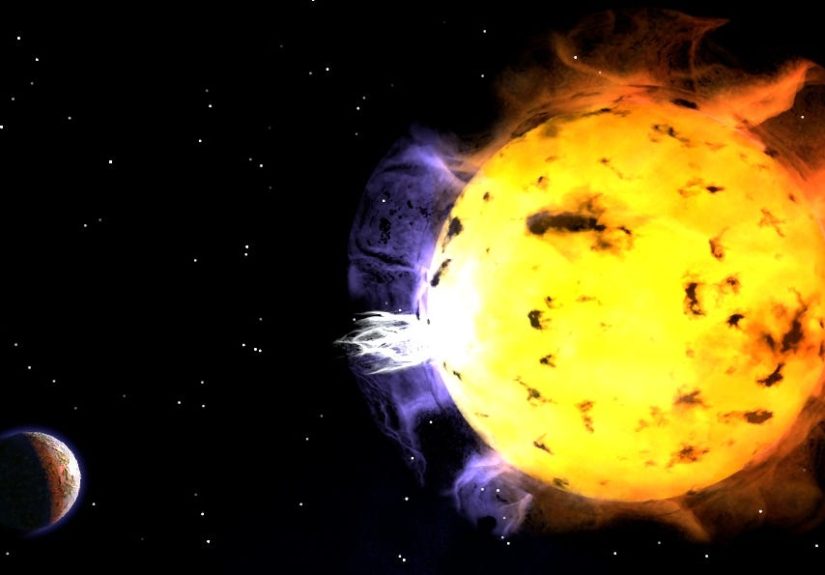
If stars had social media, Proxima Centauri would be that quiet neighbor who mostly keeps to themselves… and then suddenly posts a 68x-brighter “I’M FINE” at 3 a.m. That’s basically what happened when astronomers caught an ultra-powerful stellar flare erupting from Proxima Centaurithe closest star beyond our Sun. For a brief moment, a star that’s usually far too dim to see without a telescope dramatically brightened, unleashing a burst of radiation so intense it reignited a big question: Can a planet be “in the habitable zone” if its star behaves like a cosmic blowtorch?
Let’s break down what this flare was, why red dwarf stars like Proxima are so feisty, how scientists actually caught the outburst, and what all this means for the famous exoplanet Proxima b (and for the search for life around the most common stars in the galaxy).
Meet Proxima Centauri: Our “Next-Door” Star (Beyond the Sun)
Proxima Centauri is the nearest known star to the Sun, sitting a little over 4 light-years away in the Alpha Centauri star system. It’s a red dwarf (an M-type star), meaning it’s smaller, cooler, and dramatically dimmer in visible light than the Sun. On a normal night, Proxima is so faint (around 11th magnitude) that you won’t spot it with your eyesno matter how hard you squint. It’s the astrophysical equivalent of a porch light with a dead bulb.
And yet, Proxima hosts one of the most talked-about nearby worlds: Proxima Centauri b, a roughly Earth-mass “super-Earth” orbiting close to the star with an ~11-day year. It sits in the region where temperatures could, in theory, allow liquid waterif the planet has the right atmosphere and conditions. In other words: it’s a prime “maybe” in the cosmic real estate market.
The “Ultra-Powerful” Flare: What Was Observed?
In a widely reported superflare event, Proxima Centauri’s brightness jumped by a factor of about 68. That’s not a gentle twinkleit’s a sudden spotlight. The flare released an enormous amount of energy (often expressed in scientific units like ergs or in headline-friendly “petajoules”), putting it among the most powerful flares seen from Proxima for its size. Events like this are sometimes called superflares because they’re far more energetic than typical flares.
Proxima’s flares aren’t one-off accidents. Observations over multiple years show it produces frequent smaller flares and occasional extreme events. In other words: the star isn’t “having a moment.” This is part of its personality.
Flares come in different “flavors” of light
When people hear “flare,” they often imagine something you’d see visuallylike a brighter star. But the most important part for planets is often the high-energy radiation (ultraviolet and X-rays) and, sometimes, bursts detectable at radio and millimeter wavelengths. Those wavelengths matter because they help scientists reconstruct how much damaging radiation a nearby planet might be taking to the face… repeatedly.
How Do You Make a Stellar Flare? (No, You Can’t Microwave One)
Stellar flares are powered by magnetism. Stars are giant balls of hot, electrically charged gas, and charged gas plus motion creates magnetic fields. Those magnetic fields can twist, tangle, and store energyuntil they suddenly snap into a new configuration. That snap-and-release process is called magnetic reconnection, and it can fling energy outward as radiation and energetic particles.
NASA often describes solar storms (on our Sun) as starting when twisted magnetic fields get so contorted that they “snap and reconnect,” releasing huge energy. The same basic idea scales to other starsespecially magnetically active ones like Proxima.
Why Red Dwarfs Like Proxima Are So Dramatic
Red dwarfs are the most common stars in the Milky Way, and they’re long-livedgreat for giving life time to evolve. But many red dwarfs are also magnetically active, producing frequent flares. Proxima’s internal structure is likely highly convective (think “boiling” motion throughout much of the star), which can help generate strong, complex magnetic fields. Strong fields + constant churning = more opportunities for stored magnetic energy to get released explosively.
The tricky part is that the habitable zone is closer in around a dim star. So even if a planet sits in the “right” temperature range, it may also be parked uncomfortably close to the star’s flare zonelike renting a cozy apartment directly above a fireworks factory.
The 7-Second Record-Setter: A Flare That Changed the Conversation
Proxima’s flare reputation isn’t built on one headline. In a major multi-observatory campaign, astronomers tracked an extreme flare observed on May 1, 2019 that lasted only about seven seconds at peakbut packed a punch. The star surged to about 14,000 times brighter in ultraviolet light, while also producing an extraordinarily bright signal at millimeter wavelengths. Importantly, this event was captured across multiple parts of the electromagnetic spectrum using a coordinated set of ground- and space-based observatories.
That multiwavelength coverage matters because it lets scientists connect “what we can measure easily” to “what a planet cares about most.” For example, researchers found that millimeter and far-ultraviolet emission tracked each other closely during this flare, suggesting millimeter observations could help estimate how much intense UV is being produceduseful because UV is a big driver of atmospheric chemistry and potential biological harm.
Translation: This wasn’t just a big flareit was a better X-ray of the problem
A single, well-observed flare can teach more than a long list of poorly observed ones. The 2019 flare helped clarify how quickly Proxima can go from “quiet” to “planet-broiling,” and it strengthened the case that many red-dwarf planets face relentless radiation weather.
What This Means for Proxima b (and Any “Habitable Zone” Planet Around a Flare Star)
NASA’s exoplanet catalog lists Proxima b as a super-Earth with an ~11.2-day orbit, sitting extremely close to its star. That closeness is exactly why it was considered “potentially temperate”and exactly why flares are such a big deal.
Here are the main habitability concerns scientists discuss when a flare like this erupts:
1) Atmospheric erosion and chemical damage
Powerful flares deliver high-energy UV and X-rays that can heat upper atmospheres and drive atmospheric escape. They can also trigger chemical reactions that damage protective ozone. Some analyses suggest repeated superflares could dramatically thin ozone over time, allowing far more UV to reach the surfacebad news for surface life as we know it.
2) A “habitable zone” is not a “habitable guarantee”
The habitable zone is mostly about temperature and the possibility of liquid waternot about a planet’s magnetic shielding, atmospheric replenishment, geology, or a star’s flare frequency. Proxima b might be in a temperature-friendly orbit but still be radiation-hostile in practice.
3) Life could still be possiblejust not the postcard version
Some scientists point out that life might persist underground or under oceans, shielded from radiation. Others note that high-energy radiation can also drive useful chemistry, potentially helping generate complex organic molecules under the right conditions. The honest answer today is: we don’t know. But we do know flares shift the conversation from “Could it be Earth-like?” to “How could anything cope?”
Does a Proxima Flare Affect Earth?
Not directly. Proxima is more than four light-years away, so its flare doesn’t disrupt our satellites, GPS, or radio communications. But it matters for two huge reasons:
- Exoplanet habitability: Many of the most easily detectable Earth-size planets orbit red dwarfs. If red dwarfs are frequently violent, we need to understand whether their planets can keep atmospheresand how to identify the rare “quiet star” exceptions.
- Stellar physics and forecasting: Proxima offers a nearby laboratory for understanding how magnetic reconnection and flare energy work in stars very different from the Sun.
What We Can Learn for “Space Weather” Back Home
Our Sun also flares. NOAA classifies solar-flare impacts like radio blackouts on a scale tied to X-ray intensity (with categories often discussed as C-, M-, and X-class flares, plus radio blackout levels like R1–R5). Strong flares can disrupt high-frequency radio on the sunlit side of Earth and, when paired with coronal mass ejections, contribute to geomagnetic storms.
The key difference: the Sun’s most extreme events are relatively rare, while Proxima appears to produce strong flares far more frequently. Studying Proxima helps scientists stress-test their theories: if we can explain flare behavior in a magnetically extreme environment, we can better interpret what we see on the Sunand what we might see on other planet-hosting stars.
How Scientists Caught It: More Eyes, More Clues
Capturing a flare is partly planning and partly luck. For Proxima, astronomers have used a mix of tools:
- Wide-field optical monitoring to catch sudden brightening events, including rare superflares that spike dramatically.
- Radio and millimeter observatories (like ALMA-related campaigns) to detect flares in wavelengths once thought unlikely for stars like Proximaopening a new diagnostic window into flare energy.
- Space telescopes capable of measuring ultraviolet light, which is crucial for understanding how flares affect planetary atmospheres.
The big win of modern flare science is coordination: observing the same event across many wavelengths helps researchers connect the dots between magnetic physics, radiation output, and potential consequences for orbiting worlds.
What Comes Next: Turning One Big Flare Into Better Answers
Recent work continues to refine how often Proxima flares, how flare energies are distributed (many small events, fewer big ones), and how the biggest flares behave over timeoften with a fast spike followed by a longer fade. Those statistics matter because planet habitability depends not just on one catastrophic blast, but on the long-term “radiation climate.”
The next steps scientists focus on include:
- Measuring flare rates more precisely at multiple wavelengths (especially UV and millimeter).
- Improving models of atmospheric loss and ozone chemistry for planets around active red dwarfs.
- Looking for signatures of particle storms and possible stellar ejections that may accompany flares.
- Identifying which nearby red dwarfs are calmer, and which are chronically explosive.
Bottom line: Proxima’s ultra-powerful flare isn’t just a scary story about a “crispy planet.” It’s a data-rich reminder that in astronomy, the neighborhood is close enough to studyand wild enough to keep scientists humble.
Experiences: What This Kind of Flare Feels Like (From Earth, and In the Lab)
Most people won’t ever “see” Proxima Centauri the way they see a bright star like Sirius. It’s too faint, and it sits low in the sky for much of the United States. But the experience of a flare like this still lands in surprisingly familiar waysbecause stellar tantrums, whether from Proxima or our own Sun, have a way of connecting the abstract universe to everyday life.
Start with the human experience of sudden change. A flare is the cosmic version of a quiet room interrupted by a smoke alarm: everything is normal… until it isn’t. In observatories and research groups, that “alarm” can arrive as an unexpected spike in a light curve. Someone checking a dashboard sees a line shoot upward, and the first reaction is rarely poetic. It’s practical: “Is the instrument okay?” “Is this a glitch?” “Did we just catch something real?” That momenthalf excitement, half suspicionis the heartbeat of observational astronomy.
Then comes the scramble that looks suspiciously like group-project energy (but with more expensive equipment). Multiwavelength flare campaigns create their own kind of experience: comparing timestamps, aligning data streams, and watching different parts of the spectrum “light up” like a synchronized fireworks show. Optical might rise and fall differently than ultraviolet; millimeter signals can spike in ways that challenge assumptions. The experience is less like watching one event and more like assembling a story from multiple camera angles.
For non-scientists, the closest emotional parallel is often space weather. If you’ve ever relied on radio communication, flown on a route that cares about polar conditions, or watched aurora photos explode across social media after a geomagnetic storm, you’ve felt the cultural aftershocks of flareseven when the culprit is our Sun, not Proxima. There’s a unique flavor of awe in realizing that something happening on the Sun can ripple into GPS accuracy, satellite drag, or radio reception. That feeling is basically the same lesson Proxima teachesjust projected onto exoplanets instead of Earth.
There’s also a quieter, more personal kind of experience: the shift in how you imagine “habitable.” Many people grow up with a tidy idea that a planet is either like Earth (good) or like Mercury (bad), and that distance from a star solves the puzzle. Learning about Proxima’s flares changes that. It turns habitability into a living, breathing system: atmosphere, magnetism, chemistry, radiation, geology, and time. The experience is like discovering that “location, location, location” is truebut only after you read the fine print about storms, neighborhood noise, and whether the roof leaks.
Finally, there’s the experience of wonder that comes from scale. A flare that lasts seconds can shape a planet’s fate over billions of years. That contrasttiny in time, enormous in consequencecan be oddly grounding. It reminds you that the universe isn’t just big; it’s dynamic. Stars aren’t fixed background lights. They’re active machines, constantly converting magnetic tension into bursts of radiation, and quietly rewriting the rules for what it means to live “nearby.”
So even if you never point a telescope at Proxima Centauri, the experience of this story is still yours: the moment you realize that the nearest neighbor star isn’t just closeit’s loud. And that the search for life isn’t only about finding the right planet. It’s also about finding the right kind of star to live with.