Table of Contents >> Show >> Hide
- The Squat Basics That Make Every Variation Work Better
- How to Choose the Right Squat Variation for Your Goal
- 45 Squat Variations to Maximize Your Workout
- A) Bodyweight Foundations, Control Builders, and Conditioning
- B) Mobility, Lateral Strength, and “Different Angle” Squats
- C) Dumbbell, Kettlebell, and Landmine Squat Variations
- D) Barbell, Specialty Bar, and Machine Squat Variations
- E) Single-Leg Squat Variations for Balance, Athleticism, and Symmetry
- How to Program Squat Variations Without Turning Leg Day Into Chaos
- Common Squat Problems (and Quick Fixes That Actually Help)
- Real-World Training Experiences: What People Notice When They Rotate Squat Variations (500+ Words)
- Conclusion
Squats are the “Swiss Army knife” of lower-body training: they build strength, improve athletic performance, reinforce
daily movement (standing, sitting, climbing), and light up your legs and glutes in a way that makes stairs feel like a
personal vendetta. But doing the same squat the same way forever is like watching the same episode on repeateventually
your progress (and your motivation) stops buffering.
That’s where squat variations come in. Changing your stance, tempo, load position, or stability demands can shift
emphasis to your quads, glutes, adductors, core, or upper backwhile also keeping your joints happier and your training
more interesting. Below, you’ll learn the form “non-negotiables,” how to pick the right squat variation for your goal,
and a menu of 45 squat variations you can rotate to maximize your workouts.
The Squat Basics That Make Every Variation Work Better
Before you collect squat variations like Pokémon, lock in the fundamentals. These cues apply whether you’re doing a
bodyweight squat at home or a barbell back squat in a rack.
1) Brace first, then move
Think “ribs down, belly tight.” Take a breath into your midsection, then lightly brace like someone is about to poke
you in the sides. This helps keep your spine stable so your hips and knees can do the heavy lifting.
2) Feet stay planted and pressure stays honest
Keep your whole foot connected to the floorespecially the midfoot and heel. If your heels pop up, your squat turns
into a calf exercise (surprise!) and your balance gets wobbly.
3) Knees track with your toes
Your knees don’t need to be glued in place, but they should generally follow the direction your toes point. A little
forward knee travel is normalespecially if you have the ankle mobility for it. The goal is controlled motion, not
knee chaos.
4) Squat as deep as you can while staying strong
“Ass to grass” is cool… if you can keep a stable trunk and neutral-ish spine. If your lower back tucks hard at
the bottom (classic “butt wink”), reduce depth, use a box target, elevate your heels, or work on mobility. Depth is a
tool, not a personality trait.
How to Choose the Right Squat Variation for Your Goal
The “best” squat variation depends on what you’re trying to improve. Pick 1–2 primary squat patterns for your main
goal, then add 1–2 accessory variations to fill gaps (mobility, stability, hypertrophy, power, or conditioning).
If you want more quad growth
Choose variations that keep your torso more upright and your knees traveling forward in a controlled way: front squat,
goblet squat, heels-elevated (cyclist) squat, hack squat machine, and some split squat setups.
If you want stronger glutes and posterior chain
Use variations that allow more hip involvement: low-bar back squat, box squat, sumo squat (wide stance), belt squat
(heavy quad + glute stimulus without as much spinal loading), and many unilateral options.
If you want a stronger core and upper back
Front-loaded and overhead variations demand more trunk stiffness: front squat, Zercher squat, and overhead squat.
Thrusters add a big conditioning component too.
If you want better mobility and joint-friendly volume
Use assisted squats, deep squat holds, tempo work, and box targets. These let you practice clean reps without turning
every set into a form survival show.
45 Squat Variations to Maximize Your Workout
Use this list like a menu: pick what matches your equipment, skill level, and goal. For each movement, start with
a variation you can control perfectly, then progress by adding load, slowing tempo, increasing range of motion, or
choosing a more challenging stability demand.
A) Bodyweight Foundations, Control Builders, and Conditioning
-
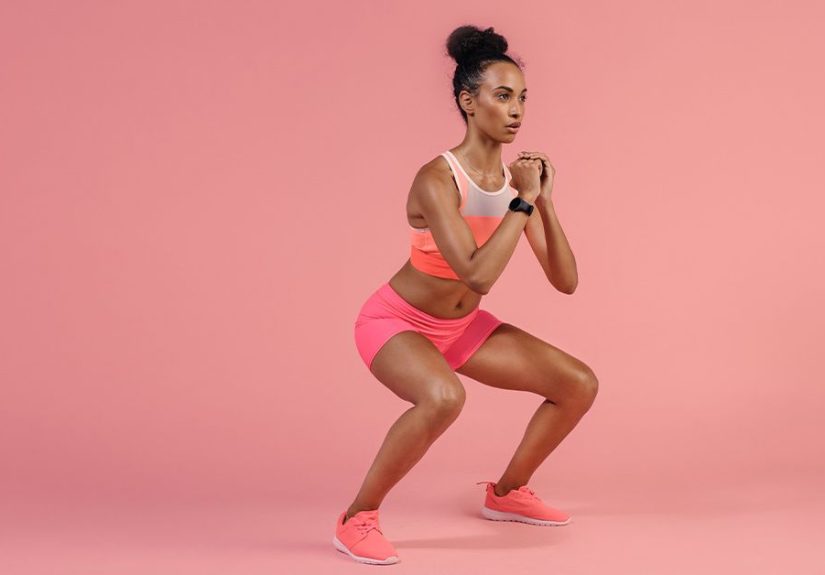
Air Squat (Bodyweight Squat)
The classic. Great for learning mechanics, warming up, and building reps without equipment.
-
Box Squat to a Bench/Chair (Bodyweight)
Sit back to a target, lightly tap, then stand. Perfect for learning depth and staying consistent rep to rep.
-
Tempo Air Squat
Slow the lowering phase (e.g., 3–5 seconds). Builds control, tension, and “honest” technique.
-
Pause Air Squat
Pause 1–3 seconds at the bottom. Great for stability, positioning, and getting stronger out of the hole.
-
Pulse Squat
Small up-and-down pulses near the bottom. Best as a finisher for burn and time under tension (not your main strength tool).
-
Narrow-Stance Squat
Feet closer than shoulder width. Often increases quad demand and makes depth harder (in a useful way).
-
Sumo Squat (Wide-Stance Squat)
Feet wider, toes turned out. Often hits adductors and glutes more while reducing forward knee travel.
-
Heels-Elevated Squat (Cyclist-Style)
Raise heels on small plates or a wedge to help upright posture and deeper knee bendhello, quads.
-
Prisoner Squat
Hands behind your head. Encourages tall posture and adds a sneaky upper-back endurance challenge.
-
TRX/Suspension-Assisted Squat
Hold straps for balance. Fantastic for learning depth and control while reducing fear of tipping.
-
Wall Sit (Isometric Squat Hold)
Hold thighs near parallel against a wall. Brutal for quad endurance and mental toughness (politely optional).
-
Deep Squat Hold (Prying Squat)
Sit in a comfortable deep squat and “pry” hips gently. Great mobility and breathing practice.
-
Jump Squat
Squat down, explode up, land softly. Builds powerkeep reps low and technique crisp.
B) Mobility, Lateral Strength, and “Different Angle” Squats
-
Cossack Squat
Shift side to side into a deep lateral squat. Excellent for adductors, hips, and side-to-side control.
-
Curtsy Squat
Step one leg behind and across, then squat. Challenges glute med stability and hip control.
C) Dumbbell, Kettlebell, and Landmine Squat Variations
-
Goblet Squat
Hold a dumbbell or kettlebell at your chest. One of the best “learn to squat well” loaded variations.
-
Dumbbell Front Squat (Two DBs Racked)
DBs at shoulders, elbows slightly forward. Great quad/core combo without needing a barbell rack.
-
Dumbbell Back Squat (DBs at Shoulders)
Keep DBs stable at the shoulders. A solid option when you want load but not a barbell setup.
-
Dumbbell Sumo Squat
Wide stance with a DB hanging between legs. Often feels friendlier on hips while hammering adductors/glutes.
-
Suitcase Squat (Single DB/KB)
Hold one weight at your side. Challenges lateral core stability while training the squat pattern.
-
Single-Kettlebell Front Rack Squat
KB racked on one side. Forces your trunk to resist rotation and side-bendingcore training disguised as leg day.
-
Double Kettlebell Front Squat
Two KBs in the rack position. Big-time bracing, big-time quads, and a posture reality check.
-
Landmine Squat
Barbell anchored in a corner/landmine base, held in front. Natural arc often feels shoulder- and back-friendly.
-
Landmine Hack Squat
Landmine setup with the bar angled behind you. Can mimic hack-squat mechanics and emphasize quads.
-
Dumbbell Thruster
Front squat into an overhead press. Full-body conditioning with legs doing most of the complaining.
D) Barbell, Specialty Bar, and Machine Squat Variations
-
High-Bar Back Squat
Bar sits higher on traps. More upright torso for many lifters; great general strength builder.
-
Low-Bar Back Squat
Bar sits lower across rear delts. Often allows heavier loads and more hip involvement.
-
Barbell Front Squat
Bar racked on the front of shoulders. Quad-focused with huge core and upper-back demands.
-
Zercher Squat
Bar held in the crook of elbows. Front-loaded challenge that lights up trunk and upper back.
-
Overhead Squat
Bar overhead with locked arms. Elite-level mobility + stability; go light and treat it like a skill.
-
Barbell Box Squat
Squat to a box, pause briefly, then stand. Great for consistent depth and building power from a dead stop.
-
Barbell Pause Squat
Pause at the bottom under load. Builds confidence, control, and strength where most people get wobbly.
-
Barbell Tempo Squat
Slow eccentric (and sometimes slow concentric). Great for technique, hypertrophy, and staying humble.
-
Pin Squat (Anderson Squat)
Start from pins in a rack (or pause on pins). Teaches powerful drive and clean positioning.
-
Safety Bar Squat
Specialty bar that shifts load slightly forward. Often easier on shoulders; great for upper back and quads.
-
Hatfield Squat
Usually with a safety bar plus holding rack handles. Lets you train legs hard while assisting balance.
-
Smith Machine Squat
Fixed bar path. Useful for hypertrophy when you want stabilityjust set your feet to match your natural pattern.
-
Hack Squat Machine
High quad emphasis with less balance demand. Great for high-effort leg work after free-weight squats.
-
Belt Squat
Load hangs from a belt at the hips. Allows heavy leg training with less spinal loading.
-
Barbell Hack Squat (Bar Behind Legs)
Bar held behind you near calves. Quad-heavy and awkward at firststart light and move carefully.
E) Single-Leg Squat Variations for Balance, Athleticism, and Symmetry
-
Split Squat (Stationary Lunge Squat)
One foot forward, one back, torso tall. Builds unilateral strength and exposes side-to-side differences fast.
-
Bulgarian Split Squat (Rear-Foot Elevated)
Back foot elevated on a bench. One of the best “brutally effective” leg buildersprogress gradually.
-
Front-Foot Elevated Split Squat
Front foot on a small platform. Often increases range of motion and glute involvement.
-
Pistol Squat
Single-leg squat with the other leg extended forward. A strength + mobility skilluse a box or support to scale.
-
Skater Squat
Single-leg squat with the non-working knee tracking down behind you. Great progression toward pistols with less ankle demand.
How to Program Squat Variations Without Turning Leg Day Into Chaos
Variety is powerful, but random variety is just cardio with paperwork. Here are practical ways to rotate squat variations
while still progressing.
Use a “Main + Assist” structure
Pick one main squat for 4–8 weeks (e.g., back squat, front squat, or goblet squat). Train it heavier and track load or
reps. Then add 1–2 assistance squats that target your weak links (e.g., pause squats for bottom strength, split squats
for symmetry, heels-elevated squats for quad focus).
Match reps to the variation
- Strength-focused: 3–6 sets of 2–6 reps (barbell back squat, front squat, safety bar squat).
- Hypertrophy-focused: 3–5 sets of 6–12 reps (goblet squat, hack squat machine, belt squat, split squats).
- Control/mobility: 2–4 sets of 5–10 reps with tempo or pauses (tempo squats, deep squat holds, box squats).
- Power: 3–6 sets of 3–5 reps (jump squats), resting enough to keep jumps crisp.
Don’t let “burn” replace range of motion
Squat pulses and partials can be great finishers, but full range of motion builds more transferable strength for most
people. Use pulses for a short burn after your main work, not as the core of your program.
Common Squat Problems (and Quick Fixes That Actually Help)
“My heels lift and I tip forward.”
Try: heels-elevated squats, goblet squats (counterbalance), ankle mobility work, or a slightly wider stance. Also check
that you’re keeping pressure through midfoot/heel.
“My knees cave in.”
Try: reduce load, slow the descent, and think “knees track over toes.” Add split squats, Cossacks, and tempo squats to
build control. Sometimes a slightly wider stance and toe angle helps.
“I feel my lower back at the bottom.”
Try: limit depth to the deepest position you can keep stable, use a box target, add pauses above your problem point,
or use belt squats/hack squats to reduce spinal loading while still training legs hard.
Real-World Training Experiences: What People Notice When They Rotate Squat Variations (500+ Words)
When lifters start using squat variations strategically (instead of doing the same two movements forever), a few
predictable “aha” moments show up. First: most people discover they don’t have a squat problemthey have a
specific squat problem. For example, someone might feel strong in a box squat but fold in a deep front squat.
That doesn’t mean they’re “bad at squats.” It means their sticking point is often a combination of mobility, bracing,
and posture under load. A front-loaded squat like a goblet squat or barbell front squat tends to expose posture and
trunk stiffness fast. People often report, “I can’t stay tall,” which is basically the exercise politely telling them,
“Hello, upper back and coreplease clock in.”
Second: unilateral squat variations (split squats, Bulgarian split squats, skater squats) reveal side-to-side
differences that bilateral squats can hide. A common experience is thinking you’re evenly strong… until your left leg
shakes like it’s auditioning for a washing machine commercial. The upside is huge: once people commit to a few weeks
of unilateral work, their main squat often feels more stable and coordinated, even if they never touch heavy singles.
Many lifters also notice their knees feel better when they build single-leg control, because the hips learn to
stabilize instead of letting the knee do all the “steering.”
Third: tempo and pause squats can feel emotionally rude, but they clean up technique faster than almost anything.
People frequently report that a lighter weight with a 3–5 second lowering phase feels harder than their usual
heavier setsbecause momentum is no longer doing free labor. Over time, these slower reps teach lifters where their
balance drifts (toes vs. heels), where their torso collapses, and whether they’re bracing consistently. After a month
of tempo or pause work, many lifters say their regular squats feel “snappier” out of the bottom, largely because they
learned to stay tight in the position where they used to relax and bounce.
Fourth: different loading tools change the “feel” in helpful ways. Goblet squats often feel surprisingly natural for
beginners because the front-held weight acts like a counterbalance, making it easier to sit between the hips.
Belt squats and hack squat machines get a lot of love during high-volume phases because they let people hammer legs
without their lower back becoming the limiting factor. Safety bar squats are another frequent favoritemany lifters
report they can train hard even when shoulders or elbows are cranky, and the bar position encourages a strong upper
back.
Lastly: the biggest mindset shift is realizing squat variations aren’t “random changes”they’re problem-solvers.
If your goal is bigger quads, you’ll notice how heels-elevated squats, front squats, and hack squats create a very
different thigh stimulus than wide-stance squats. If your goal is athleticism, jump squats and split squats make
your legs feel more “springy” and coordinated. And if your goal is simply to keep showing up consistently, variety
makes training more enjoyablebecause doing a new variation feels like a fresh challenge, not a stale routine.
Conclusion
You don’t need all 45 squat variations in one week (your legs would like to file a complaint). But you can
use them to train smarter: keep one main squat to progress, rotate 1–2 assistance variations to build weak links, and
sprinkle in mobility or conditioning options when your body (or schedule) calls for it. Master the basics, pick the
right tool for your goal, and you’ll turn squats from “leg day dread” into one of the most effective parts of your
program.