Table of Contents >> Show >> Hide
- 1) It Turned Comic Books Into Breaking News (Before Nerd Culture Was “Normal”)
- 2) It Popularized the “Event Comic” Playbook (and the Death That’s Really a Season Finale)
- 3) It Supercharged Collectible Culture… and Helped Fuel the Cautionary Tale That Followed
- 4) It Made “Legacy Heroes” and “Mantle Swaps” Feel Like a Blockbuster Move
- Conclusion: The Accident Was the Point
- Experiences: What It Felt Like When Superman “Died” (About )
In 1992, DC didn’t just publish a comic. It staged an event. A national “wait, they did WHAT?!” moment.
A black-bagged, armband-included, obituary-ready piece of pop culture theater that briefly made the local comic shop
feel like the hottest ticket in town.
The wild part? The creative goal wasn’t to permanently erase an icon. The goal was to tell a story big enough to
remind the world that Superman still matteredand, yes, to wake up sales that had gone sleepy. And in doing so,
The Death of Superman ended up nudging pop culture in a few directions that we’re still living with today:
how we treat fictional deaths, how we market “events,” how fandom behaves when scarcity is implied, and how the
“mantle swap” became a blockbuster-level move.
Here are four ways “Death Of Superman” (accidentally) changed pop cultureplus a last section of
real-world, you-had-to-be-there experiences that fans and shop owners still talk about like it was the moon landing,
only with more polybags.
1) It Turned Comic Books Into Breaking News (Before Nerd Culture Was “Normal”)
Today, “major superhero storyline” is basically a genre of headline. But in 1992, mainstream attention on comics
still came in bursts. “Death Of Superman” didn’t just get coverageit got the kind of coverage that made non-readers
ask, “Wait… like, THE Superman?”
It proved comics could hijack the national conversation
The storyline was discussed like a sports upset or an election twist: a scheduled date, a promised outcome,
and a public that was invited to watch the dominoes fall. The result was a rare moment where comic-book continuity
became watercooler chatter, late-night fodder, and “my mom heard about it on the news” energy.
It widened the audienceby baiting curiosity, not continuity
The genius (and the accidental cultural shift) was that you didn’t need years of back issues to “get” the hook.
“Superman dies” is an all-time simple premise. It pulled in lapsed readers, curious outsiders, and first-timers
who were less interested in lore and more interested in witnessing a cultural dare.
And that’s a blueprint pop culture keeps using: take a long-running property, distill it into one irresistible
sentence, and let the sentence do the marketing. You can draw a straight line from this to how franchises now sell
“moments” as much as they sell stories.
2) It Popularized the “Event Comic” Playbook (and the Death That’s Really a Season Finale)
“Event” storytelling existed before 1992, sure. But “Death Of Superman” helped standardize the modern playbook:
announce something unthinkable, build anticipation, make the release feel ceremonial, then stretch the aftermath
into a mini-era.
It made the packaging part of the story
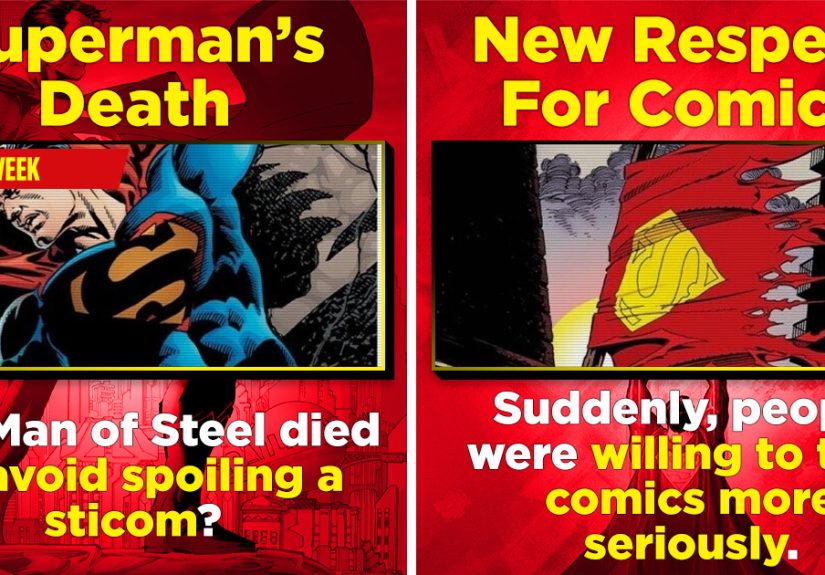
The comic wasn’t just sold; it was presented. A special edition came with mourning-themed extrasan armband,
a Daily Planet-style obituary, and other memorabiliaturning the purchase into a physical keepsake. This wasn’t
subtle. It was a funeral you could put on a shelf.
That move matters culturally because it trained audiences to treat a fictional plot point like an “occasion.”
It’s the same instinct you see now with limited theatrical releases, collector editions, “event” episodes, and
merch drops that turn a story beat into a ritual.
It normalized the “big death” as a marketing-friendly cliffhanger
Here’s the pop culture lesson “Death Of Superman” unintentionally taught: if an icon “dies,” audiences may cry…
but they also start theorizing about the return before the body’s even cold. And publishers learned that a death,
in superhero storytelling, often functions less like an ending and more like a hinge.
That mindset seeped into broader pop storytelling: “death” becomes a season finale twist, a reset button, or a
“Phase One ends here” marker. You still see the echoes anytime a franchise announces a shock move and then
immediately sells you the next chapter of grief, legacy, and rebirth.
It helped codify the “aftermath arc” as its own product
The story didn’t stop at the punchline (literally). It turned into an extended cultural moment with mourning,
tributes, and a world reacting to the absence of a pillar. The aftermath became part of the attraction:
not just “who dies,” but “what happens to everyone left behind?”
That’s now a standard franchise move: the grief episode, the memorial installment, the “world without…” season.
Modern pop culture loves consequencesespecially consequences that come with their own branding.
3) It Supercharged Collectible Culture… and Helped Fuel the Cautionary Tale That Followed
If “Death Of Superman” changed the way pop culture tells stories, it also changed the way pop culture buys them.
This was the era when people started treating certain entertainment products like stocksexcept the stock was
a comic in a bag, and the investment strategy was “buy ten and don’t touch them.”
It poured gasoline on the speculator mindset
Many buyers weren’t chasing a great reading experience; they were chasing a future eBay jackpot (before eBay was
even a household verb). Shops imposed limits. Phones rang nonstop. People who hadn’t read Superman in years
suddenly needed “the issue.”
In the short term, it looked like a magic trick: huge demand, huge attention, and copies moving fast. In the long
term, it became part of a broader collectible frenzy that encouraged gimmicks, overproduction, and “enhanced”
products designed to feel rare even when they weren’t.
It taught entertainment companies a dangerous lesson: hype sells faster than habit
The “Death” era helped convince parts of the industry that you could replace steady readership with spikes.
Why build a long relationship with an audience when you can manufacture a stampede?
The problem is that stampedes don’t last. When you sell people on resale value instead of emotional value,
the relationship is brittle. Once enough buyers realize they’re holding the opposite of a retirement plan,
the vibe can turn from “collector” to “I have boxes of regret.”
It left a permanent scar on how we view “limited” pop culture items
Even if you’ve never owned a polybagged comic in your life, you’ve inherited the skepticism this era created:
“Is it truly specialor is it just marketed like it’s special?” Today’s variant covers, limited drops,
and numbered editions live in a world where audiences both crave exclusivity and roll their eyes at it.
“Death Of Superman” didn’t invent that contradiction. It mainstreamed it.
4) It Made “Legacy Heroes” and “Mantle Swaps” Feel Like a Blockbuster Move
Killing Superman was the hook. Replacing him was the long game.
The aftermath popularized a storytelling device that’s now basically a franchise staple: the icon falls, and the
world auditions replacements. This wasn’t just “someone fills in.” It was an identity mystery, a debate, and a
mirror held up to what the symbol meant.
It showed how to turn one hero into a whole season of characters
Instead of rushing back to the status quo, the storyline introduced multiple “Supermen” figures and let the audience
argue about authenticity. That did two smart pop-culture things:
-
It multiplied entry points. Readers could latch onto different vibessteel-and-hope optimism,
edgy tech-forward ambiguity, youthful swaggerwithout needing one definitive replacement immediately. -
It turned fandom into a participant. Debates (“Which one is real?”) became part of the entertainment,
the same way modern franchises thrive on theories and tribal preferences.
It helped normalize the “brand is bigger than the person” idea
Pop culture took a quiet lesson from this era: if the symbol is strong enough, you can swap the person under it
at least temporarilyand still keep the machine running. That logic shows up everywhere now:
masks passed down, mantles inherited, “new” versions launched, thenoftenan eventual return to the classic.
It strengthened the modern cycle: death → legacy → return
Once the industry proved it could sell the absence, it discovered it could sell the comeback, too. This cycle is
now practically a rhythm of superhero pop culture. The “return” doesn’t erase the death; it uses it.
The loss becomes part of the mythology, a reference point that later stories can remix for emotion, nostalgia,
or scale.
Conclusion: The Accident Was the Point
“Death Of Superman” is remembered as a stunt, a landmark, a sales phenomenon, and a surprisingly sincere story
about what the world looks like when a moral anchor disappears. But its biggest cultural impact may be that it
taught pop culture how to treat fiction like an event: announce it, ritualize it, package it, debate it, mourn it,
and monetize the aftermath.
In other words: it didn’t just change Superman’s world. It helped change oursone black bag at a time.
Experiences: What It Felt Like When Superman “Died” (About )
If you were anywhere near a comic shop in November 1992, the vibe wasn’t “quiet hobby.” It was closer to
“midnight product launch,” except the product was grief and the line was made of people who suddenly remembered
they’d always cared about Superman. Some stores had to set one-per-customer rules, not because they were
anti-capitalist saints, but because letting one guy buy a stack of ten was how you start a small riot with
polite suburban dads.
The phone calls were relentless. Shop employees describe the day like they were taking emergency dispatch:
“Yes, we have it. No, we can’t hold it. Please stop asking if it’s the real death. Ma’am, I promise you
this is the correct fictional tragedy.” In at least one shop, a couple reportedly showed up around ten minutes
after midnight and begged through a locked door like they were trying to get into a secret club. The bouncer?
Superman’s corpse-in-a-bag.
And the bag mattered. The deluxe edition wasn’t just a comic; it was a prop. A black wrap with a bloodied “S,” a
mourning armband, a faux obituarystuff that made the purchase feel like a ceremony. Some buyers never opened it.
They didn’t want a story; they wanted an artifact. You could practically hear the thought bubble:
“This will pay for college.” (Spoiler: it mostly paid for the lesson.)
Kids were there, toosometimes with parents who didn’t normally set foot in comic shops unless bribed with a
nearby bakery. A lot of first-time buyers weren’t collectors; they were witnesses. The news coverage did what
marketing dreams of doing: it made a niche product feel like a cultural appointment. One creator even recalled
fans telling stories about parents letting them skip school to stand in line. That’s not just fandomthat’s a
permission slip for pop culture to be treated like a life event.
Some shops leaned into the absurdity with sincerity. There are accounts of comic shops hosting a wakean actual
memorial vibe, in a mall, for a character who was almost certainly coming back. People gathered anyway. They
swapped stories, argued about continuity, and treated the moment with a weird respect that only fandom can
generate: half tongue-in-cheek, half genuinely moved.
Looking back, the experience reads like a time capsule of early-’90s pop behavior: the hunger for “limited”
things, the thrill of being part of a shared moment, and the belief that cultural importance can be measured by
how fast a product sells out. It was messy, loud, and occasionally morbid. It was also, in its own way, kind of
beautiful: a community gathering around a story and acting like it matteredbecause, for a week or two, it did.