Table of Contents >> Show >> Hide
- Why permanent hair dye is such a pain to remove
- Before you start: a quick, carpet-saving checklist
- Way #1: Dish Soap + Hydrogen Peroxide “Color Lift” (Best for fresh to set-in stains)
- Way #2: Rubbing Alcohol Spot Treatment (Best for stubborn pigment deposits)
- Way #3: Oxygen Bleach (Color-Safe) or a Reputable Carpet Stain Remover (Best for older stains)
- Troubleshooting: what if the stain won’t budge?
- What NOT to do (your carpet will thank you)
- How to prevent hair dye carpet stains (because future-you deserves nice things)
- Real-world experiences and lessons (the “I learned this so you don’t have to” section)
- Conclusion
Permanent hair dye has one job: never let go. Which is great for your hair and… deeply rude for your carpet.
If you’ve just created an accidental “auburn constellation” on the floor, don’t panic-buy a new rug yet.
With the right approach (and a little patience), you can often lift or significantly fade even stubborn dye stains.
This guide walks you through three proven, fiber-safe strategies used by cleaning pros and manufacturer-aligned care guides:
a peroxide-based lift, a solvent-based lift, and an oxygen-bleach/commercial approachplus exactly what not to do
so you don’t turn a stain into a permanent “modern art” installation.
Why permanent hair dye is such a pain to remove
Permanent dye is designed to deposit color and resist washing. When it hits carpet fibersespecially porous, light-colored synthetics
it can bind fast. The goal isn’t aggressive scrubbing (that can shred fibers and spread pigment). The goal is controlled chemistry:
lift, oxidize, and rinsewithout overwetting the carpet backing.
Before you start: a quick, carpet-saving checklist
1) Blot. Don’t rub. (Seriously. Put “rubbing” in timeout.)
Blotting pulls liquid up and out; rubbing pushes dye deeper and frays fibers. Use white paper towels or a clean white cloth,
pressing firmly, lifting, and rotating to a clean area as you go.
2) Identify your carpet fiber (this matters more than your dye shade)
- Most wall-to-wall carpets are nylon or polyester (usually peroxide/oxygen-bleach tolerant with testing).
- Wool or silk blends are delicate and can discolor or weaken with oxidizersconsider calling a pro.
- Dark or patterned carpets can lighten with peroxide/oxygen bleachspot testing is non-negotiable.
3) Ventilation + safety: don’t mix cleaners
- Open windows and avoid breathing fumes when using any cleaning chemicals.
- Never mix bleach with ammonia (toxic gases can form).
- Don’t combine hydrogen peroxide and vinegar in the same container (it can create irritating compounds).
- Use one method at a time and rinse between attempts.
4) Always spot test
Pick a hidden corner or closet edge. Apply your chosen solution, wait 5–10 minutes, blot, and check for color change or texture damage.
If your “test spot” turns into a “new problem,” stop and switch strategies (or call a professional).
Way #1: Dish Soap + Hydrogen Peroxide “Color Lift” (Best for fresh to set-in stains)
Hydrogen peroxide (typically 3%) is an oxidizer that can break down dye moleculessimilar to how many “color-safe” cleaners work.
Pairing it with a small amount of dish soap helps the solution wet fibers evenly and lift residue.
What you’ll need
- 3% hydrogen peroxide
- Clear dish soap (avoid dyed soaps if possible)
- Cool water
- White cloths/paper towels
- Small bowl or spray bottle
- Optional: soft toothbrush for very tight fibers (gentle only)
Step-by-step
- Blot up excess dye. If it’s still wet, keep blotting until the towel stops picking up color.
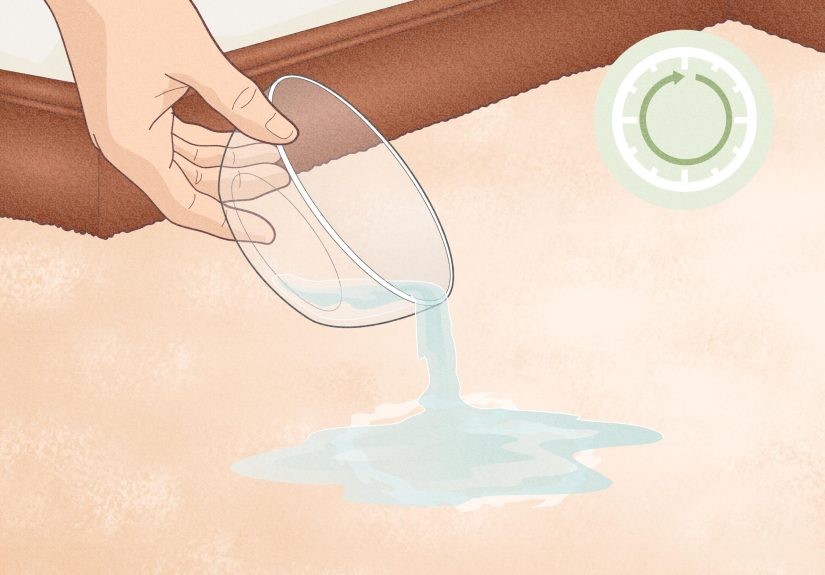
- Pre-dampen with cool water. Lightly dampen the stained area (don’t soak). This prevents the peroxide mix from “catching” too hard in one spot.
-
Mix a lifting solution. A common ratio is 1 part dish soap to 2 parts hydrogen peroxide.
(Example: 1 tablespoon soap + 2 tablespoons peroxide.) Stir gentlyno need to create a foam party. -
Apply and blot. Dab the solution onto the stain with a cloth. Let it sit 5–10 minutes, then blot.
Repeat until the dye fades noticeably. -
Rinse thoroughly. Dampen a clean cloth with cool water and blot repeatedly to remove soap/peroxide residue.
Residue can attract dirt later, like a tiny magnet for foot traffic. -
Dry correctly. Press a dry towel into the area, then weigh it down (a book wrapped in plastic works) for 20–30 minutes.
Once dry, vacuum to lift the fibers.
Pro tips (aka “how not to bleach your carpet into a polka-dot”)
- Use peroxide sparingly on dark carpets; repeated applications can lighten the dye in the carpet itself.
- If the stain is large, work from the outside edge toward the center to reduce spreading.
- Don’t overwettoo much liquid can seep into padding and later “wick” the stain back up.
Quick example
You spilled cherry-red dye on beige nylon near the bathroom sink. You blot immediately, then use the peroxide/soap mix in three short rounds.
After each round you rinse and blot dry. The stain shifts from “fire-engine red” to “faint blush,” and after drying it’s barely noticeable.
That’s a winyour carpet no longer looks like it auditioned for a vampire movie.
Way #2: Rubbing Alcohol Spot Treatment (Best for stubborn pigment deposits)
Rubbing alcohol (isopropyl alcohol) can help dissolve and lift certain dye components and residuesespecially when the stain is tacky
or has that “I’m fused to the fiber now” attitude. This method is often used as a booster when soap-and-water isn’t cutting it.
What you’ll need
- 70% isopropyl rubbing alcohol (start here; stronger isn’t always better)
- White cloths/paper towels
- Cool water
- Optional: a small amount of white vinegar for a final rinse (not mixed in the bottle with peroxide)
Step-by-step
- Blot and pre-rinse. If you’ve already tried another method, make sure the area is rinsed with water and blotted dry-ish first.
-
Apply alcohol to the cloth, not the carpet. Dampen a cloth with alcohol and dab the stain.
(Pouring alcohol directly onto carpet can spread the stain and overwet the backing.) -
Dab, lift, rotate. Press and liftdon’t scrub. Rotate to a clean section of cloth constantly.
You’re trying to transfer dye from carpet to cloth, like a slow-motion magic trick. - Rinse with cool water. Blot with a water-damp cloth to remove alcohol and loosened dye.
-
Optional finish: If you suspect leftover residue, blot once with a lightly vinegar-damp cloth (then rinse with water again).
Keep it gentle and brief. - Dry and vacuum. Same as Method #1: towel-blot, weight, dry, then vacuum.
When to choose alcohol
- You’ve already removed “the bulk” but a bright halo remains.
- The dye looks set and slightly sticky.
- You need a targeted approach without committing to stronger oxidizers again.
What to avoid
-
Don’t mix rubbing alcohol with bleach. Also, don’t play “mad scientist” by combining household cleaners.
One product at a time is the safest approach. - Don’t scrub hardyou’ll rough up carpet tips and make the area look permanently worn.
Way #3: Oxygen Bleach (Color-Safe) or a Reputable Carpet Stain Remover (Best for older stains)
If the dye has dried and settled in (or you didn’t discover it until the next day), oxygen bleach can help.
Oxygen bleach products (often based on hydrogen peroxide or sodium percarbonate) can break down colored stains without the harshness of chlorine bleach.
Many commercial carpet stain sprays are built around this conceptjust formulated for carpets.
Two options here (choose one)
- Option A: Oxygen bleach solution (powder or liquid). Great for controlled, repeatable treatments.
- Option B: Carpet stain remover spray from a reputable brand, used exactly as directed (and tested first).
Important fiber warning
Many oxygen bleach products and carpet sprays warn against use on wool, silk, or leather and require a hidden-area test.
Follow the label and your carpet manufacturer’s guidance.
Option A: Oxygen bleach method
- Vacuum first if there’s any dry residue (you don’t want grit turning into sandpaper).
- Mix according to label. Dissolve fully. Undissolved granules can cause uneven lightening or leave residue.
- Apply lightly. Use a cloth to dab solution onto the stainavoid soaking the padding.
-
Let it work. Many oxygen bleaches need time. Start with 10–15 minutes, blot, and repeat if needed.
For stubborn “residual color,” some professional guidance allows longer dwell timesalways monitor for color change. - Rinse, rinse, rinse. Blot with clean water until you’re confident the cleaner is removed.
- Dry thoroughly to prevent wicking or odor.
Option B: Commercial carpet stain remover spray
- Test in a hidden area for colorfastness.
- Blot excess dye and remove any solids.
- Saturate the stained fibers as directedusually enough to reach the stain, not flood the carpet.
- Wait the recommended time (often around 10 minutes).
- Blot, don’t rub, and repeat if the label allows.
- Let dry completely and vacuum.
Why this works for “permanent” dye
Oxidizing cleaners help break the bonds of color molecules. You’re not “scraping” dye outyou’re making it easier to lift and rinse away.
If you see progress (even slow progress), that’s a sign the chemistry is working.
Troubleshooting: what if the stain won’t budge?
If the stain keeps coming back after it dries
That’s often wicking: dye or cleaner residue in the padding rises back up as the surface dries.
Solution: use less liquid, blot more, and dry with pressure (weighted towels). In stubborn cases, a professional hot-water extraction can help.
If you have wool, vintage rugs, or unknown fibers
Consider calling an IICRC-certified carpet cleaner. Delicate fibers can be permanently damaged by DIY oxidizers or the wrong pH.
A pro can choose a controlled spotter and extraction approach that’s safer for specialty textiles.
If it’s a huge spill (or black dye on a pale carpet)
Be realistic: you may achieve “greatly faded” rather than “never happened.” Sometimes the best outcome is making the area blend in,
then rearranging a plant stand like you planned it all along.
What NOT to do (your carpet will thank you)
- Don’t scrub aggressively. It damages fibers and spreads dye.
- Don’t overwet. Overwetting can lead to backing/padding issues and recurring stains.
- Don’t mix chemicals. Especially avoid bleach + ammonia and other risky combos.
- Don’t use hot water first. Heat can set certain stains and increase spread.
- Don’t skip rinsing. Soap residue attracts dirtyour “clean spot” becomes a “new dirty spot” later.
How to prevent hair dye carpet stains (because future-you deserves nice things)
- Lay down an old towel plus a trash bag or plastic drop cloth under your dye zone.
- Keep a stack of white paper towels and a bowl of cool water nearby before you start.
- Wear gloves and set the dye bottle in the sink, not on the floor (gravity is not your assistant).
- If you drip, blot immediatelyfresh stains are dramatically easier than “next day surprises.”
Real-world experiences and lessons (the “I learned this so you don’t have to” section)
If you read enough cleaning forums, talk to homeowners, or scroll through the internet’s collective “oops” moments, you’ll notice a pattern:
hair dye accidents don’t happen during calm, well-lit, well-planned afternoons. They happen at 11:47 p.m. when someone is “just touching up roots”
and the bathroom lighting makes it look like everything is fineuntil it’s not.
One common storyline goes like this: a few drops hit the carpet, someone wipes quickly with a wet washcloth, and suddenly the stain is bigger,
brighter, and spread into a perfect little gradient. That’s the moment people discover the difference between wiping and blotting.
Wiping is basically stain-painting. Blotting is stain-removal. If there’s one habit that changes outcomes the most, it’s pressing straight down,
lifting straight up, and rotating to a clean cloth edge like you’re playing a slow, boringbut wildly effectivegame of “color transfer.”
Another frequent lesson: the first cleaning attempt is usually too aggressive and not rinse-heavy enough.
A lot of folks will do one strong pass with soap, then walk away when the stain “looks lighter.” The next day,
that same spot looks dingy or attracts dirt faster than the surrounding carpet. That’s often leftover soap residue
or cleaner still sitting in the fibers. Rinsing feels like an extra step, but it’s the difference between “I fixed it”
and “Why is that area now a dirt magnet shaped like my regret?”
People also underestimate how much carpet fiber type changes the strategy. On many synthetic carpets,
peroxide-based methods can be a lifesaver. On darker carpets, the same method can remove the stain and accidentally lighten the carpet dye,
creating a new “highlight” that never asked to be there. This is why spot testing is not optional theaterit’s quality control.
Think of it like patch testing hair dye on skin, except your carpet can’t politely tell you it’s about to have a reaction.
There’s also the “kitchen sink approach” (sometimes literally): people throw baking soda, vinegar, peroxide, dish soap, and whatever’s under the sink
onto the stain in rapid succession. Besides being less effective than a focused method, it can create safety issues and unpredictable results.
The most successful cleanups tend to be boringly methodical: choose one approach, apply gently, blot, rinse, dry, reassess.
Repeat. If you’re seeing progressany progressyou’re winning. Hair dye removal often happens in rounds, not in one dramatic “ta-da.”
Finally, the most practical lesson: perfection isn’t always the goal. Sometimes the win is “faded enough that no guest will notice,”
“gone when the fibers are fluffed back up,” or “only visible if you point a flashlight at it like a detective.”
And if you do end up calling a professional cleaner, that’s not defeatthat’s delegation. Your carpet doesn’t care who removed the stain.
It just wants to stop being involved in your beauty routine.
Conclusion
Permanent hair dye on carpet is annoyingbut it’s not always a life sentence. Start with the gentlest effective method:
blot immediately, lift with a dish soap + hydrogen peroxide mix, then use rubbing alcohol for stubborn pigment.
If the stain is older or extra stubborn, oxygen bleach (or a reputable carpet stain remover) can provide the extra pushprovided your carpet fiber can handle it.
Take it slow, rinse thoroughly, and avoid mixing cleaners. With patience and smart chemistry, your carpet can go back to being a floor… not a mood board.