Table of Contents >> Show >> Hide
- Before You Start: What “Advanced” Palm Reading Really Means
- Way 1: Read the Hand Like a Blueprint (Shape, Proportions, and “Element” Types)
- Way 2: Read the Major Lines Like a Sentence (Depth, Breaks, Branches, and Timing)
- Way 3: Read the Topography (Mounts, Minor Lines, Markings, and Texture)
- Putting It Together: A 10-Minute Advanced Reading Flow
- Ethics: How to Be Good at This Without Being Weird About It
- Practice Experiences and Field Notes (Extended, ~)
- Conclusion
- Sources Consulted (No Links)
Palm reading (also called palmistry or chiromancy) is part symbolism, part storytelling, part “wow, my hands really do have a lot going on.”
And while it’s been practiced for centuries across multiple cultures, it’s not a science and it doesn’t come with a warranty that your fate is etched in skin.
Think of advanced palm reading like an interpretive art: you’re looking for patterns, contrasts, and themesthen translating them into language that helps someone reflect.
(If you promise them a lottery win, that’s not “advanced.” That’s “please don’t.”)
In this guide, you’ll learn three advanced approaches that serious palmists use to level up beyond “heart line = love” and “life line = long life” (spoiler:
that second one is one of the most common beginner mistakes). We’ll also keep it ethical, grounded, and actually usefulbecause the most impressive readings
are the ones that feel accurate and leave the person feeling understood, not spooked.
Before You Start: What “Advanced” Palm Reading Really Means
1) Read both hands on purpose
Many modern palmists compare the non-dominant hand (baseline traits, early wiring, “default settings”) with the dominant hand (how life experiences and
choices have shaped you). The advanced move isn’t picking oneit’s tracking the differences between them and asking: What changed?
2) Separate anatomy from interpretation
Palmar creases are real anatomy that develops early in fetal development, and crease patterns can vary widely. Some crease variants are common and normal
(for example, a single transverse palmar crease shows up in a small percentage of people). Palmistry interpretation is the symbolic layer you place on top.
Advanced readers don’t confuse symbolism with medical diagnosis. If you ever feel tempted to “diagnose” someone from their hand, stop. That’s not palmistry
that’s a bad idea.
3) Watch out for “sounds true” bias
Humans are great at finding meaning in broad statements (psychology even has a name for this tendency). Advanced readers counter this by using specifics:
clear visual features, comparisons between hands, and a structured methodso the reading isn’t just a string of flattering fortune-cookie sentences.
Way 1: Read the Hand Like a Blueprint (Shape, Proportions, and “Element” Types)
Beginners often jump straight to the lines. Advanced readers start one level higher: the overall architecture of the hand. Hand shape and proportions give you
a “personality climate,” and the lines become the “weather report.”
Step A: Identify the dominant hand type (Earth, Air, Fire, Water)
Elemental hand typing is a classic system: you compare palm shape (square vs. rectangular) and finger length (short vs. long). The trick is that many people
are mixed typesespecially when you compare dominant vs. non-dominant handsso the advanced skill is spotting blends.
-
Earth (square palm, shorter fingers): practical, steady, tactile learning, prefers what’s proven.
Advanced tell: fewer but deeper lines often pair with consistency and routine-driven success. -
Air (square/rectangular palm, long fingers): analytical, communicative, mentally active.
Advanced tell: many fine lines can show mental busynessbrilliant, but sometimes overstimulated. -
Fire (rectangular palm, shorter fingers): energetic, bold, action-first.
Advanced tell: strong thumbs and firm mounts often reinforce drive and leadership instincts. -
Water (rectangular palm, long fingers): sensitive, intuitive, imaginative.
Advanced tell: soft skin + flowing lines often correlate with emotional nuance and creative depth.
Step B: Add “proportion qualifiers” (this is where it gets advanced)
Two people can share an element type and still read totally differently. Use qualifiers that narrow the story:
-
Thumb angle + strength: A wide, open thumb angle often reads as openness and generosity; a strong, balanced thumb can signal willpower
that’s sustainable (not just loud). - Finger spacing: Naturally spaced fingers can imply independence; tightly held fingers can suggest caution or privacy.
-
Flexibility: Very flexible hands often read as adaptable and impressionable; very stiff hands can read as persistent and resistant to
change. (Neither is “good” or “bad.”) - Knots (finger joints): Pronounced joints can suggest “think it through” energy; smoother fingers may suggest intuitive processing.
Example: Mixed-type decoding
Suppose the non-dominant hand looks Water (long fingers, rectangular palm), but the dominant hand looks more Fire (shorter-looking fingers relative to a
stronger palm and firmer texture). An advanced read might sound like:
“You started as a feel-first person, but you’ve trained yourself into a do-first person.”
That’s a more useful insight than “you are emotional.”
Way 2: Read the Major Lines Like a Sentence (Depth, Breaks, Branches, and Timing)
Here’s the upgrade: stop reading lines like labels and start reading them like grammar. The “meaning” of a line comes from how it behaveswhere it begins,
where it ends, how it changes, and what interacts with it.
The four majors (quick recap, then we go deeper)
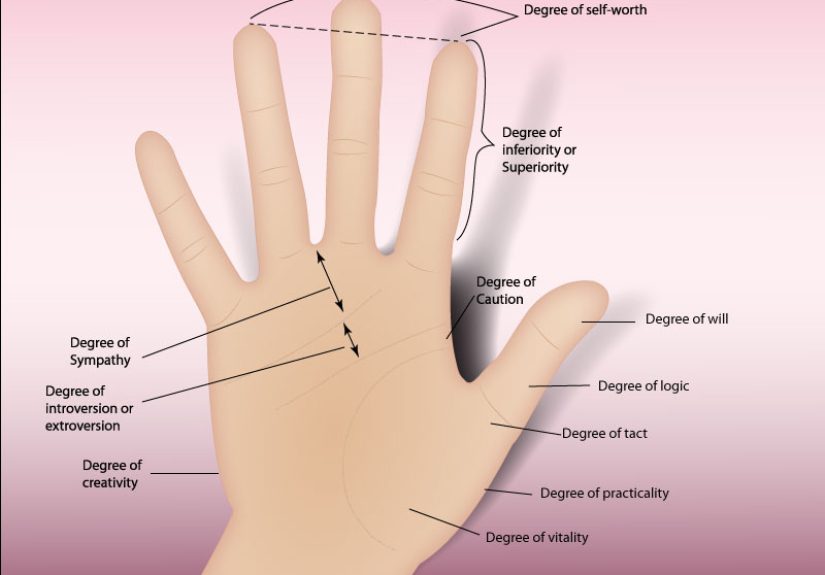
- Heart line: emotional style, connection patterns, how affection is expressed and protected.
- Head line: thinking style, decision-making, learning habits, mental stamina.
- Life line: vitality, grounding, resilience, lifestyle rhythm (not “how long you’ll live”).
- Fate line: duty, direction, external structure, career/life tracks, “pull” from obligations or goals.
Advanced line quality: the five “D’s”
When you examine a major line, run it through five filters. This keeps you consistent and prevents “random interpretation drift.”
- Depth: Deeper lines often read as stronger emphasis or consistency in that area.
- Definition: Clean vs. chained vs. frayed lines can imply clarity vs. complexity vs. stress patterns.
- Direction: Curving, rising, dropping, or flattening changes the “tone” of the story.
- Disruptions: Breaks, islands, or gaps can indicate transitions, interruptions, or periods of reorientation.
- Divisions: Forks and branches show split interests, dual pathways, or “both/and” tendencies.
Timing (use gently, not like a prophecy machine)
Many palmistry traditions map approximate “timelines” along major lines, especially the life line and fate line. Advanced readers use timing as a
reflection prompt, not a prediction: “Around this period, it looks like your direction reorganizeddoes that match a move, a new responsibility,
a shift in school/work, or a change in goals?”
Three advanced examples (what to notice and how to interpret)
Example 1: The Head Line fork (“the double-minded genius”)
A head line that ends in a fork can suggest the ability to hold two ways of thinking: practical + imaginative, logic + empathy, analysis + artistry.
Advanced read: don’t just say “you’re creative.” Say, “You can translate between two worldsnow the question is whether you choose one lane or build a bridge.”
Example 2: A chained Heart Line (“high sensitivity, high input”)
A heart line that looks like tiny linked segments (a chain) is often read as emotional sensitivity and responsiveness. The advanced move is adding context:
Is the rest of the hand also fine-lined and busy (Air/Water blend)? Then it may read as empathy plus overstimulation. If the hand is otherwise firm and minimal,
it may read as “selective vulnerability.”
Example 3: The Life Line with a parallel “support” line
Some people have a second line running alongside part of the life line (often called a “Mars line” in traditional palmistry). Symbolically, it’s read as
extra resilience or supportinternal grit, external help, or both. The advanced question becomes: Where does it appear? Around a “stress cluster”?
Near a major change marker? That’s how you tell a story that’s specific instead of generic.
A safety sidebar: don’t medicalize palms
Palms can show normal crease variants, and some variants are also discussed in medical contexts. That does not mean you can diagnose anything by looking at a
hand. If someone is worried about health, they need a cliniciannot a line interpretation. Ethical palmistry stays in the lane of reflection and personal meaning.
Way 3: Read the Topography (Mounts, Minor Lines, Markings, and Texture)
If lines are the “text,” mounts are the “tone.” The mounts are the fleshy pads on the palm, traditionally linked to planetary archetypes. Advanced readers don’t
look at one mount in isolationthey compare the whole landscape: what’s dominant, what’s balanced, and what looks underdeveloped.
How to assess mounts (the advanced checklist)
- Height: raised, flat, or sunken
- Firmness: springy/firm vs. soft
- Balance: one mount shouting while others whisper?
- Interaction: do major lines feed into that area or avoid it?
Common mounts and “advanced” interpretations
- Jupiter (below index): ambition, leadership, growth. Advanced: strong Jupiter + clear fate line can read as “directed achiever.”
- Saturn (below middle): responsibility, realism, patience. Advanced: strong Saturn + chained head line can read as “serious thinker who overthinks.”
- Apollo/Sun (below ring): creativity, pride, visibility. Advanced: strong Apollo + developing sun line can read as “recognition increases when you commit to your craft.”
- Mercury (below pinky): communication, strategy, adaptability. Advanced: strong Mercury + airy hand type can read as “quick mind, needs focus rituals.”
- Venus (base of thumb): warmth, affection, vitality. Advanced: strong Venus + deep life line often reads as “big-hearted stamina.”
- Luna/Moon (outer palm): imagination, empathy, intuition. Advanced: pronounced Luna + fine lines can read as “creative radarprotect your energy.”
- Mars (inner/outer zones): courage, boundaries, persistence. Advanced: strong Mars + firm thumb can read as “quiet fighter.”
Minor lines (use them as modifiers, not main characters)
Minor lineslike the sun line, mercury/health line (traditional name), relationship lines, travel lines, and specialty markingsare best read as modifiers.
Advanced palmistry treats them like footnotes: helpful, but not the whole book.
For example, a developing sun line (vertical line toward the ring finger) is traditionally read as increasing fulfillment or recognitionespecially when it
strengthens on the dominant hand. Meanwhile, specialty lines like the “girdle of Venus” (an arc above the heart line in some hands) are often interpreted
as heightened sensitivity and emotional intensity. The advanced move is to connect it back to the person’s lived patterns: do they recharge alone? Are they
deeply affected by environments? Do they feel “too much” and then need structure?
Markings (crosses, stars, squares, triangles): the “punctuation” of the palm
Traditional palmistry gives meanings to markingscrosses can signal turning points, squares can read as protection, stars as intense moments, triangles as
focused talent. Advanced readers do two things:
- They locate the marking precisely (which line, which mount, which side of the hand).
- They confirm with another feature (a marking without support is just a dot; a marking reinforced by line change becomes a theme).
Putting It Together: A 10-Minute Advanced Reading Flow
- Scan both hands: element type, firmness, flexibility, finger spacing.
- Pick 2 standout features: one structural (type/mount) and one line feature (fork, break, deepening).
- Cross-check: does the heart line story match Venus/Luna? does the head line story match Mercury/Air traits?
- Translate into themes: “You’re a builder,” “You’re a bridge,” “You’re in a restructure season.”
- Ask reflective questions: let the person confirm, refine, or correct the interpretation.
- Close with agency: what habits or choices support the best version of the theme?
Ethics: How to Be Good at This Without Being Weird About It
Advanced palm reading should leave someone feeling clearernot trapped. A few guidelines that keep your readings sharp and respectful:
- No medical claims. Hands are not diagnostic tools.
- No guaranteed predictions. Symbolism is not a contract with the universe.
- Avoid manipulation. If you catch yourself using super-vague statements that could fit anyone, tighten up your method.
- Offer choices. Turn “This will happen” into “This pattern suggests… what do you want to do with that?”
- Keep it consent-based. Not everyone wants a deep read. Ask before you go full detective mode.
Practice Experiences and Field Notes (Extended, ~)
Below are three composite practice experiences (not real individuals, and not “psychic proof”) designed to show how an advanced method sounds
in the real world. Think of them as training drills: observe → compare → cross-check → summarize as themes.
Experience 1: The “Two-Track Mind” Head Line
The first practice hand had an Air-leaning shape (long fingers, lots of fine lines) and a head line that ended in a clean fork. On the non-dominant hand,
the fork was faint; on the dominant hand, it was stronger and more defined. Instead of saying “You’re creative,” the read focused on function:
“You’ve developed the ability to think in parallellogic on one track, imagination on the other. That’s a gift, but it can feel like having 27 browser tabs open.”
Cross-checking supported it: a noticeably active Mercury mount (communication/strategy) and many fine vertical lines under the fingers (often read as mental
engagement). The practical takeaway wasn’t mystical. It was behavioral: build a focus ritual (single-task windows, time blocks, brain-dump notes) so the fork
becomes a superpower instead of a stress engine.
Experience 2: The “Sensitive Radar” Luna + Chained Heart Line
The second hand read Water-forward: softer texture, flowing lines, and a more pronounced Luna area along the outer palm. The heart line showed a chained
patternlittle linked segmentsespecially on the dominant hand. The advanced move here was context. Chaining can symbolize sensitivity, but
sensitivity can look like kindness, art, or burnout depending on the rest of the map. This hand also had a lighter fate line, suggesting the person may resist
rigid external structures. So the theme became: “You’re tuned in. Your challenge isn’t feelingit’s filtering.”
Instead of predicting romance outcomes, the reading framed boundaries: choose environments carefully, protect sleep, and use creative outlets as a pressure valve.
The person’s “aha” moment (in practice terms) often comes when the interpretation is specific enough to be actionable: “I need recovery time after people-heavy days.”
Experience 3: The “Builder Season” Fate Line + Support Line
The third hand leaned Earth/Fire: firmer palm, fewer but deeper lines, and a clear fate line that strengthened mid-palm. A parallel support line appeared next to
part of the life line, which traditional palmists often read as resilience or reinforcement. The advanced read wasn’t “You’ll be rich.” It was:
“Your direction gets clearer after you commityour hand shows momentum building, not instant certainty.”
Cross-checking the mounts suggested balanced Jupiter (healthy ambition) and steady Saturn (responsibility). The best practice takeaway from this scenario is how
to phrase growth: not destiny, but development. Some people don’t start with a loud “calling”they build one through reps, skill, and consistency. When your
method highlights that, the reading feels empowering rather than fatalistic.
Conclusion
Advanced palm reading is less about “predicting the future” and more about reading patterns with discipline. Start with the blueprint (hand type and structure),
translate the lines with nuance (quality, breaks, forks, timing as reflection), and finish with topography (mounts and modifiers) to create a grounded, specific
interpretation. If you keep it ethical and focused on themes people can actually use, your readings will feel more accurateand a lot less like a carnival trick.
Sources Consulted (No Links)
Encyclopaedia Britannica; Merriam-Webster Dictionary; Smithsonian Magazine; U.S. National Library of Medicine (NLM) / Circulating Now; MedlinePlus;
PubMed; JSTOR Daily; The Cut (New York Magazine/Vox Media); Allure; InStyle; HowStuffWorks; Verywell Mind; Consultant360; The Old Farmer’s Almanac;
Washington College (The Elm blog).