Table of Contents >> Show >> Hide
- Why Concrete Makes Canopy Tents Trickier
- Method 1: Use Weight Bags or Sandbags at Every Leg
- Method 2: Use Water Weights or Water Barrels
- Method 3: Use Concrete Blocks or Purpose-Built Weighted Footplates
- How Much Weight Does a Canopy Tent Need on Concrete?
- Extra Stability Tips That Actually Matter
- Mistakes to Avoid When Securing a Canopy on Concrete
- Which Method Is Best?
- Conclusion
- Real-World Experiences With Holding Down a Canopy Tent on Concrete
- SEO Tags
If you have ever set up a canopy tent on concrete, you already know the main problem: concrete is wonderfully solid right up until the moment you need to drive a stake into it. Then it becomes the world’s least cooperative surface. No easy anchoring, no forgiving soil, and no second chances if the wind decides your pop-up tent should audition for a flying role.
The good news is that holding down a canopy tent on concrete is absolutely doable. The better news is that you do not need to invent a bizarre DIY system involving gym plates, extension cords, and pure optimism. In most cases, the job comes down to choosing the right ballast, distributing weight evenly, and knowing when weather has crossed from “breezy” into “pack it up, champ.”
This guide breaks down three practical ways to hold down a canopy tent on concrete, along with weight tips, safety advice, and real-world examples. Whether you are setting up for a market, tailgate, backyard party, school event, or vendor booth, these methods can help keep your canopy where it belongs: on the ground, acting normal.
Why Concrete Makes Canopy Tents Trickier
On grass or dirt, you can often use stakes and guy lines for a firm hold. On concrete, that option disappears. Since you cannot anchor into the ground, you need to rely on ballast, which simply means added weight that resists lifting, sliding, and tipping.
Concrete also tends to show up in places where wind behaves badly. Parking lots, sidewalks, patios, school courtyards, and stadium walkways can create gusts that bounce off nearby buildings and rush underneath the canopy top. That matters because a canopy is not just a shade structure. In the wrong wind, it behaves like a sail with legs.
That is why the best hard-surface setup is never just “put something heavy near the tent.” It is about creating a balanced, low, secure system at each leg and, when needed, adding straps from the upper frame to the ballast for extra stability.
Method 1: Use Weight Bags or Sandbags at Every Leg
Why this method works
Canopy weight bags are one of the easiest and most popular solutions for concrete. They wrap around or sit beside each tent leg and add downward force without taking up too much space. For many small and medium pop-up tents, this is the most convenient answer.
Most people use sand-filled bags, though some products are sold empty so you can fill them yourself. The big advantage is portability. You can haul empty bags to the event, fill them on-site if needed, and strap them snugly to the frame. That beats dragging around random chunks of heavy material like you are preparing for a medieval siege.
Best uses
- 10×10 and 10×15 pop-up canopies
- Farmers markets and craft fairs
- Short-term events on sidewalks or parking lots
- Setups where you need quick installation and teardown
How to do it right
Use a weight bag on every single leg. Not two legs. Not “the windy side.” All of them. Uneven ballast can make the tent lean, twist, or shift under gusts. If you want better stability, attach the bags tightly to the lower frame so they cannot swing or slide.
For a typical 10×10 canopy tent on concrete, a practical starting point is often in the neighborhood of 20 to 40 pounds per leg in calmer conditions. If wind picks up, you may need substantially more. Larger canopies usually need much heavier ballast. Think of weight recommendations as a starting framework, not a magic shield.
Pros
- Easy to buy, store, and transport
- Cleaner and more professional-looking than improvised anchors
- Fast to install
- Works well for routine vendor and backyard use
Cons
- Cheap bags can tear or leak
- Lighter bags may be inadequate in windy weather
- Loose bags that are not strapped properly can shift around
Bottom line: If you want the simplest method for holding down a canopy tent on concrete, start here. Quality weight bags are practical, affordable, and easy to use. Just do not underweight the tent and expect a standing ovation from the weather.
Method 2: Use Water Weights or Water Barrels
Why this method works
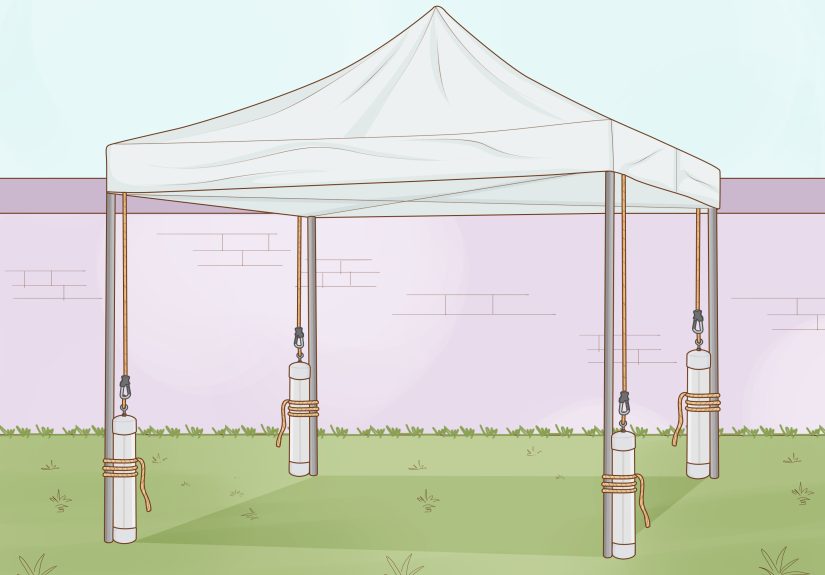
Water weights for canopy tents are especially useful when you want serious ballast without hauling serious weight before setup. They are typically empty during transport, then filled on-site with water. Some wrap around the legs like collars, while others use larger drums or barrels connected by straps or ropes.
This method is common for events on concrete or asphalt because it solves the transportation problem. Hauling four empty containers is easy. Hauling four fully loaded concrete weights up three flights of stairs is how you accidentally become everyone’s least relaxed friend.
Best uses
- Street fairs and school events
- Sports events and tailgates
- Longer setups where extra ballast is helpful
- Situations where a water source is available nearby
How to do it right
Fill each weight fully and place or fasten it at each leg. If you are using larger water barrels or drums, connect them securely to the tent with straps, not wishful thinking. Keep the ballast low to the ground, and check that each corner is carrying a similar amount of weight.
This method can be especially effective when paired with ratchet straps or guy lines from the upper frame down to the ballast. That top-down tension helps resist sway and lifting. On hard surfaces, that extra stability can make a big difference.
Pros
- Heavy when filled, light when transported empty
- Good for concrete and asphalt
- Often neater and safer than improvised blocks
- Excellent for temporary events
Cons
- You need access to water
- Some lower-quality products may leak over time
- Bulky barrels can take up more floor space
Bottom line: Water ballast is a smart solution when portability matters. It is one of the most practical ways to secure a canopy tent on concrete without sacrificing stability.
Method 3: Use Concrete Blocks or Purpose-Built Weighted Footplates
Why this method works
If you want the most serious, low-moving, hard-surface-friendly option, concrete weights or weighted footplates are hard to beat. These are often used for commercial tents, longer setups, and environments where durability matters more than convenience.
Purpose-built footplates are especially useful because they are designed to sit under or attach directly to the canopy legs. Some systems also allow stacking multiple concrete slabs or plates per leg. That creates a stable, compact base and avoids the awkwardness of trying to lash a tent to improvised masonry like you are solving a puzzle with poor odds.
Best uses
- Frequent vendor events
- Semi-permanent or all-day installations
- Commercial pop-up tents
- Windier open areas where lighter methods may not be enough
How to do it right
Choose purpose-made systems whenever possible. If you use concrete blocks, make sure they are secured with proper straps or brackets and cannot shift, scrape, or trip pedestrians. Keep the load low and centered at each leg. On some professional systems, ballast is combined with rubberized or anti-slip components to reduce sliding on hard surfaces.
This method becomes even more effective when you combine base weight with top-corner tension straps. That combination helps resist both sliding and uplift, which is exactly what wind tries to exploit.
Pros
- Very stable on concrete
- Excellent for repeated or extended use
- Less likely to shift than loose bags
- Works well with professional-grade frames
Cons
- Heavier and harder to transport
- More expensive if you buy commercial footplate systems
- Improvised concrete blocks can look messy if not handled well
Bottom line: For sturdiness and long-event reliability, concrete weights or footplates are often the strongest choice on hard surfaces.
How Much Weight Does a Canopy Tent Need on Concrete?
This is the question everyone asks, and the honest answer is: it depends. Tent size, frame strength, sidewalls, wind speed, location, and the type of ballast all matter.
Still, a practical rule of thumb for a 10×10 canopy on concrete is to start with about 20 to 40 pounds per leg in calm to light-wind conditions. Some tent sellers recommend roughly 40 pounds at each leg as a baseline for a small 10×10. Once the breeze becomes noticeably pushy, larger ballast is often needed. Bigger canopies, especially 10×15 and 10×20 models, can require much more weight per leg.
Also remember that sidewalls increase wind load. They can be great for privacy, branding, and weather protection, but they also give wind more surface to shove. A tent with walls is not playing the same game as an open canopy.
And here is the most important truth of all: there is a point where more ballast is not the answer. If the forecast calls for strong gusts, storms, or unstable conditions, the safest move may be not setting up the canopy at all, or taking it down early.
Extra Stability Tips That Actually Matter
Distribute weight evenly
All four corners should be anchored with roughly equal ballast. A tent is not a dining chair. It does not do well when one leg gets special treatment.
Use top-corner straps or guy lines
Attaching straps from the upper frame to heavy ballast adds another layer of stability. This is especially helpful on windy days or in open concrete areas.
Lower the canopy height when possible
A lower profile gives wind less leverage. If you do not need maximum headroom, a slightly lower setup can help.
Check the forecast before you leave home
Not after you arrive. Not once the tent is already wobbling. Before. Several event procedures treat winds above roughly 25 mph as a serious caution point for temporary tents, and that is not paranoia. That is experience talking.
Do not trust flimsy frames
A strong anchoring system cannot fully compensate for a weak canopy frame. If the structure itself bends easily, heavy ballast may only keep a bad situation in one place.
Mistakes to Avoid When Securing a Canopy on Concrete
- Using too little weight: The classic mistake. The tent looks fine until it suddenly does not.
- Anchoring only two legs: This creates imbalance and twist.
- Letting weights hang loosely: Swinging ballast is not stable ballast.
- Ignoring sidewalls: Walls can dramatically change how wind hits the tent.
- Skipping weather judgment: Sometimes the best setup decision is a cancellation decision.
- Forgetting local rules: Larger tents may require spacing, permits, inspections, or flame-resistance documentation depending on where you are.
Which Method Is Best?
If you want the easiest all-around choice, go with weight bags or sandbags. If portability is your top concern, water weights are excellent. If you need a stronger long-duration setup on hard surfaces, concrete footplates or concrete ballast are usually the most robust option.
For many people, the real answer is a combination: solid ballast at each leg plus top-corner straps for added stability. That layered approach makes much more sense than relying on a single “miracle” anchor and hoping the wind is in a forgiving mood.
Conclusion
Learning how to hold down a canopy tent on concrete is really about respecting the physics. Since you cannot stake into the ground, you need smart ballast, even distribution, and a plan that matches the weather. The three best methods are straightforward: weight bags or sandbags, water weights or water barrels, and concrete blocks or purpose-built weighted footplates.
Choose the method that fits your tent size, event type, and transport needs. Secure every leg, add straps when needed, and never treat wind like a suggestion. A canopy tent can be a fantastic shelter on concrete, but only when it is anchored like you actually want to see it again tomorrow.
Real-World Experiences With Holding Down a Canopy Tent on Concrete
The funniest thing about canopy tents is that people usually become experts right after the first disaster. Before that, everyone is weirdly confident. A person will unload a brand-new pop-up tent onto a concrete driveway, toss a couple of decorative bags near two legs, step back proudly, and think, “Yep, engineering complete.” Then a mild gust rolls through and suddenly the canopy is doing interpretive dance.
One of the most common real-life experiences happens at vendor markets. Early in the morning, everything feels calm. Sellers set up quickly, chat with neighbors, straighten their tablecloths, and assume the tent is secure because it has not moved for ten whole minutes. By late morning, the breeze picks up between buildings, and the tents with proper weights stay boring and stable. The underweighted tent three booths over begins to scoot sideways in tiny, humiliating increments. Nobody notices at first. Then one leg lifts an inch, and every nearby vendor does that synchronized side-eye that says, “Ah. So this is how today gets interesting.”
Tailgates offer another classic lesson. People love bringing canopies to parking lots because there is no mud, no staking hassle, and plenty of room. But parking lots are sneaky. They are open, flat, and often breezier than expected. A lightweight tent with no ballast can start shifting even when the weather feels “not that bad.” People who use water weights usually end up loving the convenience, especially when they do not want to drag heavy gear from home. People who skip ballast because their cooler is “kind of heavy” usually end up holding a tent leg while pretending that was the plan all along.
Backyard parties on patios create a different kind of experience. The setup often starts casually because the environment feels familiar. Since it is your own house, the danger can seem lower. But concrete patios can channel wind around fences, garages, and corners in strange ways. Homeowners who use proper leg weights and a couple of straps usually get through the party just fine. Homeowners who rely on furniture, flower pots, or one heroic folding chair sometimes learn that patio décor is not an anchoring system. It is just patio décor with ambitions.
School and sports events tend to teach the most practical lesson of all: weather should make the final decision. Experienced organizers know that once wind becomes a serious factor, there comes a point when no setup trick is as smart as simply taking the tent down. That is not failure. That is good judgment. The people who have done this for years are often the least dramatic about it. They do not argue with gusts, and they do not romanticize “making it work.” They add enough weight, balance every leg, use extra straps when needed, and pack up early when conditions turn sketchy. That is why their tents are still in one piece.
In other words, the real-world experience is simple: the best canopy setups on concrete are usually the least exciting ones. Nothing flies away. Nothing tips over. Nothing becomes the main character. And honestly, that is exactly what you want.