Table of Contents >> Show >> Hide
- Why Nalgene Bottles Get Funky (Even If You Only Drink Water)
- Before You Start: A 30-Second Checklist
- Method 1: The Dishwasher Clean (The “Set It and Forget It” Option)
- Method 2: Baking Soda Deep Clean (For Odors, Stains, and Weird Aftertastes)
- Method 3: Sanitizing Reset (For Mold, Neglect, or “After I Got Sick” Moments)
- Don’t Skip This: How to Clean the Cap, Threads, and Hidden Crevices
- How Often Should You Clean a Nalgene Bottle?
- Common Mistakes That Keep the Funk Coming Back
- Troubleshooting: Quick Fixes for Common Bottle Problems
- of Real-World Cleaning Experiences (So You Don’t Have to Learn the Hard Way)
- Conclusion
Your Nalgene is basically the golden retriever of water bottles: loyal, tough, always ready to go outside.
But even the friendliest bottle can develop… issues. A “mystery aroma.” A weird taste. That hazy film that
makes you wonder if you accidentally started a science project.
The good news: cleaning a Nalgene is easy, fast, and doesn’t require a lab coat. Below are three practical methods
(from everyday maintenance to “I left this in my gym bag for a week” emergencies), plus lid-cleaning tips that
actually matterbecause most bottle funk lives in the cap and threads, not the main chamber.
Why Nalgene Bottles Get Funky (Even If You Only Drink Water)
Reusable bottles pick up microbes from hands, mouths, and the surfaces they sit on all day. Add moisture and warmth,
and you can get a slippery “biofilm” layer that clings to plastic and hides in crevices. If you ever use your bottle
for flavored drinkselectrolyte mixes, iced coffee, juice, pre-workoutresidue feeds that buildup faster.
Translation: if your bottle smells “off,” it’s not a personal failure. It’s biology doing what biology does.
The goal is to remove residue, clean the hard-to-reach parts, and fully dry everything so the funk doesn’t come back
for an encore.
Before You Start: A 30-Second Checklist
- Empty it (yes, all the waygoodbye, lukewarm backseat water).
- Separate the cap from the bottle. If you have a multi-piece lid or a removable valve, take it apart.
- Check for hidden parts like gaskets, valves, or strawsthose areas trap moisture and grime.
- Plan to air-dry fully with the cap off. Damp + closed = odor city.
Method 1: The Dishwasher Clean (The “Set It and Forget It” Option)
If your Nalgene is mostly used for water and doesn’t have visible gunk, this is the easiest method.
Many Nalgene bottles and caps are designed to handle dishwasher cleaningjust load them the right way.
Best for
- Daily or regular cleaning
- General freshness
- People who consider handwashing a personal insult
What you’ll need
- Dishwasher detergent
- Dishwasher with a top rack (bonus points if it has a sanitize or high-temp option)
Steps
- Place the bottle and cap apart so water can hit every surface.
- Put the cap on the top rack and keep it away from the heating element area.
- Position the bottle for good spray coverage. If it’s too tall for the top rack, many people place
the cap up top and the bottle where it fits best without blocking the spray arms. - Run a normal cycle. If your dishwasher has a sanitize or high-temp rinse, use it occasionally for a deeper reset.
- Air-dry completely and store the bottle with the cap off.
Pro tips (small habits, big payoff)
- Don’t crowd it. If the bottle is boxed in by plates, the inside won’t get fully rinsed.
- Wash the outside, too. Bottles get set on gym floors, car cupholders, and public countertops. Be kind to yourselfclean the exterior.
- Let everything dry uncapped. This is the simplest way to prevent that “closed, damp plastic” smell from returning.
Method 2: Baking Soda Deep Clean (For Odors, Stains, and Weird Aftertastes)
Baking soda is the MVP when your bottle smells like yesterday’s lemon-electrolyte experiment or has a lingering
taste you can’t un-taste. It’s gentle, widely available, and excellent at deodorizing.
Best for
- Odors and lingering flavors
- Cloudiness from buildup (after a good scrub)
- Periodic deep cleaning without harsh chemicals
What you’ll need
- Baking soda
- Warm or hot water
- Bottle brush (ideal) or a soft sponge you can maneuver
- Old toothbrush (for threads and cap corners)
Steps
- Add baking soda (about 1 tablespoon for a standard bottle; adjust for size).
- Fill with warm/hot water and swirl until it dissolves.
- Soak for at least 1 hour. For stubborn smells, let it sit overnight.
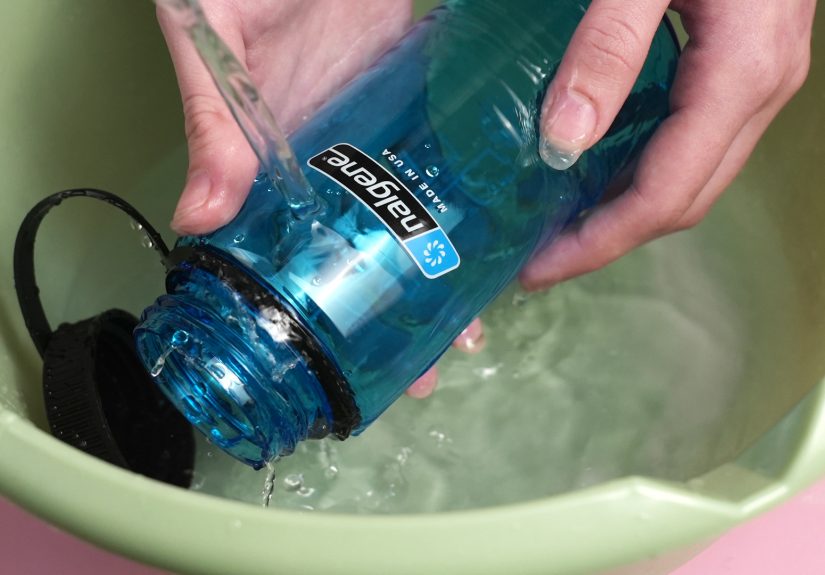
- Scrub the inside with a bottle brush, paying extra attention to the bottom curve and the shoulder area near the opening.
- Scrub the cap and threads with a toothbrushthis is where odor often hides.
- Rinse thoroughly until the water runs clear and there’s no powdery feel.
- Air-dry fully with the cap off.
Optional: Vinegar soak (do this separately, not mixed with bleach)
If you notice mineral film (common with hard water) or you want an extra deodorizing step, you can do an overnight soak
with a water-and-vinegar mixture. Rinse well afterward so your bottle doesn’t smell like a salad.
Important: never mix vinegar with bleach or bleach-based cleaners.
Specific example
Let’s say you used your Nalgene for an electrolyte drink on a long hike. You rinse it at the trailhead, but two days later
the bottle smells like “citrus gym sock.” That’s a classic case for baking soda: it lifts the odor without scratching up
the plastic or leaving a strong chemical smell behind.
Method 3: Sanitizing Reset (For Mold, Neglect, or “After I Got Sick” Moments)
Sometimes you don’t just want “clean.” You want “scorched earth.” If your bottle was forgotten with liquid inside,
developed visible specks, or you’re doing a hygiene reset after an illness, sanitizing is the move.
Two safe paths: bleach solution or cleaning tablets
A) Bleach-based sanitizing (use plain, unscented household bleach)
Bleach works, but the key is correct dilution, enough contact time, and a thorough rinse. Use regular unscented household bleach,
follow safety directions, and mix a fresh solution (old diluted bleach loses effectiveness).
Light sanitizing (good for routine “reset” cleaning)
- Wash first with warm soapy water (sanitizing works best on a clean surface).
- Fill the bottle partway with very warm water and add a small amount of bleach (a “few drops” approach is commonly recommended by some manufacturers).
- Shake well and let it sit for about an hour.
- Scrub bottle and cap, then rinse repeatedly until no bleach smell remains.
- Air-dry fully with the cap off.
Stronger disinfecting (only when truly neededvisible mold or heavy contamination)
If you’re dealing with actual mold or a bottle that was seriously neglected, you can use a stronger diluted bleach solution.
Make sure the solution reaches every surface (including the cap), keep it wet for the recommended contact time, then rinse very well.
When in doubt, err on the side of extra rinsing and complete drying.
B) Bottle-cleaning tablets (or denture-style tablets) for low-effort deep cleaning
If bleach isn’t your thingor you have a lid with lots of nookscleaning tablets are a simple alternative. You typically fill the bottle
with warm water, drop in a tablet, wait, then rinse. They’re especially handy for travel bottles, straw lids, and when you want a deep clean
without measuring anything.
Don’t Skip This: How to Clean the Cap, Threads, and Hidden Crevices
Most “my bottle smells” complaints are really “my cap smells.” The lid has grooves, threading, and sometimes valves that hold moisture.
Here’s how to clean it like you mean it.
Cap-cleaning steps
- Soak the cap in hot, soapy water for 10–15 minutes.
- Scrub the threads (both bottle and cap) with a toothbrush.
- Inspect any removable pieces (valves, gaskets, straw parts) and clean them individually.
- Rinse thoroughly and let everything dry completely before reassembling.
How Often Should You Clean a Nalgene Bottle?
- Daily: Quick wash (or dishwasher) if you use it all day, especially if you’re refilling repeatedly.
- Every few days: A more thorough wash if you only use it occasionally for plain water.
- Immediately: After smoothies, sports drinks, juice, sweetened coffee, or anything sugary.
- Weekly: A deep clean (baking soda soak or tablets) as a maintenance habit, especially if you’re outdoors a lot.
Common Mistakes That Keep the Funk Coming Back
- Storing it sealed while wet. Dry with the cap off to prevent odors and bacterial growth.
- Ignoring the cap and threads. That’s where the stink lives.
- Using scented, splashless, or gel bleach for sanitizing. Stick with regular unscented household bleach when disinfecting is needed.
- Mixing cleaners. Never mix bleach with vinegar or other chemicals.
- Assuming “looks clean” means “is clean.” Biofilm can be clear, slippery, and sneaky.
Troubleshooting: Quick Fixes for Common Bottle Problems
Problem: “My bottle tastes like plastic.”
Try Method 2 (baking soda soak) and make sure you’re not storing the bottle closed while damp. Also avoid leaving it in
hot places (like a car) for long periodsheat can intensify odors.
Problem: “There are tiny black specks.”
Treat it seriously: disassemble the lid, scrub everything, and use Method 3 if needed. If you can’t fully remove the specks
or the odor persists, consider replacing the cap (it’s cheaper than replacing your peace of mind).
Problem: “It’s cloudy even after washing.”
Cloudiness can come from mineral deposits or fine scratches. Try a vinegar soak (separately from bleach), rinse thoroughly,
and focus on consistent cleaning and drying going forward.
of Real-World Cleaning Experiences (So You Don’t Have to Learn the Hard Way)
In the real world, bottles don’t just hold pristine glacier water while you pose heroically on a mountain. They get tossed
into backpacks next to trail mix crumbs. They roll around car floors. They sit half-full on desks during stressful afternoons.
And the moment you pour anything other than water insideespecially something with sugar or flavoringyou’ve basically sent
a party invitation to residue.
One of the most common “oops” moments happens after workouts. You finish a gym session, take a few triumphant gulps, and toss
the bottle into a bag. Hours later, that warm, sealed environment becomes the perfect place for odor to bloom. People often
try to fix this by rinsing quickly and hoping for the best. The rinse helps, but it usually doesn’t touch the cap threads
where moisture hides. That’s why a quick toothbrush scrub around the lid and the bottle’s mouth can feel like a cheat code:
it targets the exact spot the smell is coming from.
Another classic scenario: the “outdoor breakfast experiment.” Someone uses the bottle to mix pancake batter on a camping trip
(creative! resourceful!) and then forgets to clean it right away (less creative!). Flour and fat cling to plastic, and once
that mixture dries, it becomes stubborn. In cases like this, the dishwasher can help, but baking soda soaks are often the
herobecause they loosen grime, lift odors, and make scrubbing easier. You’ll know it’s working when the bottle stops smelling
like yesterday’s campsite and starts smelling like… nothing. “Nothing” is the dream scent for a water bottle.
Travel adds its own chaos. If you’ve ever refilled your bottle at airports, gas stations, and trailhead spigots, you’ve probably
also set it down on surfaces you’d rather not think about. That’s when cleaning the outside matters just as much as cleaning
the inside. A bottle that’s spotless internally but grimy on the exterior is like washing your hands but then grabbing a sticky
doorknob and calling it a day.
And then there’s the “I swear I only drink water” crowdwho still ends up with a funky bottle. That’s not weird; it’s normal.
Microbes don’t need sugar to exist, and a damp bottle stored capped can develop odors simply from trapped moisture. The most
practical habit isn’t an elaborate cleaning ritual; it’s consistency: wash it regularly, clean the lid parts, and let it dry
completely with the cap off. Do that, and your Nalgene stays what it was meant to be: a sturdy bottle that doesn’t smell like
regret.
Conclusion
A clean Nalgene isn’t complicatedit’s just a combination of the right method for the mess you have and the discipline to let it dry
uncapped. Use the dishwasher for easy upkeep, baking soda for odors and buildup, and a sanitizing reset (bleach solution or tablets)
when life gets messy. Clean the cap like it owes you money, and you’ll keep your bottle fresh, safe, and ready for the next adventure.