Table of Contents >> Show >> Hide
- The 24 Horrifying Behind-the-Scenes Stories
- The Wizard of Oz (1939): The “snow” that wasn’t snow
- The Wizard of Oz (1939): The Tin Man makeup that sent a star to the hospital
- The Wizard of Oz (1939): A stunt gone wrong left real burns on screen
- Twilight Zone: The Movie (1983): The helicopter crash that changed set safety forever
- The Crow (1994): A prop-gun failure with fatal consequences
- Titanic (1997): The day the chowder turned into a crime scene
- Apocalypse Now (1979): A typhoon erased months of work
- Apocalypse Now (1979): A leading man’s health crisis mid-shoot
- Jaws (1975): The shark that wouldn’t work… and nearly sank the movie
- The Abyss (1989): James Cameron’s near-drowning scare
- The Abyss (1989): “The Abuse”when the set nickname says it all
- The Revenant (2015): A prestige film that felt like survival training
- Star Wars: The Force Awakens (2015): A hydraulics accident injured Harrison Ford
- Deadpool 2 (2018): A stunt performer’s death during a motorcycle sequence
- Resident Evil: The Final Chapter (2016): A catastrophic on-set injury
- Back to the Future Part III (1990): The hanging scene that went too far
- The Exorcist (1973): A fire wiped out a major set
- The Exorcist (1973): Ellen Burstyn’s injury that made the take infamous
- Raiders of the Lost Ark (1981): Illness on location changed an iconic scene
- The Shining (1980): The myth of endless takes… and the real toll of pressure
- Ben-Hur (1959): The chariot-race “death” rumorand what’s true
- The Conqueror (1956): A radioactive cloud hanging over a production
- Mission: Impossible Fallout (2018): Tom Cruise’s ankle-breaking leap
- Harry Potter and the Deathly Hallows (2010): A stunt rehearsal that changed a life
- The Hunger Games: Catching Fire (2013): When water work damages more than your schedule
- What These Stories Teach Us About Film Sets (Besides “Maybe Don’t”)
- Bonus Add-On: of “Set Life” Experience (The Part You Don’t See on Screen)
- Conclusion
Movies sell us magic: perfect lighting, perfect hair, perfectly timed explosions that somehow never singe an eyebrow. Behind the camera, though, filmmaking can look less like “glamorous art” and more like “group project… but the group is hundreds of people, the deadline is on fire, and someone just yelled ‘ROLLING!’ while sprinting away from a helicopter.”
Big movies are big because they’re ambitiouslarger sets, harder stunts, longer days, and more moving parts than a junk drawer. That scale can create unforgettable cinema… and also unforgettable nightmares. The stories below aren’t urban legends or spooky chain-email fluff. They’re real, reported moments from major productions where things went sideways fast: freak accidents, dangerous decisions, brutal conditions, and the kind of “we can fix it in post” optimism that does not apply to bones.
Consider this a guided tour through Hollywood’s most terrifying “behind the scenes” loreequal parts cautionary tale, film history, and a reminder that the real special effect is everyone surviving the shoot.
The 24 Horrifying Behind-the-Scenes Stories
The Wizard of Oz (1939): The “snow” that wasn’t snow
When Dorothy danced through a dreamy winter wonderland, the flakes drifting down weren’t exactly made for lungs. The production has been widely reported to have used asbestos as snow for certain scenesbecause in the 1930s, “health and safety” was mostly a vibe. It’s a chilling reminder that old-Hollywood “movie magic” sometimes came with real-world consequences that took decades to fully understand.
The Wizard of Oz (1939): The Tin Man makeup that sent a star to the hospital
Buddy Ebsen was the original Tin Manuntil the aluminum-based powder reportedly caused severe breathing problems, forcing him off the film. The role went to Jack Haley, and even then the makeup process remained a brutal endurance test. It’s the kind of behind-the-scenes swap that sounds like triviauntil you remember it began with a medical emergency.
The Wizard of Oz (1939): A stunt gone wrong left real burns on screen
Margaret Hamilton’s Wicked Witch didn’t just “act” terrified during a fiery exit. Reports and retrospectives describe how a pyrotechnic effect misfired, causing serious burns. The irony writes itself: the villain gets scorched… for real. It’s one of the most infamous early examples of why controlled effects must still be controlled.
Twilight Zone: The Movie (1983): The helicopter crash that changed set safety forever
One of the darkest days in film history happened during a nighttime sequence involving a helicopter and pyrotechnics. Actor Vic Morrow and two child performers were killed in an on-set crash. The tragedy led to years of legal fallout and became a watershed moment for conversations about risk, responsibility, and the limits of “getting the shot.”
The Crow (1994): A prop-gun failure with fatal consequences
Brandon Lee’s death remains one of the most devastating accidents in Hollywood history. During production, a gun used in a scene fired in a way it never should have, fatally injuring him. The incident didn’t just haunt a single movieits shockwaves reshaped how the industry talks about firearms, blanks, and on-set protocols.
Titanic (1997): The day the chowder turned into a crime scene
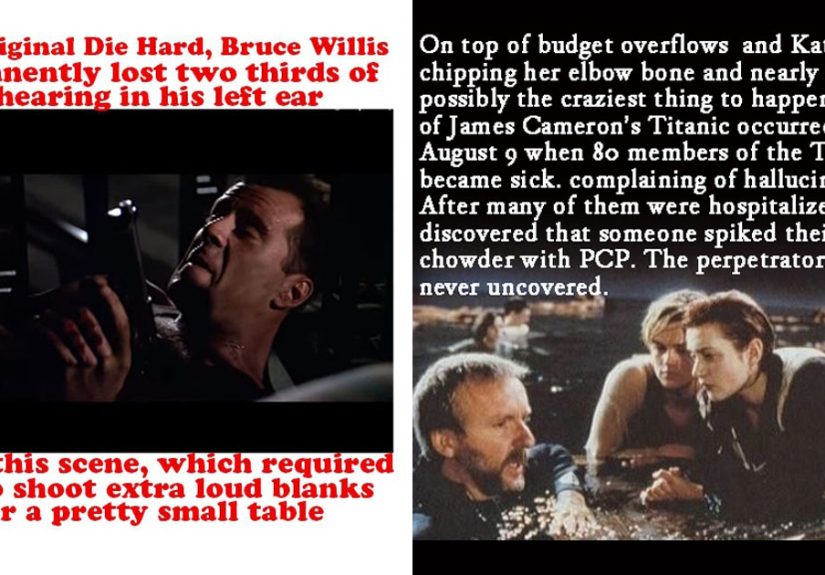
You expect storms at seanot in craft services. During production in 1996, a large number of cast and crew members were hospitalized after consuming chowder that was later reported to have been laced with PCP. Accounts describe confusion, panic, and a surreal medical-nightmare atmosphere. The culprit was never publicly pinned down, which is honestly the most terrifying part: anyone could’ve done it, and the movie still had to finish.
Apocalypse Now (1979): A typhoon erased months of work
Francis Ford Coppola’s war epic didn’t just depict chaosit lived it. A major storm reportedly destroyed sets in the Philippines, forcing costly rebuilds and delays. The production became a legend for spiraling schedules and escalating stress, proving that Mother Nature is the ultimate executive producer: she does notes, she doesn’t negotiate, and she always wins.
Apocalypse Now (1979): A leading man’s health crisis mid-shoot
The film’s infamous “production hell” included a very real medical emergency: Martin Sheen suffered a heart attack during filming, which required the production to adapt while keeping the project alive. The behind-the-scenes story is brutal because it highlights how fragile a massive production becomes when one key person is suddenly fighting for their life.
Jaws (1975): The shark that wouldn’t work… and nearly sank the movie
The mechanical sharknicknamed “Bruce”famously malfunctioned, especially in ocean conditions. Delays piled up, budgets ballooned, and Spielberg reportedly feared the project would end his career. The nightmare became the film’s signature advantage: because the shark rarely worked, the movie shows it less, and the suspense became legendary. Sometimes failure is just accidental genius.
The Abyss (1989): James Cameron’s near-drowning scare
Filming underwater is hard. Filming underwater for hours every day is a slow-motion stress test. James Cameron has publicly described a moment during production when he was underwater and his air supply failed, creating a dangerous situation. The set became notorious for pushing human limitsbecause water doesn’t care if you’re the director.
The Abyss (1989): “The Abuse”when the set nickname says it all
Reports about the production describe exhaustion, infections, and a grinding schedule that wore down cast and crew. One famous anecdote from retrospectives is that the title got altered on a board to read “The Abuse,” which tells you everything you need to know. It’s not just the stunts that break peopleit’s the relentless repetition under extreme conditions.
The Revenant (2015): A prestige film that felt like survival training
The Revenant is gorgeous, but it was also widely reported as punishing to makefrigid weather, complicated logistics, and a production that reportedly moved locations in search of the right natural conditions. The result looks authentic because it was authentic: people really were cold, tired, and operating at the edge of what a crew can reasonably endure.
Star Wars: The Force Awakens (2015): A hydraulics accident injured Harrison Ford
Even in a galaxy far, far away, heavy machinery is still heavy machinery. Harrison Ford suffered a serious leg injury when a hydraulic door on the Millennium Falcon set came down. Big franchises rely on massive practical buildsand those builds come with industrial-grade risks that don’t care how iconic you are.
Deadpool 2 (2018): A stunt performer’s death during a motorcycle sequence
Stunts are engineered dangeremphasis on engineered. During production, stunt performer Joi “SJ” Harris was killed while performing a motorcycle stunt. The tragedy highlighted a hard truth: even with preparation, the margin for error can be thin, and the consequences can be permanent. It’s a sobering counterweight to how casually audiences consume “cool action moments.”
Resident Evil: The Final Chapter (2016): A catastrophic on-set injury
Olivia Jackson, a stunt performer, suffered life-altering injuries during production that were widely reported in entertainment trade coverage. The details are harrowing because they underscore how one misjudged piece of timing or equipment can change a person’s entire life in a second. The behind-the-scenes story isn’t “fun trivia”it’s a reminder that stunts are real labor performed by real bodies.
Back to the Future Part III (1990): The hanging scene that went too far
Michael J. Fox has described a moment during the hanging sequence when the stunt nearly became tragically real. It’s a nightmare scenario: a scene built around simulated danger where the simulation starts slipping. The most unsettling part is how quickly “acting” can become “emergency” when a rig, a knot, or timing goes wrong.
The Exorcist (1973): A fire wiped out a major set
Horror movies love a good “cursed production” story, but some of The Exorcist’s misfortunes were plain reality. A reported fire destroyed much of the MacNeil house set, triggering costly delays. Even if you don’t believe in curses, you can believe in electrical problems, bad luck, and how fragile a schedule becomes when your main set turns into ash.
The Exorcist (1973): Ellen Burstyn’s injury that made the take infamous
The scene where Chris MacNeil is thrown backward is notorious because Burstyn’s scream is real. Accounts from production history describe how a stunt rig yanked her hard enough to cause serious injury. It’s one of those moments where authenticity is not a complimentit’s evidence that something went wrong and the camera kept rolling.
Raiders of the Lost Ark (1981): Illness on location changed an iconic scene
The famous moment where Indiana Jones simply shoots the flashy swordsman didn’t start as a jokeit started as a stomach problem. Reports from behind-the-scenes coverage say Harrison Ford was ill during filming, and the scene was changed to something quicker. The result is hilarious on screen, but the origin story is pure production reality: sometimes your body edits the script for you.
The Shining (1980): The myth of endless takes… and the real toll of pressure
For years, the story that Shelley Duvall endured “127 takes” of a single scene spread like gospel. Later reporting and documentation efforts have challenged how that number gets used and repeated. Still, what isn’t a myth is that the shoot was widely described as psychologically demanding, and Duvall’s experience has become a major touchpoint in debates about directorial methods and actor welfare.
Ben-Hur (1959): The chariot-race “death” rumorand what’s true
The Ben-Hur chariot race is so intense that a rumor persisted for decades: that a stunt performer died on camera. Film historians and behind-the-scenes analyses have repeatedly pushed back on that claim. The real story is still wilddangerous stunts, high-speed chaos, real injuries in an era with looser safety standards but not every horrifying legend survives fact-checking.
The Conqueror (1956): A radioactive cloud hanging over a production
Few behind-the-scenes stories are as eerie as the long-running debate around The Conqueror, which filmed in areas later associated with nuclear-test fallout. Over time, reports highlighted cancer diagnoses among cast and crew, sparking arguments about causation versus coincidence. The horror here is slow-burn: it’s about exposure, uncertainty, and the unsettling possibility that the danger wasn’t on setit was in the environment.
Mission: Impossible Fallout (2018): Tom Cruise’s ankle-breaking leap
Tom Cruise’s stunts are basically their own cinematic universe, but one rooftop jump went wrong: he broke his ankle during the leap. What makes it extra intense is that footage of the mishap ended up informing the final sequence, because of course it did. It’s a reminder that “practical” can be thrilling… and brutally unforgiving.
Harry Potter and the Deathly Hallows (2010): A stunt rehearsal that changed a life
Stunt performer David HolmesDaniel Radcliffe’s longtime doublewas left paralyzed after a serious accident during rehearsal for the franchise. The story resurfaced in widespread coverage around a documentary exploring his life and recovery. It’s one of the most heartbreaking behind-the-scenes realities: the magic on screen is built on invisible, high-risk work that audiences rarely see.
The Hunger Games: Catching Fire (2013): When water work damages more than your schedule
Water shoots look slick; they feel miserable. Jennifer Lawrence has described suffering severe ear problems during the sequel’s water-heavy filming, including infections and a punctured eardrum that led to temporary hearing loss. It’s not as instantly headline-grabbing as an explosion, but it’s the kind of injury that lingersand reminds you that “safe” scenes can still hurt.
What These Stories Teach Us About Film Sets (Besides “Maybe Don’t”)
It’s tempting to treat behind-the-scenes horror stories as entertainmentlike a haunted-house tour, but with more union paperwork. The better way to read them is as a timeline of lessons the industry keeps learning (and relearning):
- Scale multiplies risk. Bigger sets and bigger stunts mean more chances for a single failure to cascade.
- Nature doesn’t care about call sheets. Oceans, storms, cold, heatnone of it respects your budget.
- Safety rules are written in scar tissue. Many modern standards exist because past productions went tragically wrong.
- “It’ll be fine” is not a plan. Whether it’s equipment, food, or pyrotechnics, assumptions are where disasters begin.
- Human bodies are not replaceable. The final cut isn’t worth a life-altering injuryfull stop.
Bonus Add-On: of “Set Life” Experience (The Part You Don’t See on Screen)
If you’ve never been near a film set, it’s easy to imagine the work as glamorous chaos: directors shouting, actors emoting, someone handing out lattes, and a magical moment when the sun hits the lens just right. The truth is less shiny and more specific. A film set is a traveling city built to manufacture seconds. Not minutesseconds. Ten seconds of footage can require an hour of lighting tweaks, a half hour of reset, a safety meeting, a rehearsal, another reset, and a quiet, collective prayer that the fog machine doesn’t suddenly decide to cosplay as a wildfire.
The strangest thing about “horrifying behind-the-scenes” stories is how often they begin with something ordinary. Not a dramatic screamjust a small compromise. A rushed decision because the sun is setting. A prop that’s “basically fine.” A stunt that’s been done a hundred timesuntil the hundred-and-first time, when a gust of wind or a mistimed cue turns routine into catastrophe. Film crews live in a world where tiny variables have huge consequences. That’s why the best sets feel almost boring: safety briefings, checklists, redundancy, and people empowered to stop the machine when something feels off.
Then there’s the endurance factor, which rarely makes the behind-the-scenes highlight reels. Long days flatten judgment. Sleep deprivation makes everyone a little worse at math, timing, and patiencethree things you absolutely need when you’re coordinating vehicles, rigs, water tanks, pyrotechnics, or even just a heavy door on a spaceship set. Add weather, location travel, and the pressure of expensive schedules, and you get a recipe for stress that seeps into everything: bodies tighten up, tempers shorten, and people start thinking in dangerous wayslike the shot is the goal, rather than the people.
And yet, what’s almost miraculous is how many productions do it right. The best stunt teams treat danger like engineering, not bravado. Great coordinators plan for failure modes the way pilots do: “If X happens, we do Y.” Great ADs (assistant directors) protect time for safety even when time is the one thing nobody has. Great directors understand that a crew that feels safe also works betterbecause fear and chaos don’t produce creativity, they produce mistakes. The “horror stories” survive because they’re shocking, but the quiet success stories are happening every day: a risky beat redesigned to be safer, a stunt adjusted, a schedule changed, a “no” that prevents someone’s worst day.
So when you watch a massive movie and feel your stomach drop during a set piece, there’s a useful thought to keep in mind: the real spectacle isn’t just what you’re seeingit’s the invisible discipline it takes to make danger look real without making it real. And when that discipline fails, the behind-the-scenes story stops being fun… and becomes the kind of headline nobody wants.
Conclusion
The next time a blockbuster makes something look effortless, remember: “effortless” is often a carefully managed illusion built by professionals who plan, rehearse, test, and repeat until risk is minimized. These 24 stories are horrifying precisely because they reveal what happens when that system breaksor when it never existed in the first place. Movie history is packed with triumphs, but the real progress is when the industry learns to protect the people who make the magic.