Table of Contents >> Show >> Hide
- Why Washi Tape Works So Well for Decorating
- Before You Tape Anything: 6 Quick Rules That Save Your Sanity
- 20 Ways to Decorate With Washi Tape
- 1) Create a Geometric Accent Wall (Without Paint Drama)
- 2) Fake a Picture Frame Around Posters or Kids’ Art
- 3) Make a Gallery Wall That’s Perfectly Spaced
- 4) Turn a Boring Door Into a “Custom” Door
- 5) Outline a Faux Headboard (The Renter-Friendly Flex)
- 6) Add a Pop to Stair Risers
- 7) Give Drawer Fronts a Quick Makeover
- 8) Dress Up Cabinet Doors or Shelving Edges
- 9) Add Pattern to the Back of a Bookshelf
- 10) Upgrade a Lampshade With Stripes or a Graphic Band
- 11) Make a Custom Light Switch Plate (No Tools Required)
- 12) Wrap Plant Pots Like They’re Wearing Tiny Designer Outfits
- 13) Turn Jars Into Vases, Pencil Holders, or Bathroom Storage
- 14) Create a Washi Tape “Picture Ledge” Illusion
- 15) Make a Wall Calendar, Chore Chart, or Weekly Planner Grid
- 16) Color-Code Cords, Chargers, and Tech Accessories
- 17) Make “Instant Art” With Tape-Only Shapes
- 18) Build a Kids’ Racetrack or Play Town on the Floor
- 19) Make Seasonal Decor: No-Dye Eggs, No-Carve Pumpkins, Easy Ornaments
- 20) Go Big for the Holidays: A Washi Tape “Tree” or Card Display
- How to Make These Ideas Look “Styled” Instead of “Stuck On”
- Experience Section: The Real-Life Stuff Nobody Tells You (But Everyone Learns Anyway)
- Conclusion
Washi tape is the commitment-phobe’s best friend: it shows up colorful, charming, and ready to transform a space
without asking you to buy a gallon of paint, learn power tools, or explain “the vibe” to anyone.
It’s decorative paper tape (inspired by traditional Japanese washi paper) that’s generally easy to tear,
reposition, and removemaking it perfect for renters, serial redecorators, and anyone whose DIY confidence
depends heavily on the ability to undo things.
The fun part? You don’t need an art degree. You need a roll (or five), a clean surface, and the willingness to
say, “If it’s crooked, it’s…modern.” Below are 20 genuinely doable ways to decorate with washi tapesome purely
pretty, some sneakily practical, and all designed to make your home (or desk) look like you’ve got it together.
Why Washi Tape Works So Well for Decorating
Washi tape hits a sweet spot between “temporary” and “actually useful.” It’s often gentle enough for smooth,
sealed walls and many household surfaces, but sticky enough to hold lightweight décor, define lines, and add
pattern in minutes. It’s also forgiving: you can experiment with color palettes, seasonal themes, and bold
geometric designs without the stress of permanent mistakes.
Before You Tape Anything: 6 Quick Rules That Save Your Sanity
- Clean first. Dust and oils are the enemy. Wipe the surface with a dry microfiber cloth (or a barely damp one) and let it fully dry.
- Patch test. Especially on painted walls, antiques, raw wood, or delicate finishes. Leave a small strip for an hour or overnight and remove slowly.
- Smooth walls love tape; textured walls tolerate it. Tape tends to lift on heavy texture. Save big patterns for smoother areas.
- Measure like you mean it. A simple ruler, level, or “step back and squint” check prevents the “why is this diamond slowly becoming a trapezoid?” situation.
- Burnish gently. Press tape down with your finger or a plastic card to reduce bubbles. Don’t scrape like you’re icing a cake with a shovel.
- Remove slowly. Pull back at a low angle. If you’re worried, warm it slightly with your hand first and go gently.
20 Ways to Decorate With Washi Tape
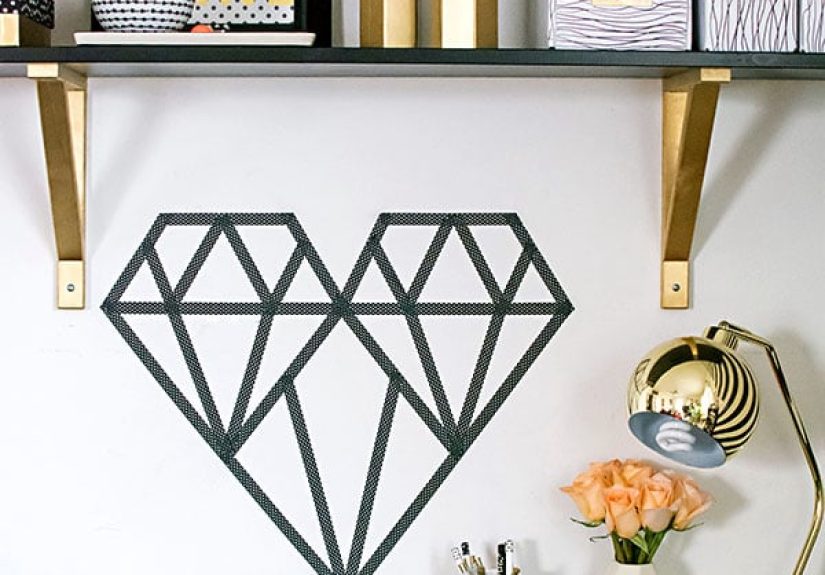
1) Create a Geometric Accent Wall (Without Paint Drama)
Think triangles, chevrons, a simple grid, or a repeating “plus sign” pattern. Choose one or two colors for a
clean, modern lookor go full confetti if you want your wall to feel like it has a personality disorder (in
the best way).Pro tip: Mark light pencil dots for endpoints, then connect with tape. If you’re building a grid,
lay down thin tape guides first and fill sections with wider tape for that crisp “designed on purpose” look.2) Fake a Picture Frame Around Posters or Kids’ Art
Instead of framing every single thing (expensive) or using thumbtacks (tiny wall wounds), outline artwork
with tape. It reads like a frame, feels intentional, and takes about 90 seconds.Use a solid color for a clean border, or pattern tape for a playful “gallery wall, but make it casual” vibe.
3) Make a Gallery Wall That’s Perfectly Spaced
Layout paralysis is real. Use washi tape to mark rectangles where frames will go. Step back, adjust, and only
then hang. Bonus: you can use tape to label the center points and keep spacing consistent.Extra credit: If you’re doing a “grid gallery,” use tape to create visual alignment lines across the wall.
4) Turn a Boring Door Into a “Custom” Door
Flat doors can look… aggressively plain. Add a border about an inch from the edge, or create faux panels with
straight lines. Suddenly your standard door has “character,” and you didn’t even buy molding.Keep it subtle with a matte solid tape, or go bold with a black-and-white graphic pattern for modern contrast.
5) Outline a Faux Headboard (The Renter-Friendly Flex)
No headboard? No problem. Use tape to outline an arch, rectangle, or soft geometric shape behind your bed.
It gives your room a focal point without taking up floor space (or requiring a power drill).Add a second border line for depth, like a drawn headboard. Your pillows will feel emotionally supported.
6) Add a Pop to Stair Risers
If you have stairs with plain risers, tape stripes or a repeating pattern across the front. This works best on
smooth, sealed surfaces. It’s a small detail with big “wow, you did that?” energy.Go uniform for a polished look, or alternate designs for a playful, eclectic effect.
7) Give Drawer Fronts a Quick Makeover
Dressers and cabinets get boring fast. Tape a border around the edge of each drawer, or add stripes down the
center like “designer inlay.” For a cleaner finish, trim with a craft knife (carefully) against a ruler.Style idea: Use one “hero pattern” tape on every other drawer, and a solid coordinating color on the rest.
8) Dress Up Cabinet Doors or Shelving Edges
A thin tape line along the edge of cabinet doors, shelves, or open cubbies can look surprisingly polished.
It’s like eyeliner for your furnituresubtle but transformative.This is especially great for kids’ storage shelves: color-code by category (toys, books, crafts) and call it “organization.”
9) Add Pattern to the Back of a Bookshelf
If the back panel of your bookshelf is plain, cover it in horizontal stripes, a checkerboard pattern, or
a diagonal herringbone. It makes books and décor pop like they’re staged for a catalog.If you’re nervous, start with a small shelf section. Tape is forgiving. Your confidence will grow faster than your “washi stash.”
10) Upgrade a Lampshade With Stripes or a Graphic Band
A plain lampshade is basically begging for a makeover. Add evenly spaced vertical stripes, or wrap a thick band
around the bottom edge for a crisp, tailored look.Keep patterns simplelight + repeating lines tend to look more “designer” and less “middle school craft night,” unless that’s the goal.
11) Make a Custom Light Switch Plate (No Tools Required)
If you can remove the plate with a screwdriver, greatcover it and reattach. If not, you can still add a neat
border around the plate on the wall itself. Either way, it’s a tiny change that reads surprisingly intentional.Safety note: Don’t tape over outlets or create anything that interferes with the switch mechanism.
12) Wrap Plant Pots Like They’re Wearing Tiny Designer Outfits
Terra cotta pots can look rustic. Or… dusty. Washi tape bands around the rim or base make pots feel curated.
Use a solid color for a modern look, or a bright pattern for playful plants.If your pots get watered frequently, keep tape away from the soil line and wipe moisture off quickly.
13) Turn Jars Into Vases, Pencil Holders, or Bathroom Storage
Wrap glass jars in tape strips (horizontal bands, vertical panels, or layered blocks). Use them as vases,
cotton ball holders, makeup brush cups, or desk organizers. It’s “upcycling,” which is the fancy word for
“I’m not throwing this away.”A little twine bow on top is optional, but emotionally satisfying.
14) Create a Washi Tape “Picture Ledge” Illusion
You know those minimalist ledges that hold frames? You can mimic the look by taping a thin horizontal line and
placing lightweight prints above iteither taped up or leaned on an actual surface below. It tricks the eye
into seeing structure and styling.Add tiny “brackets” with short vertical tape pieces if you want the ledge illusion to really sell it.
15) Make a Wall Calendar, Chore Chart, or Weekly Planner Grid
Use tape to create a clean grid: seven columns for days, or a simple month layout. Write in the boxes with a
removable marker on a laminated sheet, acrylic board, or even paper you swap out weekly.This is décor that also prevents the “Wait, that’s today?” panic. Pretty and functionalthe dream.
16) Color-Code Cords, Chargers, and Tech Accessories
If your household has more than one phone, you already know the Charger Hunger Games. Wrap a small band of tape
around each cord end so everyone can identify theirs instantly.Bonus: use tape to label camera batteries, SD card cases, or the TV remote that always “mysteriously” ends up in the couch cushions.
17) Make “Instant Art” With Tape-Only Shapes
Create minimalist tape art directly on the wall: a mountain line, a sunrise arch, abstract angles, or a simple
line drawing style face (yes, that trendy one). Keep it monochrome for a modern look, or use two colors max.The secret is negative space. Let the wall color do half the work while you pretend this was easy all along.
18) Build a Kids’ Racetrack or Play Town on the Floor
Washi tape is a parent/caregiver cheat code for rainy days: outline roads, parking spots, or a whole city map
on the floor. It’s easy to change, easy to remove, and turns toy cars into an activity with a beginning, middle,
and “why is there a traffic jam at the snack cabinet?” ending.Keep turns wide, add crosswalk stripes, and label “Gas Station” to feel like a world-building genius.
19) Make Seasonal Decor: No-Dye Eggs, No-Carve Pumpkins, Easy Ornaments
Washi tape shines in seasonal crafts because it’s clean, quick, and doesn’t require you to store glitter for
the next five years.- Eggs: Add stripes, checks, or patchwork patterns with thin tape for a crisp, graphic look.
- Pumpkins: Make plaid or striped patterns on no-carve pumpkins with removable tape layers.
- Ornaments: Cover clear or wooden ornaments with overlapping strips for an easy custom look.
20) Go Big for the Holidays: A Washi Tape “Tree” or Card Display
No room for a tree (or you just don’t want pine needles judging you)? Tape a large triangle on the wall as a
stylized tree and clip holiday cards or lightweight ornaments along the “branches.”It’s festive, space-saving, and wildly satisfying. Plus, it doubles as a card displayso your holiday mail
becomes part of the décor instead of a pile on the counter that slowly becomes your personality.
How to Make These Ideas Look “Styled” Instead of “Stuck On”
Washi tape is simple, but the difference between “cute DIY” and “why does this look like a craft store exploded?”
is usually just a few design choices:
- Pick a palette. Two to three coordinating colors almost always look more intentional than five competing patterns.
- Repeat one element. Use the same tape pattern in two spots (like a pot band and a frame border) to create visual cohesion.
- Use solids as “breathing room.” Pair a busy pattern with a solid tape so your eyes can relax.
- Mind the scale. Big patterns read bolder; thin tapes create detail. Use wide tape for blocks, thin tape for lines and borders.
- Finish edges cleanly. Tear for casual texture; trim for crisp geometry. Decide which look you want and commit.
Experience Section: The Real-Life Stuff Nobody Tells You (But Everyone Learns Anyway)
Let’s talk about the “experience” side of decorating with washi tapethe part that doesn’t show up in the
perfect photos. Because in real homes, there are pets, kids, humidity, textured walls, and that one friend who
leans on everything like they’re auditioning to become a coat rack.
First experience: your wall is not as smooth as you think. Many people start with the dream of a
perfectly crisp grid wall. Then they meet the reality of subtle orange-peel paint texture. The tape goes on fine
for the first 10 minutes, and you think, “I was born for this.” Then a corner lifts. Then another. The lesson:
if your wall has texture, choose larger shapes with fewer tiny endpoints, burnish gently, and accept that
micro-perfection is a myth invented by people who don’t have ceiling fans.
Second experience: measure twice, tape once…then still adjust. Tape is wonderfully forgiving,
but lines that look straight up close can look slightly off from across the room. A common win is making tiny
pencil marks, stepping back every few strips, and correcting earlybecause if you wait until the end, your
“diamond” pattern may quietly evolve into “modern interpretive geometry.”
Third experience: humidity is the sneaky villain. Bathrooms, kitchens, and any place near a
steamy kettle can shorten tape’s lifespan. People often discover this when a taped jar in the bathroom starts
sliding like it’s late for a meeting. The workaround is simple: use tape in drier zones, keep it away from
direct water contact, and treat moisture-prone rooms as “accent only” territory (think a border on a mirror
frame rather than fully wrapping a container that gets handled with wet hands).
Fourth experience: kids will treat tape roads as urban planning. The first time you make a
racetrack, it’s adorable. The second time, it becomes a fully developed transportation system with “construction”
zones, detours, and one dramatic bridge collapse. This is a feature, not a bug. A great trick is to keep a small
“road kit” (two rolls, a marker, a few toy cars) so you can rebuild the map in new shapes without digging through
a drawer like you’re searching for a lost artifact.
Fifth experience: the best tape projects start with a small win. People who fall in love with
washi tape usually begin with something low-stakes: a quick frame border, a pot band, a simple cable label.
That small success builds confidence, and suddenly they’re outlining doors and making a wall calendar grid with
the focus of a professional architect. Starting small also helps you learn how your surfaces behavebecause
not all paint finishes, plastics, or wood varnishes respond the same way.
Sixth experience: removal is an art. When tape comes off easily, it feels like magic. When it
resists, people tend to pull faster (a natural human response), which is how you invite paint flakes to the party.
The better experience is slow removal at a low angle, especially if the tape has been up a while. If you’re
nervous, warm the strip slightly with your hand and peel back gradually. The goal is “clean goodbye,” not
“ripcord ejection.”
And the biggest experience of all: washi tape is a creativity shortcut. It’s one of the rare
decorating tools that rewards experimentation. You can try a bold pattern, live with it for a week, and swap it
out without regret. That’s not just convenientit’s empowering. Decorating stops being a high-stakes decision
and becomes a playful process. Which is exactly what your home deserves… right after you finally find the tape
end again.
Conclusion
If you want fast, friendly, renter-approved decorating, washi tape is basically the Swiss Army knife of DIY style.
Use it to add pattern, organize the chaos, fake expensive details, and bring seasonal fun into your spacewithout
committing to anything you can’t undo. Start with one small project, learn what surfaces love your tape, and
build from there. Worst-case scenario: you peel it off and try again. Best-case scenario: your home looks
noticeably cooler, and you did it with something you can tear by hand.