Table of Contents >> Show >> Hide
- How to Choose a Kitchen Color Scheme You’ll Still Like Later
- 1) Warm White + Natural Wood + Matte Black
- 2) Crisp White + Navy + Brass
- 3) Greige + Creamy White + Light Oak
- 4) Sage Green + Off-White + Warm Brass
- 5) Forest Green + Walnut + Soft White
- 6) Charcoal + Warm White + Natural Stone
- 7) Soft Gray + White + Stainless
- 8) Blue-Gray + White + Warm Wood
- 9) Black + White + One Warm “Bridge” (Wood or Brass)
- 10) Buttercream + Soft Gray + Butcher Block
- 11) Clay/Terracotta + Ivory + Aged Brass
- 12) Tonal Taupe + Mushroom + Soft White (The “Quiet Luxury” Kitchen)
- Quick Ways to Test a Kitchen Color Scheme Before You Commit
- Conclusion: The Best Kitchen Color Schemes Are the Ones You Can Live With
- Real-Life “Experience” Lessons: What These Palettes Feel Like After the Photos
Picking a kitchen color scheme can feel like naming a baby: you love “something unique,” but you also don’t want to explain it for the next 15 years. The good news? You don’t need to gamble on a neon backsplash or commit to a cabinet color that only looks good in a showroom with flattering lighting and a professional photographer whispering, “work it.”
Below are 12 no-fail kitchen color schemes that hold up in real lifemorning chaos, spaghetti sauce splatters, and all. These palettes are flexible, widely loved across design styles, and easy to refresh with hardware, lighting, and décor. If you want timeless kitchen paint colors and kitchen cabinet colors you won’t side-eye a year from now, start here.
How to Choose a Kitchen Color Scheme You’ll Still Like Later
Before we get to the fun part, here’s the “no regrets” formula. Most kitchen color regrets happen when we pick paint first and reality second. Try this quick decision path instead:
- Start with what doesn’t change easily: countertops, floors, and backsplash tile. Your paint should support these, not fight them.
- Choose your “main neutral”: an off-white, warm gray, greige, taupe, or soft charcoal. This is your kitchen’s long-term anchor.
- Add one strong supporting color: navy, sage, forest green, deep blue-gray, or near-black. These read as “classic,” not “trend stunt.”
- Decide your metal vibe: brushed nickel for crisp and clean, brass for warm and elevated, matte black for graphic and modern.
- Use the 60–30–10 idea: about 60% dominant color (walls/cabinets), 30% secondary (island/lower cabinets), 10% accents (hardware, lighting, décor).
One more truth that saves money: undertones matter. Two “whites” can disagree like siblings in the backseat. If your countertop has warm beige flecks, a cool icy white can look oddly blue. If your floor leans orange, a pinky beige can suddenly look… aggressively peach. Always test samples in your kitchen’s actual lighting.
1) Warm White + Natural Wood + Matte Black
This is the kitchen color palette equivalent of a perfectly toasted bagel: simple, satisfying, and somehow always a good idea. Warm white cabinets keep the room bright, natural wood adds warmth and texture, and matte black hardware brings crisp contrast.
Try it like this: warm white perimeter cabinets, white or light stone counters, a wood island or wood shelving, and black pulls/faucet. Keep the backsplash quiet (soft white tile, subtle veining) so the wood can do its cozy thing.
Why you won’t regret it: it’s flexible. You can pivot the style farmhouse, modern, Scandinavian, or classic just by changing lighting and stools.
2) Crisp White + Navy + Brass
If you want a “color kitchen” that still behaves like a neutral, navy is your best employee. Pair it with crisp white for a clean foundation, then add brass accents to make it feel intentional (not like you ran out of white paint halfway through).
Try it like this: white upper cabinets and walls, navy lower cabinets or a navy island, brass hardware, and a light backsplash. A touch of warm wood (cutting boards, shelves) keeps it from feeling too nautical.
Why you won’t regret it: navy has staying power, and the combo photographs beautifully without needing “filters and prayers.”
3) Greige + Creamy White + Light Oak
Greige (that sweet spot between gray and beige) is a quiet hero in no-fail kitchen color schemes. It reads calm, hides day-to-day smudges better than bright white, and plays nicely with warm or cool finishesif you pick the undertone thoughtfully.
Try it like this: greige cabinets or walls, creamy white trim/uppers, light oak floors or a light wood island, and brushed nickel fixtures. Add texture through linen Roman shades, woven baskets, or matte ceramic accessories.
Why you won’t regret it: it stays soft and welcoming even as trends change around it.
4) Sage Green + Off-White + Warm Brass
Sage green is popular for a reason: it feels fresh without being loud. It’s nature-inspired, easy on the eyes, and reads “designed” even when your kitchen is currently “busy” (aka you own appliances).
Try it like this: sage lower cabinets, off-white uppers, warm brass hardware, and simple white tile. If you want a little drama, choose a deeper green for the island and keep perimeter cabinets light.
Why you won’t regret it: it brings color without turning your kitchen into a themed restaurant.
5) Forest Green + Walnut + Soft White
Want moody but timeless? A deep forest green paired with walnut wood feels rich, grounded, and surprisingly livable. The key is balance: use soft white (not stark) to keep the space from feeling heavy.
Try it like this: forest green island or lower cabinets, walnut open shelving or a walnut hood surround, soft white walls/uppers, and light stone counters. Add brass or aged bronze for warmth, or brushed nickel if you want it cooler.
Why you won’t regret it: it feels upscale and cozy at the same timelike a kitchen that reads hardcover books.
6) Charcoal + Warm White + Natural Stone
Charcoal is the “I’m dramatic, but I pay my bills” version of black. It gives you contrast and depth without sucking all the light out of the room. Pair it with warm white and natural stone for a classic, tailored look.
Try it like this: charcoal lower cabinets or island, warm white perimeter cabinets, stone countertops with subtle movement, and a backsplash that echoes the stone. Matte black hardware can work here because the charcoal “grounds” it.
Why you won’t regret it: it looks intentional in both modern and traditional kitchensand it’s forgiving.
7) Soft Gray + White + Stainless
This one is for the person who wants clean and classic without leaning too warm or too stark. Soft gray kitchens feel calm and structured, and they make stainless appliances look like they belong (instead of looking like they crashed the party).
Try it like this: light gray cabinets, white walls, white backsplash, stainless appliances, and brushed nickel hardware. If it feels too flat, bring in warmth through wood floors or a warm runner.
Why you won’t regret it: it’s a timeless kitchen color scheme that adapts easily when you change décor.
8) Blue-Gray + White + Warm Wood
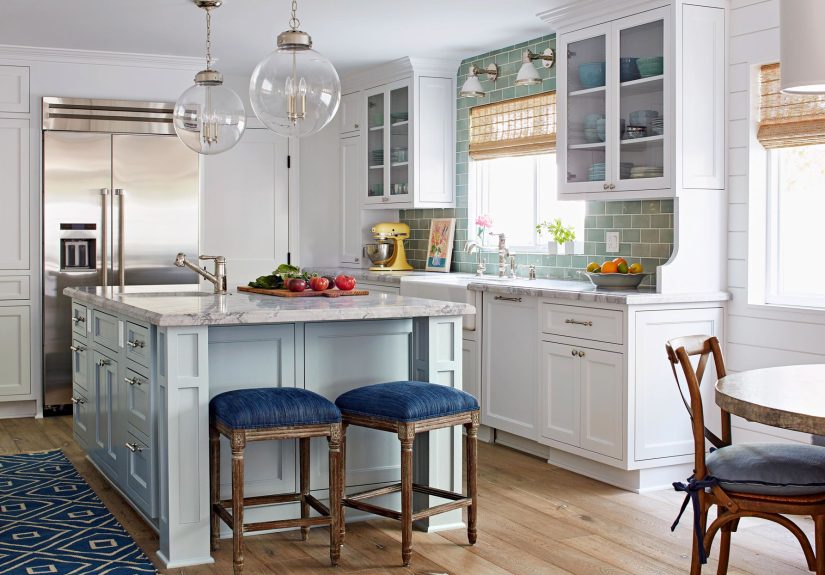
Blue-gray is a sweet spot: it adds color, but it still behaves like a neutral. It can feel coastal, classic, or modern depending on the materials around it. Warm wood is the cheat code that makes it feel inviting instead of chilly.
Try it like this: blue-gray island, white perimeter cabinets, warm wood floors or shelves, and a backsplash in soft white. Choose brass for a warm pop or nickel for a quieter finish.
Why you won’t regret it: it’s calm, versatile, and doesn’t scream “I followed a trend.”
9) Black + White + One Warm “Bridge” (Wood or Brass)
Black-and-white kitchens can be stunningand also slightly harsh if you don’t add a bridge. The bridge is your warm element: wood tones, brass hardware, warm veining in stone, or even a creamy white instead of bright white.
Try it like this: white cabinets with black counters (or vice versa), then add warmth with wood shelves, a wood island, brass pendants, or a backsplash with soft beige veining.
Why you won’t regret it: high contrast reads classic, and the warm bridge keeps it from feeling like a chessboard you have to cook in.
10) Buttercream + Soft Gray + Butcher Block
If stark white feels too clinical, buttercream (a creamy, gentle yellow-white) brings warmth without looking “banana.” Pair it with soft gray for balance and butcher block for a cozy, collected feel.
Try it like this: buttercream walls or uppers, soft gray lowers, butcher block counters on at least one surface (island, coffee nook), and simple white tile. Add black or bronze hardware for contrast.
Why you won’t regret it: it’s cheerful in winter, flattering in warm light, and makes the kitchen feel like a place people actually live.
11) Clay/Terracotta + Ivory + Aged Brass
Terracotta and clay tones are earthy, warm, and surprisingly timeless when used in the right dosage. The trick is to keep it “baked” (muted and complex), not “traffic cone.”
Try it like this: ivory cabinets, clay-toned walls (or a clay backsplash), aged brass hardware, and warm stone or wood floors. If you want more restraint, keep walls neutral and bring clay in through tile, stools, or décor.
Why you won’t regret it: it feels welcoming and elevatedespecially in homes with warm floors or lots of natural light.
12) Tonal Taupe + Mushroom + Soft White (The “Quiet Luxury” Kitchen)
For a kitchen that feels high-end without announcing itself, go tonal. Layer taupe, mushroom, and soft white in different texturesmatte cabinets, honed stone, plaster-look walls, or subtly veined backsplash tile.
Try it like this: taupe cabinets, soft white walls, a slightly darker mushroom island, and stone with creamy undertones. Use brushed nickel or unlacquered brass for a gentle glow.
Why you won’t regret it: it’s timeless, calming, and makes the room feel expensive even when your “decor budget” is mostly paper towels.
Quick Ways to Test a Kitchen Color Scheme Before You Commit
- Sample in multiple spots: near a window, in a shadowy corner, and under your nighttime lights.
- Test next to fixed materials: hold samples against counters, floors, and backsplash tilealways.
- View it at “real life” distance: a tiny swatch is misleading. Use larger samples or poster boards.
- Check morning vs. evening: undertones change fast when the sun moves and warm bulbs turn on.
- Make a mini palette board: paint sample + cabinet finish + hardware + tile. If it looks good together, it will live well together.
Conclusion: The Best Kitchen Color Schemes Are the Ones You Can Live With
A no-fail kitchen color scheme isn’t about playing it safeit’s about choosing combinations that stay charming when the novelty wears off. The 12 palettes above work because they balance contrast and warmth, give your eye a place to rest, and leave room for your kitchen to evolve. Pick your anchor neutral, add a supporting color that has depth, and let materials (wood, stone, metal) do some of the heavy lifting.
Real-Life “Experience” Lessons: What These Palettes Feel Like After the Photos
Let’s talk about the part design blogs don’t always show: how a kitchen color scheme behaves when it’s not perfectly staged. In day-to-day life, the “best” kitchen colors aren’t just prettythey’re practical. Warm whites and creamy off-whites, for example, tend to feel friendlier over time than super bright whites, especially at night when your lighting turns everything warmer. That’s why palettes like warm white + wood + black keep winning: they look crisp in daylight, cozy at dinner, and forgiving when you’re cleaning up after a “quick weeknight meal” that somehow used every pot you own.
Two-tone kitchen cabinets (like white + navy or off-white + sage) are another real-life winner because they hide wear where life happens most. Lower cabinets get kicked, bumped, and smudged; a deeper color down low won’t look tired as quickly. Meanwhile, lighter uppers keep the room feeling open. It’s not just a style moveit’s a sanity move. Similarly, charcoal and forest green are surprisingly livable “dark” choices. They’re dramatic, yes, but they can also be more forgiving than mid-tone colors that show every fingerprint in the wrong light.
Here’s a lesson people learn the hard way: lighting is basically a co-designer. If your kitchen has warm bulbs, a cool gray can look icy. If your kitchen is shaded, a deep color everywhere can feel heavy. That’s why the most regret-proof palettes usually include a light counterbalancesoft white walls, a bright backsplash, lighter counters, or reflective finishes. Another lived-in trick: add warmth through materials, not just paint. If a palette starts feeling “flat,” a wood shelf, a textured runner, or warmer hardware can fix the mood without repainting the whole room.
Also: trends aren’t the enemybad proportions are. A buttery cream can be timeless, but if it’s too bright and everywhere, it can read cartoonish. Terracotta can be gorgeous, but it’s often better as a backsplash, a pantry nook, or an accent wall rather than every cabinet. The no-fail approach is to give your boldest color a job and boundaries: an island, lowers, a hutch, or a small bar area. Then let your neutral carry the rest of the space.
Finally, the most useful “experience” advice is boringand it works: test samples bigger than you think you need. Colors that look perfect on a tiny chip can feel totally different across a wall or a run of cabinets. Live with them for a few days. Look at them when you’re caffeinated, when you’re tired, when the sun is blasting in, and when it’s raining. If you still like it after all that, congratulations: you’ve basically stress-tested your kitchen color scheme like a responsible adult. Which means you can enjoy your beautiful kitchen without the nagging feeling that you should’ve chosen “one shade less… something.”