Table of Contents >> Show >> Hide
- Fact #1: They weren’t “museum paintings” at firstthey were murals on the walls of his home
- Fact #2: The group is traditionally counted as 14 works, made late in Goya’s life (around 1820–1823)
- Fact #3: “Black Paintings” is a nicknamenot a title Goya wrote on the back
- Fact #4: They were private worksmore like a visual diary than a public statement
- Fact #5: The themes mix myth, superstition, and everyday human dread
- Fact #6: They look unfinished on purposeand that roughness is part of the power
- Fact #7: The original room setup matteredthese works were designed to be encountered as a whole
- Fact #8: They survived a dramatic “rescue”the murals were transferred to canvas in the 1870s
- Fact #9: “Saturn Devouring His Son” isn’t just shockit’s a symbol machine
- Fact #10: Their meaningand even their authorshiphas been debated, which adds to the mystery
- The 14 Black Paintings at a glance (common English titles)
- So… why are they still so gripping?
- Experiences: What it feels like to meet Goya’s dark paintings (a 500-word add-on)
- Conclusion
Francisco Goya’s Black Paintings (often called his “dark paintings”) are the rare kind of art that doesn’t just hang on a wallit
changes the temperature of the room. They feel modern, brutally honest, and a little bit like walking into someone’s dream when
they forgot to lock the door. And the wildest part? These weren’t made for critics, collectors, or even polite company.
Below are ten facts that make Goya’s mysterious dark paintings easier to understandwithout draining the mystery (because honestly, the mystery is
half the point).
Fact #1: They weren’t “museum paintings” at firstthey were murals on the walls of his home
The Black Paintings began life in the least glamorous place imaginable: the plaster walls of Goya’s country house near Madrid, known as the
Quinta del Sordo (“House/Villa of the Deaf Man”). These weren’t canvases meant for shipping or selling. They were painted directly
onto the interior surfaces of roomsmore like a private environment than a traditional “series.”
Why that matters
When art starts as architecture, it changes how you read it. You don’t approach it as a single object; you’re surrounded by it. That immersive
quality helps explain why the Black Paintings feel so intense: they were never meant to be “visited.” They were meant to be lived with.
Fact #2: The group is traditionally counted as 14 works, made late in Goya’s life (around 1820–1823)
The Black Paintings are most often described as a set of 14 late works produced when Goya was in his 70s. The dates
usually fall roughly between 1820 and 1823, a period shaped by aging, illness, and a Spain rattled by political repression and
instability. The result is a body of work that doesn’t feel like a “career move”it feels like a truth spill.
If you’ve ever wondered why these images don’t behave like polite historical paintings, that’s your clue: they were made at a stage of life when
“impressing people” stops being the goal and “saying what you mean” takes over.
Fact #3: “Black Paintings” is a nicknamenot a title Goya wrote on the back
Goya didn’t package these works as a branded collection called Black Paintings. The label came later and reflects two things:
their dark palette (lots of browns, grays, and blacks) and their somber, unsettling subject matter.
In other words: the name is less of a catalog entry and more of a warning label.
It’s also worth remembering that “black” here doesn’t mean “only black.” It’s about mood, contrast, and the way figures seem to emerge from
darkness like your brain is trying to finish the image before your eyes do.
Fact #4: They were private worksmore like a visual diary than a public statement
A lot of famous art is made to be seen. The Black Paintings are famous precisely because they were not. Multiple sources emphasize how
private these works werecreated without a public commission and without obvious concern for courtly taste.
A helpful way to think about them
Imagine them as a late-life conversationGoya talking to himself about fear, superstition, power, aging, and the strange things people do when they
gather in crowds. There’s no “official message” printed on a museum card that can tame them, because they weren’t born in a public setting.
Fact #5: The themes mix myth, superstition, and everyday human dread
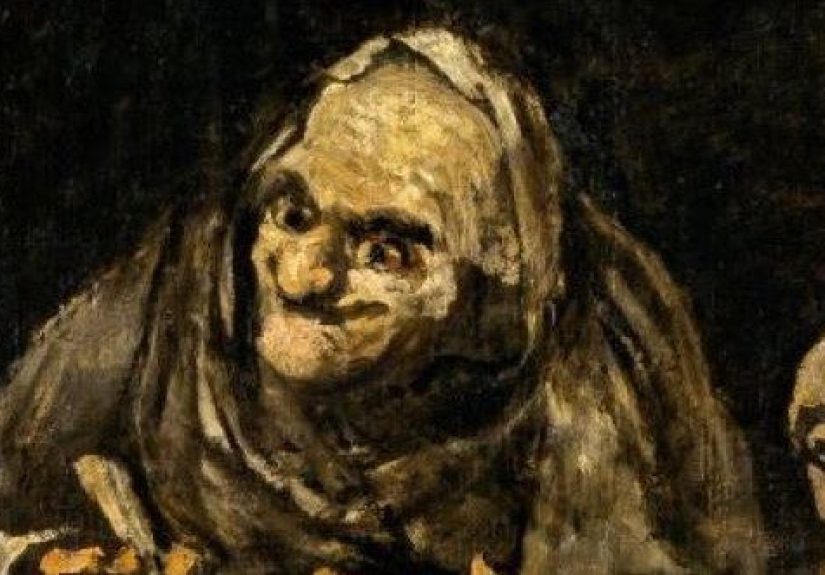
The Black Paintings don’t stick to one lane. They jump between mythic terror, folk belief, religious satire, and scenes that look like
ordinary life got warped in a funhouse mirror. The most famous example is “Saturn Devouring His Son”, which draws on the classical
myth of Saturn (Cronus) consuming his children to avoid being overthrown.
But the “myth” pieces sit beside images of pilgrims, witches, and tense gatheringssuggesting that Goya’s real subject might be less “monsters”
and more the human capacity to become monstrous when fear, power, or groupthink takes the wheel.
Fact #6: They look unfinished on purposeand that roughness is part of the power
One reason these paintings feel shockingly modern is their direct, loose, and sometimes brutal brushwork. Instead of crisp outlines
and glossy finishes, you get smeared light, abrupt shadows, and faces that seem to form at the last second. This isn’t “lazy.” It’s strategic.
What the style does to you
The roughness keeps your brain working. You start “completing” the image mentally, which can feel unsettlingbecause it makes you a participant.
The paintings don’t merely show darkness; they recruit your imagination to help build it.
Fact #7: The original room setup matteredthese works were designed to be encountered as a whole
Accounts of the Black Paintings emphasize that they were placed across rooms in Goya’s house, not isolated on separate gallery walls.
That means the works likely played off one another: figures facing across a space, tensions echoed from image to image, and an overall atmosphere
created by the full arrangement.
Even if we can’t perfectly recreate every original sightline today, the key point remains: this was an environment. Goya wasn’t
just painting pictures; he was shaping what it felt like to stand inside them.
Fact #8: They survived a dramatic “rescue”the murals were transferred to canvas in the 1870s
Because the paintings were originally on plaster walls, preserving them wasn’t simple. After Goya’s death, the house changed hands, and in the
1870s the images were removed from the walls and transferred to canvas under professional supervisionan operation
associated with conservator-restorer Salvador Martínez Cubells and the owner who commissioned the transfer.
The trade-off
This kind of transfer can save the image, but it can also change it. Many discussions note damage, loss, and alterationmeaning what we see today is
incredibly valuable, but not a perfect snapshot of the original walls. It’s a surviving version of a private interior world.
Fact #9: “Saturn Devouring His Son” isn’t just shockit’s a symbol machine
The popular reaction to “Saturn” is often: “Whoa.” (A totally reasonable response.) But interpretations go beyond shock value. Some readings
treat Saturn as Time consuming everything, or as a vision of power terrified of being replaced. Others see it as a mythic mask over
something more personal: aging, paranoia, or the sense that history is chewing up ordinary people.
The painting’s lasting impact comes from how quickly it turns into metaphor. It’s not a puzzle you “solve” once. It’s a meaning factory that keeps
producing interpretations as soon as you look away and look back.
Fact #10: Their meaningand even their authorshiphas been debated, which adds to the mystery
The Black Paintings are famous, but they’re also complicated. Scholars have debated details of their creation, condition, and interpretation,
and a few have even questioned attribution. At the same time, major institutionsincluding the Museo del Pradorecognize them as
Goya’s works and present them as such.
That tension is part of the story: the paintings don’t arrive with neat documentation or a tidy “artist’s statement.” They arrive like a rumor you
can’t stop researchingbecause every answer opens a new question.
The 14 Black Paintings at a glance (common English titles)
Titles vary a bit across sources and translations, but these are the works most commonly associated with the traditional set:
- Saturn Devouring His Son
- Witches’ Sabbath (The Great He-Goat)
- A Pilgrimage to San Isidro
- Procession of the Holy Office
- Asmodea (Fantastic Vision)
- Atropos (The Fates)
- Duel with Cudgels
- The Dog
- Two Old Men
- Two Old Men Eating Soup
- Women Laughing
- Men Reading
- Judith and Holofernes
- La Leocadia (sometimes titled after the figure)
So… why are they still so gripping?
Because the Black Paintings feel less like “art history” and more like a live wire. They don’t flatter the viewer. They don’t offer a
comfortable moral. They just tell the truth the way nightmares tell the truth: indirectly, symbolically, and with zero interest in being polite.
Experiences: What it feels like to meet Goya’s dark paintings (a 500-word add-on)
Reading about the Black Paintings is one experience. Encountering themespecially in a museum settingis another. Visitors often describe
the moment the same way you might describe stepping into a room where a conversation has suddenly gone quiet. You’re not sure what you interrupted,
but you can feel that it mattered.
A common experience is realizing how much the paintings depend on distance. From across the room, forms can look simple: a figure, a
group, a dark field. But as you get closer, your certainty breaks down. Edges dissolve. Expressions become hard to pin down. Your eyes start doing
extra work, and your brain starts offering guesses: “Is that a smile or a grimace?” “Is that person praying, mocking, or just… staring?”
That uncertainty can be strangely magneticlike your mind keeps trying to stabilize the image, and the image keeps refusing.
Another experience is noticing how quiet the paintings are, even when the subject seems loud. They don’t scream the way a
blockbuster horror movie screams. They brood. They whisper. They stare. In a gallery, that can create a ripple effect: people lower their voices,
slow their steps, and spend longer in front of a single work than they expected. It’s less “ooh, cool” and more “wait… what am I actually seeing?”
Many viewers also feel a push-and-pull between the “headline” and the “human.” Take “Saturn Devouring His Son.” You might arrive with the famous
image already in your headbecause it has become a cultural reference point. But standing in front of it tends to replace internet familiarity with
something more complicated. The myth becomes less like a story from a book and more like a symbol of panic, power, and fear of replacement.
People step back, look again, and suddenly it’s not just a shocking sceneit’s a picture of what terror does to a mind.
Then there’s “The Dog,” which often hits people in a surprisingly emotional way. It’s not packed with figures or action; it’s a lot
of space and a small presence. That emptiness can feel like a pause in a nightmareone of those moments when nothing “happens,” but your chest still
tightens because you sense what could happen. Viewers sometimes linger there, because it’s both simpler and more mysterious than the crowded scenes.
Finally, there’s the after-effect: walking out and noticing how normal life looks slightly different for a few minutes. Bright walls feel brighter.
Happy conversations sound a little louder. That’s the strange gift of Goya’s mysterious dark paintingsthey don’t just show darkness. They sharpen
your awareness of light.
Conclusion
Goya’s Black Paintings remain mysterious because they refuse to behave. They’re personal but universal, specific but dreamlike, historical
but startlingly modern. They’re also proof that “late style” can be fearless: when artists stop performing and start confessing, the work can feel
uncomfortably alivelike it’s still happening while you look at it.